The Pickup's Arts & Culture coverage is sponsored by Brut Hotel.
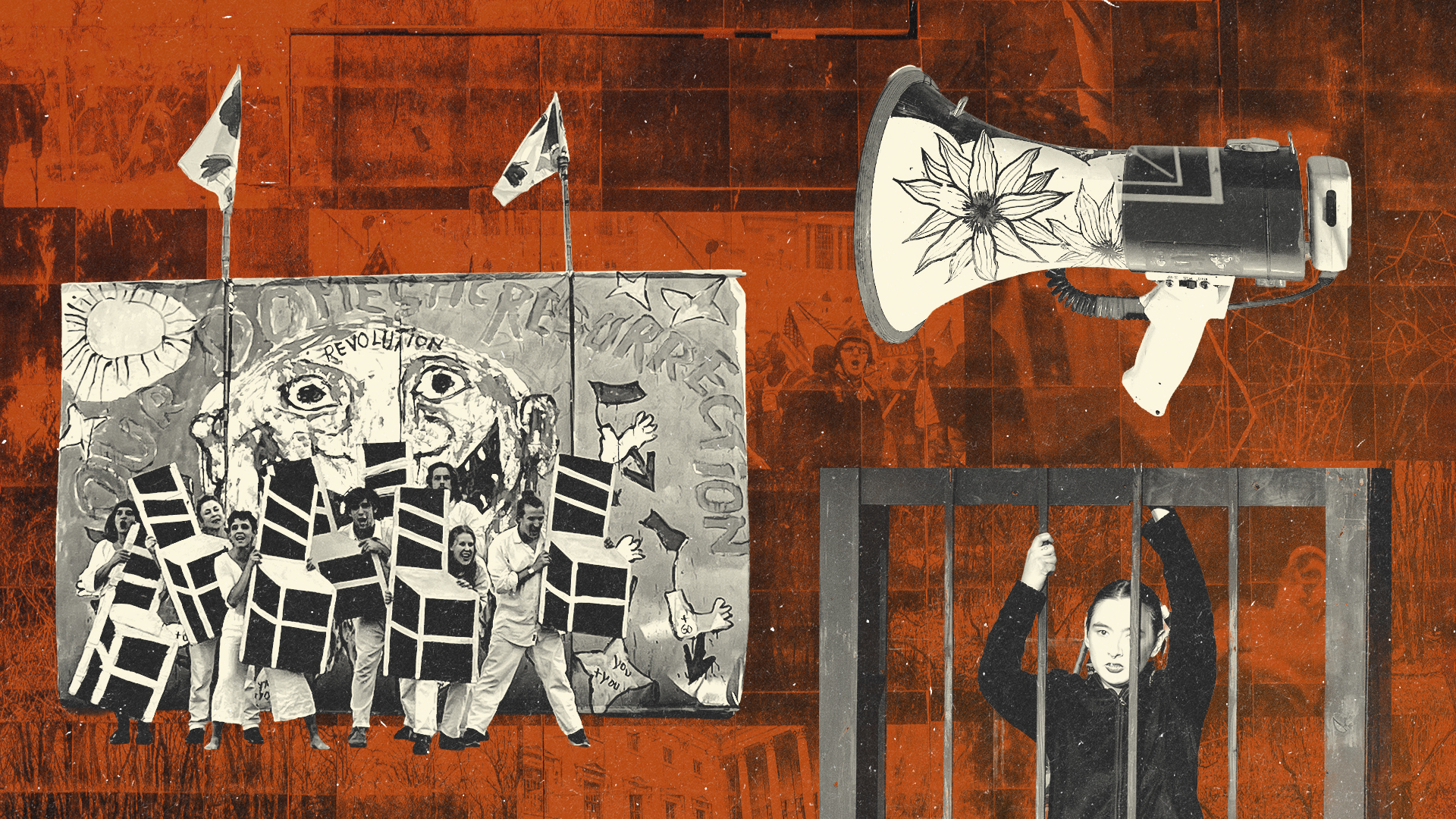
Back in 2020, just weeks after George Floyd was murdered, with protests surging around the nation, Donald Trump descended on Tulsa during Juneteenth weekend for his ill-fated COVID-spreader rally. It was the height of the pandemic, and artists, like everyone else, were at a boiling point. On the day of Trump’s rally, local protestors and artists took to the streets, parading through downtown with giant figures straight out of the lineage of Bread & Puppet.
Yatika Fields remembers the puppet-making workshop he and other Tulsa artists organized before that weekend as an event that “allowed space to create, talk and express feelings and work through these questions, anger, and grief.”
“The workshop helped bring people together, create and use their hands through a time of questions and anxiety, but also talk with one another,” Fields told me. “It was difficult because of COVID-19 protocols, but in safety, we carried on and were able to use the objects and puppets made to demonstrate the power of collectivity in the face of fear and danger.”
That same weekend, local activists draped the Black Wall Street Memorial with a tarp—an undeniably creative action intended to prevent visiting Republican politicians from getting a photo op with it.1 Citizens painted “Black Lives Matter” on Greenwood Avenue, only to see the street later “resurfaced” by the City of Tulsa. The next year, initiatives like the Greenwood Art Project, Fire in Little Africa, and the Woody Guthrie Center’s exhibit “Songs of Conscience, Sounds of Freedom” activated the community during the centennial of the Tulsa Race Massacre. ArtHouse Tulsa continued infiltrating Tulsa with game-changing DIY house shows. Joseph Rushmore’s "Commentary on the Apocalypse” smoldered at the Center for Public Secrets in the aftermath of January 6, 2021. This furious spurt of creative action was galvanizing, cathartic, and clarifying—a much-needed infusion of powerful images and voices into Tulsa’s often cautious culture.

In the fall of 2025, Bread & Puppet itself came through Oklahoma City. The legendary radical theatre troupe, founded in 1963 and based in Vermont, put on a politically outspoken (and also beautiful) show that reminded me how long it had been since I’d seen its like around here. Where were the explicitly political performances, the guerilla installations about the Heritage Foundation or anti-trans legislation, the anti-ICE resistance murals in Tulsa?
We’ve definitely seen a few public-facing gestures of politically-focused art in the last year. I remember, among others, Allison Ward’s “Waking the Witch” group show at Living Arts; a “No Kings” protest song by Casii Stephan and Damion Shade; John Fullbright tearing into Woody Guthrie’s “Deportee” last summer at Guthrie Green; a blistering Theatre Tulsa Cabaret; a handful of workshops on the history and practice of protest art; anti-Trump paintings and posters here and there; and, at the Temple of Dance studio, a surprising Christmas show that threaded a strong narrative about the dangers of political repression through an evening of burlesque acts and holiday songs. Protests organized by Indivisible Tulsa County and other groups made space for creative local versions of the “tactical frivolity” that marked so much national protest last year.
People are turning out for these moments, as momentum builds in response to escalating political violence. This past weekend, Liggett Studio was packed for a talk by Tulsa-born, Brooklyn-based art activist Julie Peppito, and an open mic organized at Belafonte in honor of Renee Good, killed by ICE in Minneapolis on January 7, drew an age-diverse crowd full of LGBTQ+, Black, Hispanic, and Indigenous creatives. There’s clearly a hunger here for group expressions of frustration and protest, for voices that can articulate collective anger and grief outside of online echo chambers.

But it’s also been a long five years since 2021, with Tulsans feeling the same relentless beat-down that communities across the country have experienced. The horrors are now coming from so many directions that it’s hard to know where to aim the arrow of resistance.
And then there are the perennial questions that hit even harder in a year that’s already included too many devastations: What can art do in times like this, anyway? Do we really need artists to remind us that things are going badly in America? Will anyone who doesn’t already know that have their eyes opened by a painting? Will those who might appreciate the confirmation the most—the debt-broken, the hungry, the immigrant families, the community organizers—even see it? Why do we expect artists to speak up when those in actual power refuse to?
I posed those questions to a few Tulsa artists recently, looking to understand how they’re dealing with current political, social, and economic realities through their creative practice. There are as many ways to be an artist in a moment like this as there are to get involved in a protest, they’ve told me. Artists can be beauty creators, escape providers, entertainment purveyors, and economic boosters: all needed. They can also be bearers of culture, the ones who demonstrate things like free expression and collective strength when the walls come closing in.
For a range of reasons, many of the expressions of resistance happening now in Tulsa look a little different than the ones that get higher visibility at rallies and protests. They’re less about changing policy and more about changing culture, less about defending the system as it has been and more about working underneath that system in the realm of human need and obligation. They’re less about now and more about next.
Feeling The Tension
As co-founder of ArtHouse Tulsa and Studio 1801, as well as in his personal practice, photographer and curator Rogelio Esparza has been on the front lines of community-centered art for a while. He’s lived in Tulsa for more than two decades since immigrating from Mexico, and he’s feeling the tension. “I am an artist, but I have to think of myself and my responsibilities first,” he said.
“If it was just me living like a single person here, it'd be different,” Esparza continued. “But with my family, I have to think, like, if something happens to me, it's not just me. My family depends on me being here, and I have to remember that. So I love the artists that can be vocal … and express themselves very, very loudly. I support them, but I also support people that have to navigate a certain way that is best for themselves and their family or their loved ones.”
“Because of my status I don't have the privilege to be outspoken about my political beliefs in the U.S. and I felt it was unsafe to be part of any kind of activism,” said Zuany Perez, who’s been a force in Tulsa local fashion and music over the past several years under the moniker Swan Shekinaa. With her family, she recently self-deported to Mexico, her country of origin, after living in Oklahoma since she was five years old. Rising risks to immigrants’ safety finally made conditions too dangerous for them to stay—let alone protest.
“The final straw was an accumulation of events,” Perez told me. “Students in affluent colleges getting visas revoked, detained, and deported, and knowing my plans for going back to college were gone; ICE recruiters offering bonuses to underqualified/majority brown and Latino first- and second-gens; ICE encouraging racial profiling and knowing my mom cleaning houses in Broken Arrow, Bixby, and Mounds could possibly get stopped and detained regardless if she has citizenship, and [us] not knowing where she could be for days or weeks; seeing ‘If you see something, say something’ at the Tulsa bus stops and knowing it was the same propaganda that was used post 9/11. But honestly I knew it was time to get our plane tickets and leave when the homeless folks and their encampments were being arrested and displaced by Oklahoma Highway Patrol because their jurisdiction was extended and they have direct ICE connections.”
There’s another factor here, especially for artists directly impacted by the Trump administration’s policies: exhaustion. “I think we're all tired and we don't have energy to be angry,” Esparza said. “We're just exhausted by everything, by reality, by work, by trying to dream on, but also being faced with a lot of reality.”
Yatika Fields agrees. “Exhaustion is real at this time,” he told me. “We have to double down on our productivity to stay afloat, work more and more to survive with the inflation of living conditions. This takes away from a lot that is innately us; many of us can’t afford to be healthy, something that is intrinsic to our well-being, self-worth, mental and spiritual aspirations.”
For Trueson Daugherty, an artist who leads creative gatherings at The Parlour with his wife Zia Daugherty, those assessments ring true. “A lot of people are in survival mode, and it's very difficult to make art when you're under extreme duress,” he said.
That includes the very practical element of being able to afford to make art. Like the restaurant workers honored in Sophia del Rio’s recent show at Positive Space, many artists are part of the precariat, living with unstable employment, marginalized status, few benefits, and chronic unpredictability. “Materials and resources, accessible studio space in Tulsa: these are real problems that are barriers to cultural and creative cultivation,” Fields said, noting that applying for grants that support those needs can be a challenging process.
During the pandemic, many nonprofit arts organizations received federal funds that they used to pay artists for projects, some directly tied to political matters that are now, let’s be honest, no longer trendy. “We called it the COVID Art Renaissance,” Esparza said, noting that those nonprofits found very willing participants among struggling Tulsa creatives. Those funds have now dried up, as have many of the opportunities that empowered local artists to do more projects on a big, bold scale. And in a moment when arts exhibits and grants are being cancelled due to lack of alignment with Trump administration priorities, it’s a big gamble for organizations and artists alike to invest in putting out politically confrontational work.
Along with a depletion of energy and resources in the arts community, Daugherty also observes a creeping sense of resignation, even fatalism. “When you're resigned to the feeling that change is impossible, where you've kind of given up, I think it starts to feel like a lost cause,” he said. “Nobody wants to support a lost cause. It’s just a waste of energy when it's going to lose anyway. That's what creates that kind of resignation. And I know I definitely feel that a lot, like, well, I'm in Trump country and this is what the people that I live with voted for.”
In the face of all this, Daugherty (who once took an ax to a cross in a performance art piece) has pivoted away from angry protest and overtly political art-making—partly because it feels ineffective. As he puts it, “I don't think a single one of those people that are in the House or the Senate or in government here in Oklahoma that are doing crazy things are going to watch my video performance and have a profound realization and, you know, lay down their arms and say, ‘Sir, what should we do?’ If anything, it does the opposite. It's like, okay, I told you so. That's why we need to get people like this guy out of here.”
Then there’s the “read the room” element, Daugherty said, that leads him to question the point of making a painting right now at all, when people are watching their families and neighbors get snatched by ICE, losing healthcare, struggling to pay every bill, and watching a Heritage Foundation takeover of the U.S. government in real time. Sure, a piece of political art can be a rallying point, but increasingly it’s not even doing that as well as it once did.
“Visual art doesn't have the pulse or the influence that I think it used to have, given the fact that anybody can create an image of anything,” Daugherty said, “so the power comes down to where technology isn't.”
Daugherty has gradually shifted his art practice out of the image zone and into what he calls “ethics”—in other words, direct engagement with people in his community. “We are trying to build something better, something new,” he said. “That often involves tearing down the old structures in order to make space for the new ones. But I think that right now, it's like, what kind of structures do we even have left? What are we going to tear down?”
Shifting The Focus
It’s a movement that’s surging among Tulsa artists. The city is overflowing with DIY film screenings, noise shows, craft sessions, discussions over meals, zines, open mics. They’re often not explicitly political, but—as in 1980s Poland, for example, where clandestine art groups helped Polish culture survive during martial law—the conversations and connections that happen there build webs that can be stronger than a protest line.
Instead of expending money and energy on one-off public displays, many Tulsa artists are working through gatherings like these, using alternative spaces as headquarters for a much longer game. Yatika Fields put the idea in the plainspoken way that marks a lot of his thinking about creativity and culture: “It’s imperative to create open spaces for workshops and dialogues to communicate during times of duress, which is a constant state in America.”

Creative gatherings can also be places to push back against the brain-depletion and misinformation that plague current political discourse. For Zhenya Yevtushenko, whose father Yevgeny Yevtushenko (1933-2017) was renowned for resistance poetry such as “Babi Yar,” the battle right now is as much for attention—for staying connected with reality—as it is against any particular policy or government.
“My father’s life taught me that control over narrative has always been one of the biggest tools of power,” he told me. “Censorship, revisionist histories, and erasure were not just tools used during the Cold War. The biggest difference from his generation to ours is what David Foster Wallace also noted: the speed at which we are fed information and disinformation. Be mindful of what you allow an algorithm to feed you—that is also a form of indoctrination and oppression.”
Contrast that tech hellscape with the engaged conversation Yevtushenko sees throughout poetry groups in Tulsa. “I have never attended a poetry event in Tulsa without hearing a poet speak about social justice issues, whether personal, local, national, or international,” he said. Tulsa poets are active in raising money for service organizations and political causes, collaborating with other artists and small businesses, and generally making sure that some key human truths—about expression, dignity, belonging—stay part of the public dialogue. “We promote dialogue,” he said, “because each of us understands that the freedom of speech is permanently tied to the responsibility to listen.”

Spaces to listen as well as to shout are key for Tulsa’s artists right now, as they navigate how to do political engagement right now. Esparza—who’s shifting much of his focus to resource-sharing in his East Tulsa community—said he loves seeing what’s happening in, for instance, the events at The Parlour, where art becomes a connective space for people to come together, cope with what’s going on, and start building something different here at home.
“You can protest, you can share through your art, or you can just make sure that the resources are being given to the people that need it, and finding and creating spaces for people to feel comfortable to come up and ask for help,” Esparza said. “Because a lot of the time right now, they're like, who do we trust?”
“Poetry Is Not About Virtue-Signaling”
Who do we trust? It might seem counterintuitive to say “artists,” but I’ve had better luck getting straight talk from them than from just about anyone else. As the attention economy fails, trust is becoming a higher-value aspiration.
As Sterlin Harjo told The Pickup recently, “[Truth] feels like the most noble thing to be fighting for right now. The need for truth comes out of skepticism, I think.” Among the artists I spend time with in Tulsa, the bullshit meter tends to be fairly strong, as does a strain of dark humor that comes from spending a lot of time in a place that works so hard to project an “all is well” version of itself. Tulsa’s history as a meeting place for Native, Black, Hispanic, and Asian stories in particular gives many of its artists a radar that’s sensitive to—and skeptical of—the demand for urgency or one-off outrage.
“I think because Tulsa is on allotted Muscogee land that was stolen by white men, artists and art workers need to remember how they directly benefit from this act of violence,” Zuany Perez said. “Humility goes a long way these days and getting off of the self-made pretentious hill is the easiest way to start to be part of community [and] community activism, [as well as] remembering that Tulsa historically was a trade city where people of all kinds came to thrive, which is still true. Working from there is essential.”
The artists who make the biggest difference here are often the ones most in dialogue with the city’s history of erasure and silencing, who keep their eyes wide open to the past as well as the present. They understand that art is a lasting weapon—passed down from older generations and taken up by new ones—that slices through falsehoods of many kinds.
“In a time when few things are private,” Yevtushenko told me, “I believe the example that we set as creatives is more important than ever, whether you are a performance-based artist or not.” He mentioned people like Daugherty, Evan Hughes, Steph Simon, Lacee Rains, Tea Rush, Lyssie Brown, Written Quincey, Kode Ransom, and Tulsa Artist Fellows like Kalup Linzy and Kaveh Bassiri as people setting strong examples—creating spaces for others, investing in community building and mentorship, and using their art to tell sometimes uncomfortable truths.
“Poetry is not about virtue-signaling,” Yevtushenko said. “Many Oklahoma writers understand the tradition that we are in conversation with. We speak with Woody Guthrie, Ralph Ellison, S.E. Hinton, N. Scott Momaday, and many more. In Tulsa alone you can feel the community impact of Oklahomans Joy Harjo, Deborah Hunter, Rilla Askew, and Quraysh Ali Lansana—their voices and examples have a gravity that informs, pushes, and pulls many of us in the Tulsa literary scene.”
Engaging with those voices preserves the dimensionality of this place—an act of ongoing resistance to narratives about which we should be skeptical, including narratives about what we should be giving our energy to. Think of Lee Roy Chapman’s guerilla installation of Larry Clark’s photos at North Tulsa’s Big Ten Ballroom, back when both Clark and that venue had been neglected for decades. "According to the Chamber of Commerce,” Chapman told the Tulsa Voice a year before his death, “we’re just this straight-laced, great, cheap place to live. Raise a family, corporations should move here … that’s kinda their message. Whereas, I see Tulsa as an incubator for serious cultural giants."
Tulsa’s history is full of people like this, and its present is too. “I think of ‘survivance,’ a term coined by Gerald Viznor, an Anishinaabe scholar,” Yatika Fields said. “It signified the particular doing and working, an active, ongoing resistance and resilience of Indigenous peoples against settler colonialism—the ability to create counter-narratives to stereotypes, with a focus on strength and agency, and the movement forward with cultural vitality and presence in response.”
Strength In Numbers, Even Small Ones
For the artists I spoke with, a priority right now is making more spaces for more people to work together with these values in mind. Many local cultural institutions are doing this work, too—I’m thinking of Philbrook with its recent exhibit War Club: Native Art and Activism; the Tulsa Artist Fellowship with its ongoing support for art focused on life-making and place-making; the Tulsa Performing Arts Center with recent productions like Channeling Our Ancestors and Ragtime; and smaller galleries like Liggett Studio and Positive Space. Even Guthrie Green, with its subtly psychedelic light displays and intentional music programming, provides a space for new kinds of reflection. And Gilcrease is surging back with a renewed focus on the intersections of history and culture that have shaped what Oklahoma is today.
But it’s often the DIY enterprises, nimble and independent as they are, that continue to lead the way, like Tri-City Collective, Drifters Theater, Mass Movement Community Arts, Words of the People, ONE AUX, Mixed-Use Space Tulsa, Greenwood Griots, the Center for Public Secrets, and the wild world of Tulsa comedy. Fields pointed to Four Mothers Collective, Burning Cedar Sovereign Wellness and Strawberry Moon as “Native women-led projects and spaces that help bridge these needs and desires for nurturing cultural relevance and flip of narratives … telling stories and creating new ones.”
As our collective state of duress continues, it’s time to think creatively again about ways for bigger institutions and smaller-scale creators to collaborate, as many did during the pandemic. Fields brought up the idea of resource-sharing through regular supply swaps as one possible example of this approach. While many artists and arts organizations might not currently be up to making large-scale protest art, the work that happens in these less public-facing ways can be even more powerful. “We are always shifting; change is inevitable,” Fields said. “It’s [about] how we engage and work with others to see it through with strength and confidence.”
What's At Stake
So what’s the role of art in times of crisis? According to Bread & Puppet’s founder Peter Schumann, art is as critical to our survival as physical nourishment. We can’t eat art, he has said—but like bread, it feeds us. It reminds us of what’s at stake. Creative work that’s about beauty, joy, and remembering is just as vital as art made in direct protest. It shows us what’s at risk of being stripped away. It builds our courage and endurance. It shows us what’s worthy of our focus.
Daugherty remembers hearing a phrase that changed how he thought about the need for art in dangerous times: “Art is what doesn’t have to happen.” Far from marking creativity as a luxury, that phrase is a key to its collective power. Art isn’t just imagining something different from the contingencies of the moment, but acting toward that end, making space for different dreams and realities to come forward.
Concerts that disrupt conformity, gallery shows that have us questioning our perspectives, public activations that focus our attention and stoke our collective fire, resource-sharing gatherings, collective spaces for dialogue, truth-telling, protection, and rest—we need them all right now. “There is no one single way to [be a] poet," Yevtushenko told me. "The same can be said of creative activism.”
“It takes a community of differences on the same path to create an equilibrium,” Fields said. “The creative efforts have to come from all sides, open to many ways and doors to enter the conversation and see the many perspectives…. They all have a place to bring awareness and advocate for such causes. Public art, painting, sculptures, musical shows, films, dinners, writing workshops, and community gardens—there's more, but these are examples and places that can provide outlets to discover self, self-help, nurture the human spirit, and synthesize relationships to provide change.”
“Synthesizing relationships to provide change”—that’s how many of Tulsa’s artists are protesting these days. “An act of creation, by its very nature, is revolutionary,” Yevtushenko said. “And love, to quote James Baldwin, has never been a popular movement, but it is the most revolutionary act there is. Out of all the poets and writers that I have known and worked with, we all understand that our locus of control is our example. Go to a performance, go to an open mic, and you’ll see what I’m talking about. We never stop being advocates for love.”
Footnotes
- Victor Luckerson, Built From The Fire, p. 415.Return to content at reference 1↩


