

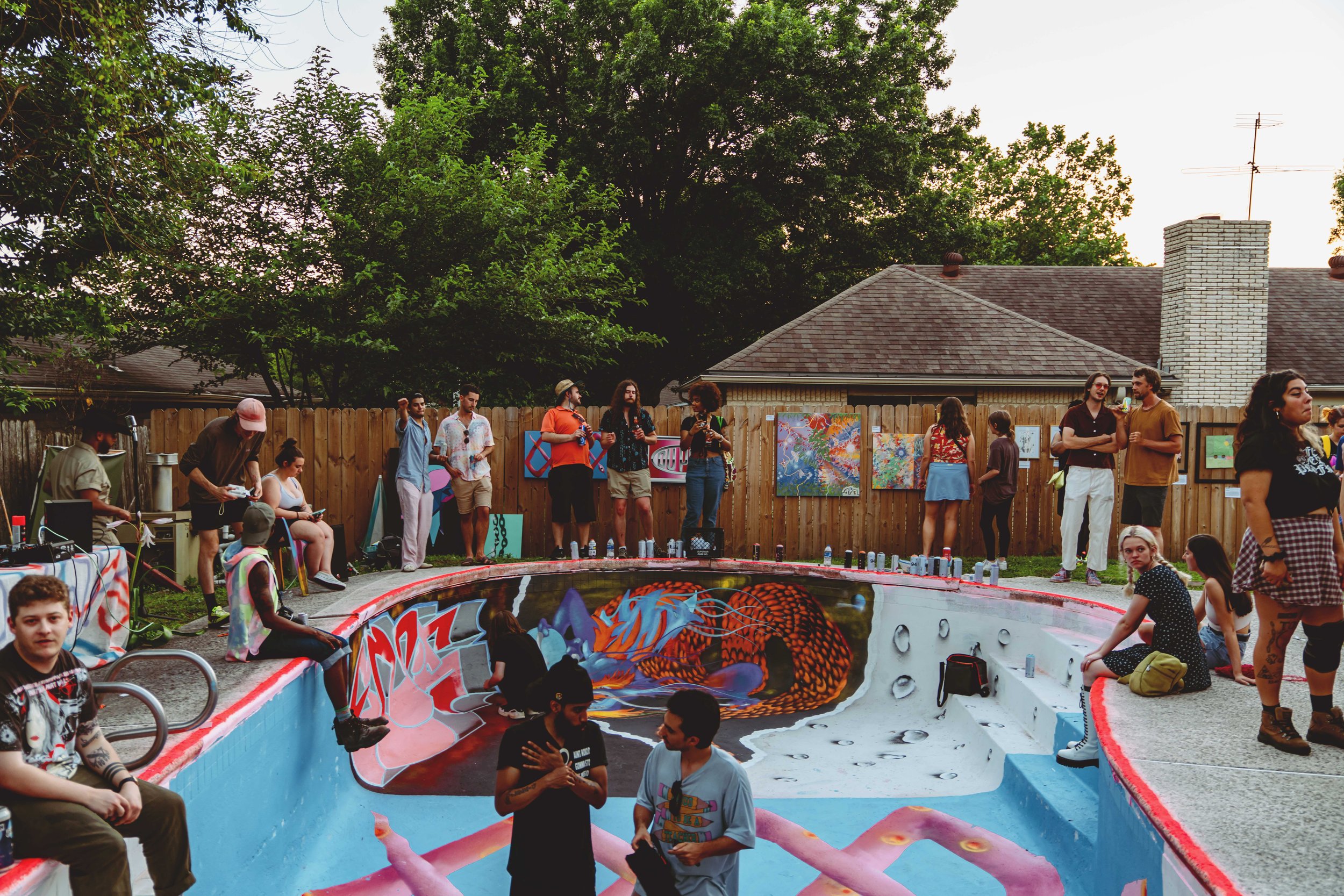
When Allison Ward and Rogelio Esparza started setting up their fall 2019 ArtHouseShow in a friends East Tulsa backyard, they thought they had everything covered. "We were like, ok, we have a pool," Esparza said. "How do we use that? We have to have somebody painting a mural. We need to have music. Let's have a DJ. Great. Put the DJ in the pool. I was like, I have a huge canvas. And then we're like, let's paint it a color. Allison was like, green. So we'll have a DJ in an empty pool with an artist painting a mural and another one over there with a green backdrop and you can hang out in the pool and watch the person paint the mural. Done."
They got lights. Tape. Extension cords. Paint. Adhesive hooks to hang art by over a dozen local artists. Nails to hang the art when the hooks wouldn't stay stuck to the backyard fence. Then came the wasps. "I was taping a border around the pool so people could see where the edge was and all of a sudden I got stung," he said. "I was like, okay, there's a nest right here. Oh, there are nests over there! Well, that was one thing we didn't think we'd need to do—kill wasps! Thankfully Allison's partner did a lot of it. He was fantastic at that. I was just running around. They were chasing us. Oh, it was insane. It was crazy."
But the show was an underground hit. Ward and Esparza ended up featured on NowThis and that painted swimming pool became one of Tones Beach's most noteworthy creations. Most of all, the community response was massive—just like it had been for the shows they'd curated before.
Ward and Esparza were high school best friends—theater kids—who reunited in 2019 when Esparza moved back to Tulsa after going to school for photography in New York and Ward had several years of punk band life under her belt. (She's also a painter who recently had a show at Liggett Studio.) ArtHouse Tulsa started as a way to connect with other artists and make some productive use of the empty space in the house they shared. "There was a time during the second show when I was standing in the living room and I was like, there's at least 150 people in our house right now," Esparza said. "Artists would come up to us that night and say, why are people with spaces not doing more of this?"
It's a DIY model—art exhibit meets house party—that doesn't have many parallels around here. Artists submit pieces; somebody volunteers their house for a night; the art is hung and lit; and the doors are opened. (Any sales happen directly between artists and buyers.) For Ward, it's really about connection. "A lot of times local artists make things and then post them on Instagram and once they're posted its like, well, that's it," she said. "At these shows, people are actually talking to each other about their art. People are actually getting to know each other. Everybody's very welcoming. Ro and I are both struggling artists, so it's not a gallerist that you're talking to when you're involved in something with us. It's people literally just like you."
The chance for outside-the-mainstream artists to gather casually with other artists and community members is a rarity—and an encouragement. "Something that we really strive for is giving artists a platform who don't already have one, or who don't show their work regularly," Esparza explained. "Even if it's just something this small, putting an art show in a backyard, it gives an artist the confidence to maybe put out their art next year by themselves or contact somebody at a gallery. How do people that don't have a platform get a platform so that they can get other platforms? We need a starting place."
While Ward and Esparza hope to have a permanent space and more stable funding for ArtHouse Tulsa in the future, for now it thrives on pocket money, donations and what Esparza calls "disrupting the normal." "We want to take art shows into communities where people wouldn't usually come to see art, where people actually live. Why are we not taking these freaky art shows to the suburbs of Tulsa? I feel like the more we spread it throughout the city, the more it becomes a 'normal' within everything." They're hoping to showcase more artists from the neighborhoods they host shows in, collaborate with other existing artist groups and generally keep nurturing the work of people in the Tulsa community. "I just really believe in growing the art scene here, in the city that you're from, as opposed to going to the coasts and trying to make it," Ward said.