


ONE AUX: A Night Of Ambience
Noise Town
April 17, 2024
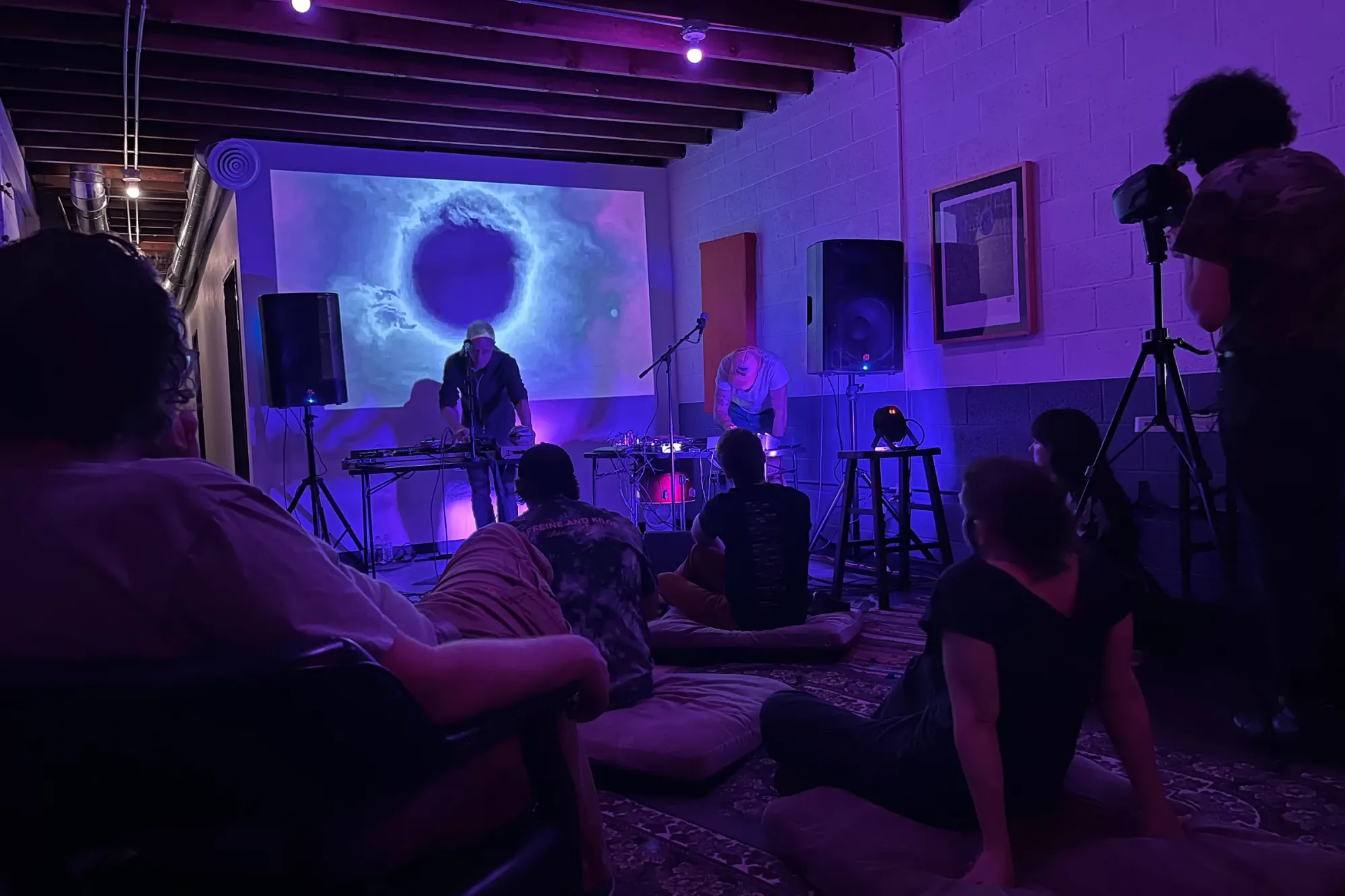
If you’ve never spent a Wednesday night sitting on a floor in West Tulsa listening to experimental ambient soundscapes with trippy projections in a music venue the size of a New York City railroad apartment across from the Tulsa Stove Hospital (est. 1921), have you even Tulsa’d?
Nothing against Leon Russell et al., but there’s more to the Tulsa sound than “The Tulsa Sound.” In my ongoing hunt for the “what else?” in local music, I stopped by Noise Town recently for a ONE AUX show. As always with gigs from these friendly, enthusiastically non-mainstream organizers (Carl Antonowicz and Todd Woodlan, who just released an album of “subaqueous longform noise” under the name Tired Ocean), I left expectations at the door and opened up to the ride.
Was it a coincidence that a vintage encyclopedia called Unsolved Mysteries Of The Past was sitting on a table near this delightful venue’s door, so that I enjoyed 45 minutes of reading about ley lines, standing stones, and Victorian ghosts as the sun set, while waiting for the show to start? (“We’re on Tulsa time tonight,” said proprietor Mike Rodriguez.) I looked up from the book to see a handwritten sign posted on the fridge, wedged into a corner under a three-eyed astronaut: “Soda/water $2. Ear plugs $2. Top quality egg $1.” Unsolved mysteries, a shifting sky, and the promise of a quality egg: it was a juxtaposition that set me up nicely for the hours to come.
Tulsan Whettman Chelmets ushered listeners into this “Ambient Night” with a sonar drone and a lapping guitar, a faraway melody like something heard through a forest in a fairy tale. As projection artist Small Rock captured live video and ran it back through filters that gave it a rainbow edge like a dying VCR tape, the melody fragmented: a stutter in the signal with shreds of guitar still shuddering through. Gradually a five-note lullaby emerged, gently rocking against flickering images of plastic fencing, and the guitar veered close to “song” again, like something remembered from before. A satisfying opening set: noisy enough to please a ONE AUX regular, yet soft enough for a couple seated on floor cushions a few feet away from me to cuddle to.
The next set, by an artist listed as Pseudokufic, guided listeners through a disciplined slow-build to a thrilling payoff. (I later learned that Pseudokufic is Alican Çamci, who holds advanced degrees in music composition from the University of Chicago and the Johns Hopkins Peabody Institute, has presented work all over the world, and now teaches composition and scoring for media at the University of Tulsa.) His piece unfolded like a great literary essay: there’s no way we could have guessed the depths of where we were going from its opening sounds, but looking back, the end was already contained in its beginning.
A slow tapping as if inside a house, deep in the pipes. A low gamelan, a second of cicada screech, maybe a saxophone, a Stockhausen-ish chorus. Then fireworks, or gunfire, and fragments of shouts from a group of demonstrators. Pseudokufic added single syllables through a mic; the shouts and cicadas grew in intensity. Finally, over an ever-shifting hum, a recording of a written passage by the mid-twentieth-century musique concrete composer Iannis Xenakis—about “the sonic phenomena of a political crowd” — brought together the how and the why of what we were hearing, and pulled the audience to the edge of our seats.