


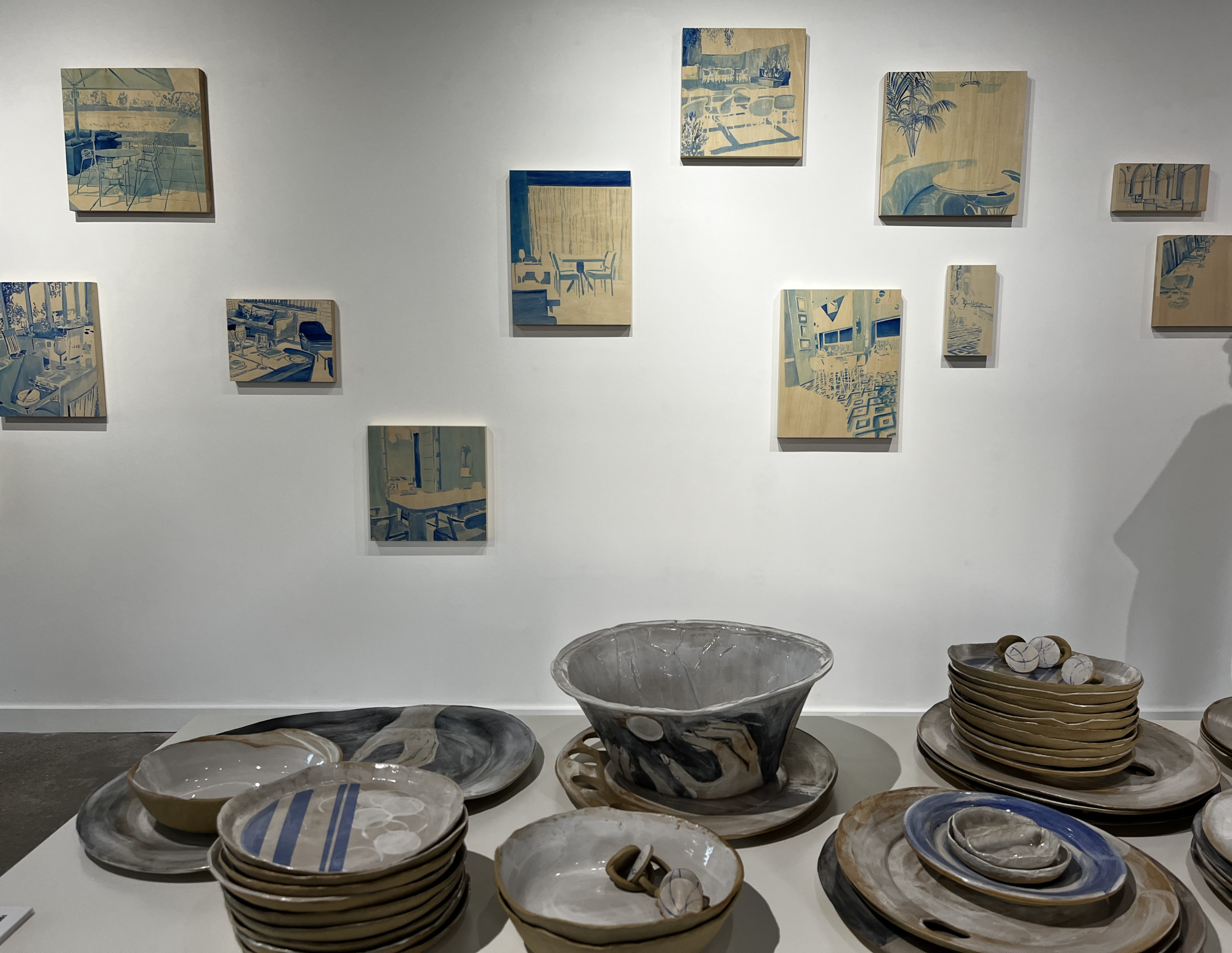
“Mise en Place” by Sophia del Rio
Positive Space Tulsa
through October 25
If you’re a restaurant worker, or if you know a restaurant worker, or if you eat at restaurants, run over to Positive Space Tulsa this week and spend some time with “Mise en Place.” The gallery’s current show, which closes on Saturday, is a pointed and moving reflection on the restaurant industry: its contradictions, its abuses, and the value of the people who make, serve, and clean up what you eat and drink.
Packed with conceptual rigor, dark humor, and skillful imagery, this is art grounded in activism. “Mise en Place” comes from the restaurant experience of artist Sophia del Rio, who moved from Washington, D.C. to the Fort Worth area during the height of the pandemic. Texas was open for business, she said in a talk at the show’s opening, and she needed work. “I had not worked in the restaurant industry in maybe like 10 years at that point,” she said. “But it was the easiest job to just walk into. You can walk in and if you're an able-bodied person who can sell something, you can start work that day.”
What she found in the many restaurants she worked in during that time disturbed her. Restaurant owners regularly surveilled employees with cameras and sound recording equipment installed in dining rooms, walk-in freezers, and hallways. They relied on tips to pay their workers; tip pooling was a common practice. Del Rio observed wage theft, time theft, and human trafficking. “And of course,” she said, “if you can't work that double and you're too tired, well, your supervisor will go ahead and give you that bump of cocaine to keep you on your feet and working.”
Del Rio was eventually able to leave the industry and return to more stable work, but what she saw and heard stayed with her. “It didn’t feel right to just walk away,” she said, so she and a chef friend decided to organize a dinner where restaurant workers could safely gather—to be served themselves, for a change, and to have a conversation about wages and labor rights, out from under the prying and abusive eyes of their employers. Del Rio made custom ceramic plates for that dinner, each painted with a hand reaching toward a hole that represents the “coin,” the “tip,” the missing value. Those plates form the centerpiece of “Mise en Place,” stacked on a huge table in the middle of the gallery.
All the work in the show emerged out of that dinner conversation, and it’s all as keenly considered and packed with ironies as those plates. Even the show’s title suggests a double meaning: the French phrase for “everything in its place” can refer to the organization of ingredients in a fine dining kitchen, or maybe to the position restaurant workers find themselves in, with limited options for straying from “their place.” The beautiful dining rooms Del Rio painted on birch wood, in shades of placid blue, look like something out of the magazine Kinfolk; they’re both visually delicious and absent of people, a reminder of how exclusionary spaces like this can be for the people who make them run.