


The Pickup's Arts & Culture coverage is supported by Brut Hotel, featuring a rooftop VIP after party for Tulsa Irish Fest on March 14.
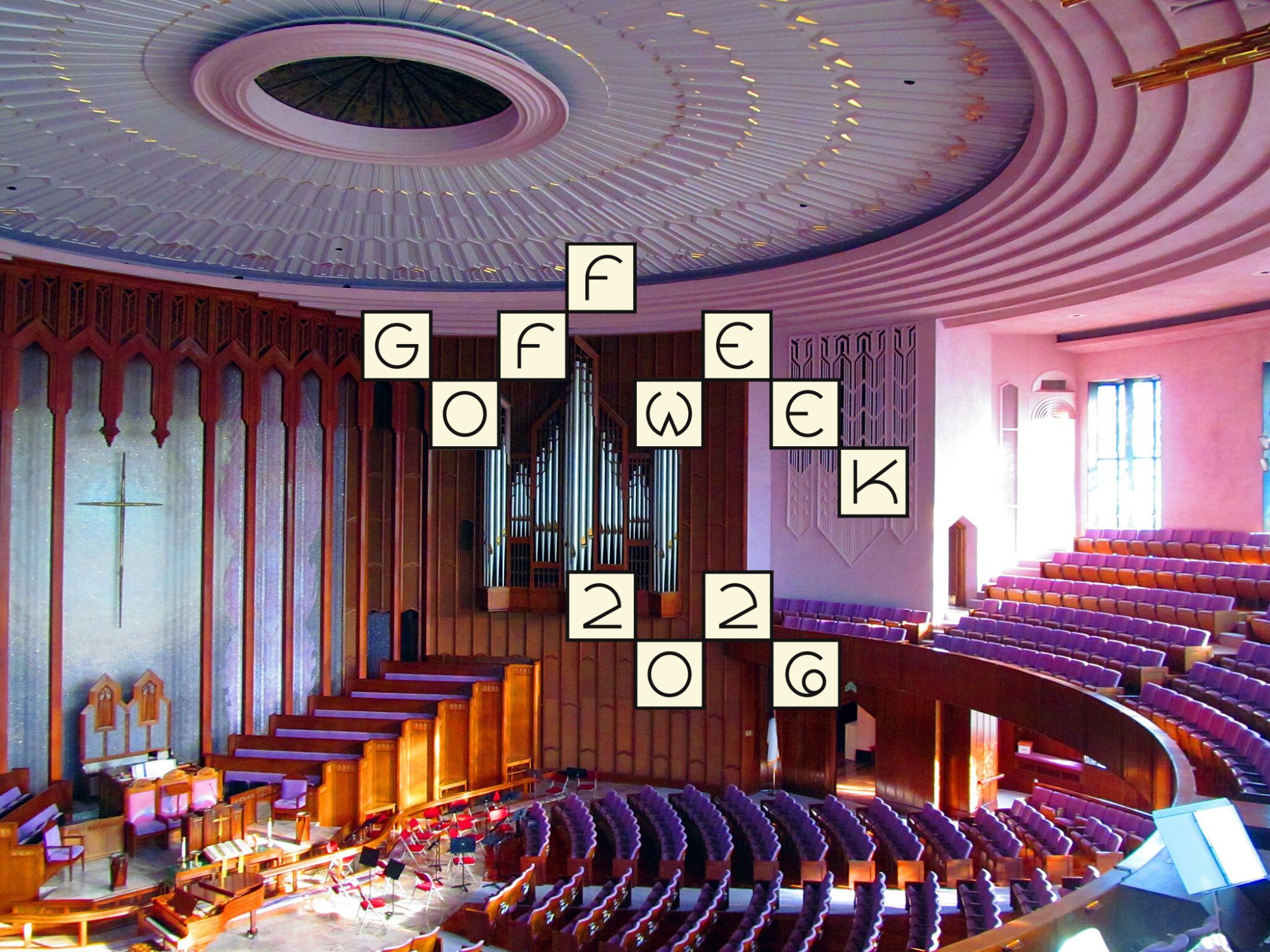
Goff Week isn’t just about Bruce Goff. It’s about the others in his circle, too, as well as the times he was working in. One of Tulsa’s 1920s-era architectural jewels, Boston Avenue United Methodist Church, has been the subject of some controversy about who actually designed it—Goff himself or his teacher, Dr. Adah Robinson. (The church itself is firmly for attributing the design to Robinson.) As it turns out, the building reflects more than Art Deco thinking; it emerged from then-pastor John Rice’s progressive ideas about faith and evolution. We spoke with Dr. Gary Peluso-Verdend, Boston Avenue’s theologian-in-residence, about the links between the church’s architecture and the shape of its congregation’s faith and practice.
If you’re interested in experiencing the innovative spirit of Boston Avenue’s design for yourself, stop by on March 21 for “EQUINOX,” an immersive experience curated by Trueson Daugherty, which will include a creative salon, performances by Ramsey Thornton and Micaela Young, and a full organ sound bath in which the building itself becomes the instrument.
Alicia Chesser: How did you get interested in the architecture of Boston Avenue in the first place?
Gary Peluso-Verdend: I’m the former president of Phillips Theological Seminary here in Tulsa—I’m retired from that—and I was also the founding director of the Center for Religion and Public Life there, so I’ve been interested over time in the intersection of how people practice their religion out in public, both for good and for bad. One of my favorite replies to people who say things like, “I don’t know if Islam is compatible with democracy” is, “well, I’m not sure Christianity has always been compatible with democracy.”
One of the things I wanted to do in preparation for the 130th anniversary of the Boston Avenue congregation is spend some time digging through the archives; that was around the anniversary of the Race Massacre here in Tulsa. And we knew that there was a fairly infamous sermon that had been preached the Sunday after the Massacre, from the pulpit at Boston Avenue, by the resident bishop.
We were really interested: what were the connections of the congregation? There weren’t a whole lot, but there were some [connected] with white supremacy and Christianity as that played out in Tulsa in 1921. I got interested in the pastor who replaced that pastor in 1922 and was there until 1927: John Rice. He was the pastor who worked with Adah Robinson on designing the church home that is there now at 13th and Boston.
At the time, in 1922, the church was located at 5th and Boston. There’s a plaque on the street if you ever walk by it. They were outgrowing it.
Rice was an interesting character. One of the practices he started when he came was getting on radio. He had an administrative assistant who was such an accomplished typist that, while he preached the sermon in the first service, she would type verbatim what he was saying, and then they would mimeograph it and offer it for sale for a dime after the second service. All the sermons he preached are bound together in the archive, along with some other papers.
I found out John Rice was born in 1862, on a plantation in South Carolina. He had slaveholders on both sides of his family. He had a lot of smarts, apparently, because he got through all the school systems that were local, went on to college and theological seminary as he was preparing for ministry in the Methodist Episcopal Church South, which is what Boston Avenue also was at the time.
[The church] moved him around; he had pulpits in several different states. And then around 1900, his wife died, and he farmed his kids out to relatives, and his oldest son to an orphanage, where he basically paid for him to be there while he, John Rice, went on to the rather new University of Chicago. He started a PhD there and did what we call A.B.D.: All But Dissertation. So he didn’t quite graduate, but he did all of his classwork there.

At University of Chicago, he was exposed to a whole school of progressive thinkers. Most people in the U.S. at that time believed that the earth was created in 4004 B.C. Well, in 1859 Charles Darwin publishes The Origin Of Species, and the controversy between science and religion really starts heating up. About the same time, archaeologists are uncovering new caches of dinosaur bones and beginning to seriously question whether all these were animals that died in the great flood and didn’t make it onto the Ark of Noah—which is what they originally thought.
So Rice is exposed to all this and starts thinking not only that the earth is a lot older than we think, but also that perhaps God’s way of creating is evolutionary. That God doesn’t create things all at once, but that God creates through evolution. And Rice has some sermons that were actually offprints that were circulated well beyond the congregation. He says, God creates through evolution. He says, I don’t know what evolution means in scientific terms, but I can tell you that things evolve.
During the Scopes trial in 1925 in Tennessee, Rice was one of the local spokespeople for religion and evolution, rather than religion against evolution. Prominent members of his congregation who basically were all fundamentalists didn't agree with him at all. Roger Coffey at Boston Avenue, whose grandparents were very involved in the construction of the new building, said they used to complain all the time about the fundamentalists at church who were always giving the pastor grief. We know both from John's writings as well as from several of his friends that at least they suspected that his health deteriorated in part because of the attacks from within against him.
So Rice was involved in those contours in 1925. At the same time he's also advocating for a new church building. A summer or two before, he took a tour of Europe and looked at churches and he came back saying that the cathedrals of Europe were more inspired by paganism, and that America doesn't need to look backwards for the way our faith ought to be, nor the buildings in which we ought to be exercising that faith. We need to bring them forward.
When the church building committee got together, there was a member of the church who already knew Adah Robinson and brought her in on the conversations with John Rice to begin imagining what a new building might look like. Mrs. Cole—that was Roger Coffey's grandmother—said in some of her writing that it was so great to listen to them talk together. She said that when they agreed, it was kind of wonderful; when they disagreed, it was “fascinating as lightning.”
Adah was Quaker in background. She didn't know anything about Methodism and the Wesleyan movement. So John was schooling her in all that. The way I understand the controversy is that Adah was the artistic designer and Goff and his firm were the actual structural architects of this thing. Somewhat early on after the building was built—the controversy was going on even then—John Rice's daughter wrote a letter that's in the archive at the Tulsa Historical Society. She said: Dad and Adah Robinson talked all the time. Dad didn't talk to Bruce Goff. It wasn't a controversy. It was just his conversations. His collaboration was with Adah Robinson.

John Rice spent five years at Boston Avenue and he left in 1927, two years before the building was actually done. There was a bunch of speculation about why he left at the time. One thing was clear: his health was failing. He wound up dying soon after the church was built. I think he had cancer and some other issues, a botched surgery of some kind. But several of his friends also said the toll taken on him by the fundamentalists ragging on him and telling the bishop that you ought to move this guy because he's no good for the church—that this eventually got to John.
After he left, he became the editor for a year of a newspaper for the United Methodist Conference for the geographical region. After that, he got invited by a liberal Congregationalist startup congregation that no longer exists to be their pastor. He was the pastor there outside the Methodist system for the last couple of years of his life, and they enjoyed him so much. The Boston Avenue tributes to him [after his death] were a little formal, a little stiff, I thought. Whereas the Congregationalists, the people who had him as their pastor, sang his praises and nominated him for sainthood basically.
Because Boston Avenue at the time was a Southern Methodist church, it was populated by people and descendants of people who were from the Old South. One of the founding members of Boston Avenue in the 1890s, their family was driven from their plantation when Sherman burned his way to the sea. Archer of Archer Avenue was a member. Tate Brady was a member for some period of time. The pastor before John Rice was chaplain to the KKK as it was starting up here.
So that was in the water, right? And what John Rice and Adah Robinson imagined together was a space that, as one of his friends said, was evolutionary. Even in the way that you look up at the church from the outside, the facade draws your eye upwards, as if creation is ongoing, as if it's future-looking.
They decided not to go with what First Methodist did, with a Gothic structure, but more of a Gothic meets Art Deco, something that's modern and different. When the church was inaugurated as the new home, the congregation did invite John Rice to come back for the inaugural sermon, which he did. We have a good part of that, along with the reflections of Mrs. Cole, who was the chair of the building committee. They each mentioned this being a place for Christians to look forward because God is always creating and the future is not decided on by looking backwards—that faith evolves. Again it was that evolutionary kind of perspective that Christianity is not about an orthodoxy rooted somewhere in the past. It’s our responsibility to conform ourselves to that past, but God is still creating. And therefore we need to be as open as the creation is to what God is doing out in front of us.
What an incredible point of view at that time.
It was. But it wasn’t as if, from then on, the church was unabashedly progressive. The pastor who followed John Rice was somewhat in the pocket of Rice's antagonists. It's not at all uncommon in church life that as a pastor leaves, a congregation will think about all the deficits that pastor had and seek to fill those deficits. And the next pastor brings their own deficits in, so you wind up with a flip flop back and forth between pastors. I don't know how long that flip flop went on, but the pastor who followed John was criticized by some of John's supporters as being just as a glad-hander and pretty much in the pocket of the more fundamentalist parts of the congregation.

Their subsequent pastors included several persons who wound up stepping from the Boston Avenue pulpit into being elected bishops in the church. One of those bishops in the early ‘50s helped desegregate the University of Arkansas. Another, Finis Crutchfield, who was pastor at Boston Avenue during the Civil Rights movement, was quite the controversial guy. After Boston Avenue, he became a bishop in Texas. He died of AIDS, which his family said he contracted while ministering to AIDS patients. A Texas reporter did a deep dive and said, no, Bishop Crutchfield was a closeted gay man who persecuted gays within the church while he himself was putting on a cowboy hat and notching a belt and clandestinely hitting all the bars. That was so unfortunate in so many ways, because he had to be closeted at the time.
[Crutchfield] was a tremendous pastor at Boston Avenue during the Civil Rights era. He was one of the founding members of the Open Housing Commission in Tulsa that was the precursor, I think, to the Human Rights Commission in the city, and he was very active in interfaith affairs. During his time there, the church held the first funeral for a Black person that it had ever had, for the man who had been janitor there for decades. I read the minutes of the administrative board meeting, which is sort of the highest level of decision making in the church, where he informed them that he was going to be on this Open Housing Commission. There was a lengthy discussion in regard to this. It was clear there were people who didn't like the fact that he was going to be advocating for not redlining, basically. He was a very progressive influence also on the congregation and pastors.
Going back to the question of how much the building has affected the people: I can't quite imagine a universally conservative congregation growing out of Boston Avenue, especially these days. By the people who built it and in the design of it, the building was meant to emphasize that Christianity needs to be a forward-looking religion, to keep evolving along with whatever God has in mind. It's not a necessity that the congregation would necessarily follow that, but I think the shape of the congregation has certainly been affected by its sanctuary shape. It wouldn't be a space for a Pentecostal service; it's set up more traditionally. People look at it and they immediately know, well, that looks religious, but not in the way of “the little white chapel in the vale” or in the way that First Methodist looks.
A couple of years ago, a German documentary film crew came through, and they were doing some interviews at various places in the country talking with people about white Christian nationalism here. One of the crew was the daughter of a Lutheran pastor, but the others were completely secular. As they were looking for places to film within our building, it was interesting how they all said, this doesn't quite feel like a church to me. But they meant it in a good way. There's that element of humanity there.
All around the outside, if you read the iconography of it, you see the Methodist circuit riders and you see [John Wesley’s mother] Susanna Wesley, and you see other bits of the Wesleyan heritage there. But in the sanctuary, while there's a very prominent cross, you see the coreopsis and tritoma flower themes in the back windows. I swore for the longest time those were angel wings. I had no idea they were stylized flowers. That was that kind of blending of the human and the modern with something that also has a rootedness to it.
John Rice said in his inaugural sermon that the constant challenge is: Will the church be able to basically keep up with where God is going?


It’s such powerful imagery—the encouragement to grow like a coreopsis grows up out of the ground, taking in this pool of light pouring down from the top. I'm curious about other particular elements of the church that speak to you as a theologian.
One that stands out is the thoroughgoing use of the Art Deco. That's not necessarily theological. For me, that’s just cool. Theologically, there's that long hallway outside the sanctuary that has at the one end the scene related to the Hebrew Bible and the Exodus event of the burning bush, and on the other end a cross, but also a few iconographic representations of scenes from the life of Jesus, including a cave that looks like it could be either where a stable was set or a tomb. It's just a really interesting piece of iconography. But these weren't original to the church, because they ran out of money, frankly, when they were building it in the 1920s. And of course, the Depression hit, and I think they finally were able to burn the mortgage sometime in the 1940s, but there was a time in the early ‘30s when they almost lost the building because it was going to be foreclosed.
They didn't have enough money to get it finished or to pay off their debt, so they had a bunch of creative refinancing to do. That was a tense time for the church's life, for sure. The original thought for that hallway is that they were going to show (again that for this sort of progressive evolutionary structure) the history of Methodism from the time of John Wesley up through the founding of the church in America and the split between north and south in 1844, and then leaving open the possibility of the north and the south reuniting at some point in history, which it didn't do until 1939 by creating a whole separate jurisdiction for Black congregations to be a part of, which is the only way that the south would go for it. So that's originally what they had thought of doing. They didn't have any money to do any of that, which was kind of a good thing, because those sorts of murals always become time capsules rather than really looking forward.
They're dated after a while, right? Change keeps happening.
Exactly. Who knows what the shape will be after that? So it left the opportunity open for that hall to be something else than a Methodist history. Eventually they created these tremendous mosaics with thousands and thousands of pieces in each of them; an artist in Italy put the thing together. And that allows for the congregation to continue to be reminded of all the time of our connection with Judaism, but not so that Judaism is superseded by Christianity.
So that’s one that I consider to be a real positive theological move. The congregation has been very involved for a long time now in interfaith activity. Mouzon Biggs, who was there for 33 years, was a tremendous advocate for Jewish/Christian relations and very much supportive also of the Islamic community. But there are many people in the congregation who are leaders in interfaith efforts in the city.
One of the other interesting elements that isn't always done even in Methodist circles would be the inclusion of Susanna Wesley amongst the prominent Methodists in the iconography on the outside of the building.
I've always thought that was a surprising inclusion.
And it's a great one. It's so fitting because there wouldn't be John Wesley without Susanna. She was quite the force in his life. When the original designers were talking about who to put there, there was quite a bit of opposition to putting Susanna out there. But Rice was an advocate; he said she really needs to be there, then he polled a whole bunch of Methodist clergy in the area and they all thought it was a great idea. That was one of the battles he won along the way, for sure.
One of my favorite stories is a Winston Churchill story. When the Germans bombed Parliament during World War II, and Parliament was deciding how to rebuild, Churchill was absolutely insistent that they rebuild it in the same way they had it, which is so different from our Congress that sits in the round and they look at the back of each other's heads, except for whoever is on the speaker stand. In the British Parliament, the two sides sit facing each other almost like the choir pews in a cathedral, with the speaker, the Prime Minister, in between them, so there's a lot of face to face argument. And what Churchill said is, we shape our buildings and then our buildings shape us.
We're all shaped by our spaces. Some people walk into Boston Avenue and say, well, this isn't church to me, because it doesn't look like the little white church in the vale. And then I’m sure there are people at Boston Avenue who are part of adult Sunday school classes that are bigger than the average congregation these days, who might walk into what the average-sized church is today with just under 65 people in worship and go, wow, this is church? Because they're shaped by something else.
In the whole history of Christianity, there's been such a range of ways to be shaped. One of the things I like saying is that “church” as we know it was an invention of the Reformation. Before the Reformation, people didn't “go to church” every Sunday. Church was more what we've referred to as processional religion; it was a holiday religion. A lot of things happened outside the church buildings, even in these little hamlets where there may or may not be a resident priest. There was an obligation to go one or two times a year. But they were all Christians because they were part of the society. Church wasn't the place you go to for a sermon that could be two hours long and a prayer that could itself be an hour long, with professors walking in their academic robes straight from the university to the church. Those are all Reformation inventions. So therefore, because it wasn't always that way, it means it won't always be that way. And we're in that era where it's becoming something else and we're not sure what.
Again!
Again. We're evolving. Or devolving, depending on your perspective!
Stay in touch
Sign up for The Talegate, our free newsletter<br>Fresh Tulsa stories every Tuesday and Friday
Editor's note: This interview has been edited for length.


