


Skip to Content
Tulsa Lore

The Obscure Sci-Fi Author Who Became Tulsa’s Tall-Tale Biographer

R.A. Lafferty captured a city that doesn’t really exist anymore. And maybe never even existed at all.

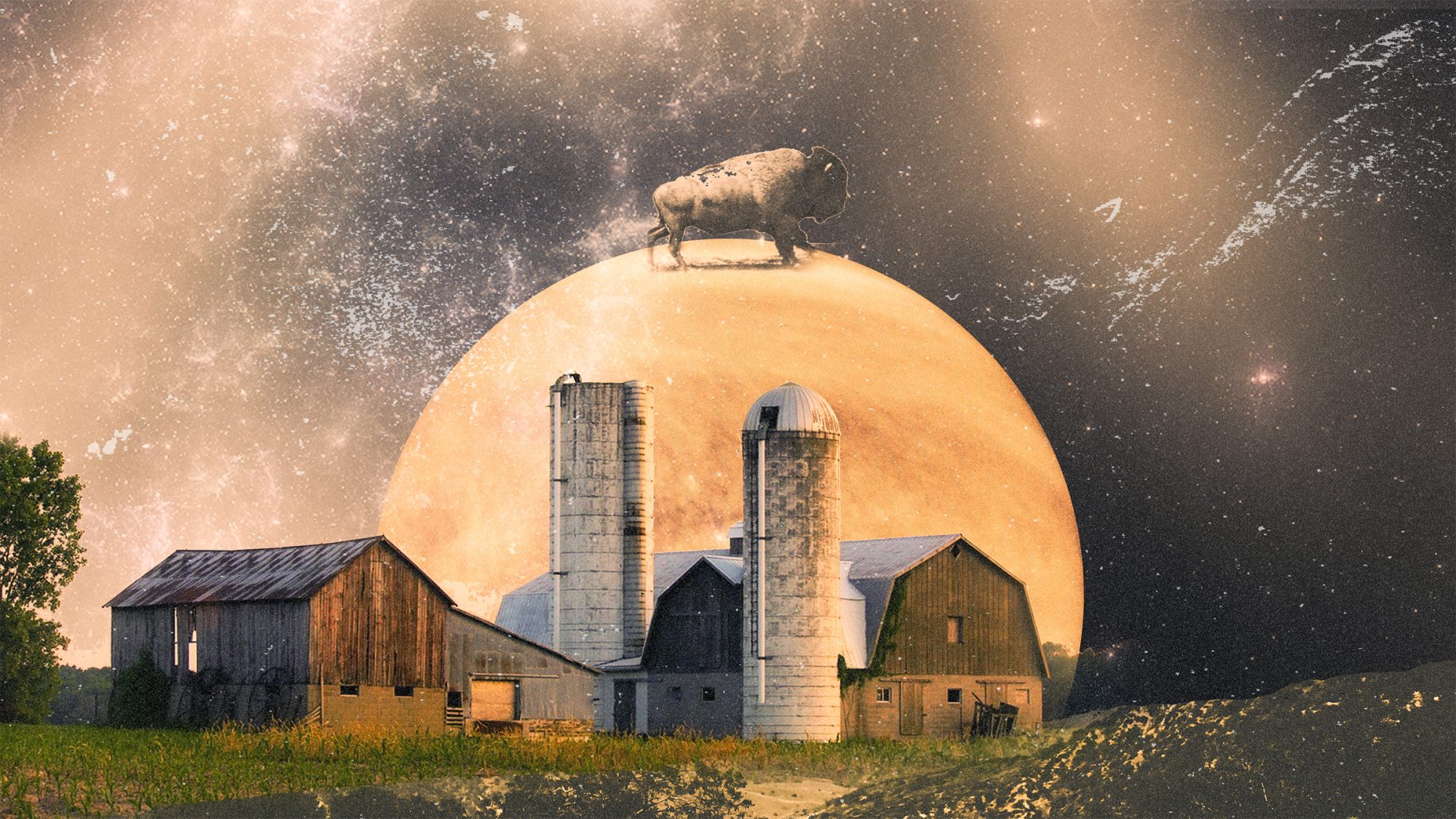
illustration by Ryan McGahan

‘Where do you get your stories, Oread?’
‘I tell my mother I make them out of iron.’
‘And where do you really get them?’
‘I make them out of iron.’
“Funnyfingers,” 1965

In the caves along the west side of the Arkansas River, a girl who isn’t really a girl at all makes words in a smithy. She's as clever as she is lovely, but don't let her childlike stature fool you: she's as ancient as the hills themselves. 

Elsewhere across the river, a pair of gentlemen wander a shantytown that’s seemingly sprung up overnight, where odd-speaking people peddle their wares and services with smiles and neighborly congeniality. Down the street, a kid picks up a small tube that can make objects disappear just by looking through it, causing all sorts of mayhem for the usually quiet community. And somewhere out in the Cimarron, a cadre of academics have drinks with a living comet, all of them waiting to be reborn through a baptism of mud and earth.

These are just a few of the people and places you'll meet in the fiction of the late Raphael Aloysius (R.A.) Lafferty, an Iowa-born but Tulsa-based writer who churned out some of the most imaginative speculative fiction of the 1960s and 1970s. He’s one of the most readable, delightful authors I’ve encountered. And with his stylistic blend of science fiction with folkish, tall-tale wit, he may also be the most Tulsan. 

Stay in touch

Sign up for our free newsletter, The Talegate

Lafferty moved here with his family at age four, and aside from a stint in the Army, he lived here until his death. During the many years he worked in an electrical supply shop downtown, Lafferty published over 200 short stories and 32 novels, most of which capture a Tulsa that doesn’t exist anymore—at least not in a physical sense. His Tulsa is one of cable cars, of taking the rails to Sand Springs, of banks of caves along the Arkansas river used as hideouts for bootlegging and storage. His story “Grey Ghost: A Reminiscence” takes place on Halloween night in 1924 at the old Electric Park dog track that Lafferty locates “south of Tulsa between Peoria and the Arkansas River,” offering a window into his childhood experience of a bygone Tulsa preserved in prose.

Despite his impressive output, his work tends to linger in relative obscurity. If anyone comes to Lafferty at all these days, it’s likely at the recommendation of another, more famous author. Jeff VanderMeer, Samuel R. Delany, Connie Willis, and John Scalzi all consider him either an influence or a favorite. His most notable champion for decades has been Neil Gaiman, who cites Lafferty as one of his earliest influences and obsessions (an unfortunate connection for Lafferty, given the recent revelations about Gaiman’s coercive manipulation of women).

College Boys Hunt For Oklahoma’s Fearsome Abominable Snowmen

Thankfully, Lafferty’s work can stand on its own merit, though potential readers might still need a helping hand to discover him. I came to it through my colleague and friend Dr. Andrew Ferguson, a scholar and teacher who is currently working on Lafferty’s biography. I met Ferguson at the University of Tulsa, which houses an impressive archive of Lafferty’s materials. Recently, I was able to chat with Ferguson about Lafferty, and we discussed Lafferty’s place in the science fiction canon until our conversation drifted toward his more local, personal resonance with each of us—as the best chats about books often do.

“When it comes to the new wave in science fiction of the 1960s and 1970s,” Ferguson explained, “Lafferty’s an offshoot that isn’t organically coming through the system of science fiction fanclubs and whatnot. He was older than most of his contemporaries, one of these weird one-off types of authors that you get once in a while after a genre becomes established. Once there is such a thing as ‘science fiction,’ you want guys like him to come fuck it up for you.”

That ability to “fuck it up” gives Lafferty his spark. He often blends high-concept science fiction with an almost avuncular style, as if he’s telling a joke that you don’t quite realize is a joke until the end. In “Nine-Hundred Grandmothers,” for instance, a “Special Aspect Man” named Ceran Swicegood explores a distant asteroid, and he asks members of the immortal alien species who live there how the universe began. This existential setup is playfully undone as Ceran finds himself thwarted by a seemingly endless number of Grandmothers content to tell their stories on their own time. It builds to a conclusion that’s far too funny to spoil here. 

But just as often, the stories work in the opposite direction, beginning with a humorous setup and ending as something else entirely. In “Boomer Flats,” a trio of cryptozoology academics from the university in “T-Town” head south into the Oklahoma wilds in search of ABSMs (“abominable snowmen”). What begins as a silly excursion that involves characters named Willy McGilly and Crayola Crawfish (Lafferty loves a good name) turns solemn and introspective once they meet the strange people out in the Oklahoma wilds: bears that live like people, immortal uncles from a race of folks long forgotten, living stars stopping by for a drink and a game of pool. One of the academics, Velikof Vonk, asks a man named Comet what species he belongs to, and the Comet answers:

“To the human species, of course, Velikof. I belong to still another race of it; another race that mixes sometimes, and then withdraws again to gather more strength and depth. Some individuals with us withdraw for quite long times. There are a number of races of us in the wide cousinship, you see, and it is a necessity that we be strangers to each other for a good part of the time.”

In recognizing something of themselves in the other, the three academics take part in a ritual that binds them to the mythos of the land itself. What begins as a farce ends in a religious experience, humbling and beautiful and welcoming in a way that beckons the reader to become part of the story that links us all together.  

A Perspective As Diverse As The City

Lafferty’s deft blend of high-concept speculative fiction and fireside yard-spinning delivery strikes me as incredibly Tulsan, and Ferguson explains that this is by design. “Lafferty was a quiet person,” he told me, “more into listening than telling stories himself. The voices he heard, the people jostling up against each other and working together (or not), made their ways into his own. He’s the voice of Tulsa storytellers, the planter and working classes made up of Irish, Jewish, Black, and immigrant communities.”

This choir of perspectives makes Lafferty a timely (and, if I’m being honest, a necessary) read for anyone living in Tulsa. As long as I’ve lived here, Tulsa has never felt like a single-voiced community; for Lafferty, that was an essential part of its magic. In the story “In Our Block,” two men named Art Spooner and Jim Boomer take a walk in a familiar part of their neighborhood rendered barely recognizable by its new inhabitants—strange-speaking, helpful folk who built a community so quickly no one seemed to notice. In someone else’s hands, you’d have an alien invasion story streaked with paranoia, but with Lafferty, it’s mostly a playspace for fun ideas (a typist who prepares a letter without a typewriter, a building described as a “seven-foot cube” that can produce raw materials of any size) and clever turns of phrase (“See how foxy I turn all your questions?” is one of my favorite sentences ever written). 

“In Our Block” is a joke wrapped in a story that delights in surprising the reader by withholding a punchline that I didn’t quite get until I read the story a second time. I’m still unsure whether I got it. That’s probably by design, too, seeing that I don’t fully get Tulsa, even after living here 18 years. It’s the not knowing that keeps me curious, always on the lookout for unexpected details that illuminate what makes this city tick.  

The only unfortunate thing about Lafferty’s writing is that it’s hard to find, given that much of it is out of print. Most of the stories I’ve mentioned here, though, can be found in The Best of R.A. Lafferty (Tor Books, 2019), which is a wonderful collection with some thoughtful introductions before each story, including a piece about “Funnyfingers” by Dr. Ferguson. As far as an introduction to what Lafferty offers, you couldn’t pick a better place to start. From the existential humor of “Nine-Hundred Grandmothers” to the poetry and myth of “Boomer Flats,” you’ll find no shortage of Tulsa-inspired stories to get you looking at this place a little differently.

photo by David Chandler

I’m especially partial to “Slow Tuesday Night,” the first story in that collection, a fever dream of a timeloop in which everyone in the city begins each day dirt poor and then quickly comes into extravagant wealth only for it all to go bust by the time the clock hits midnight. It’s the type of story only someone who’d lived in Tulsa for a while could write, turning the town’s economic history of oil boom and financial collapse into a science fiction tale that reads like your elderly neighbor’s favorite anecdote. It has all the elements of cynical misanthropic satire, which Lafferty defangs with his genuine love for the story’s people and the world they inhabit.

Before you dive into Lafferty, it helps to know that his stories don’t always function in the way you expect. When I teach Lafferty’s stories to my students, I ask them to think of each tale as a sort of puzzle box, not as something to solve but something to play with, to turn over and over again as you read it. To truly enjoy Lafferty, you should consider his work from multiple angles—the language he uses, the strange twists on familiar locations, the characters that begin as one type and end as something else entirely. That’s where I find the joy in reading his work and sharing it with others. 

Or maybe a better way to think about Lafferty’s short fiction is to consider him a fabulist biographer of Tulsa, a textual tour guide of a city poised on the crossroads where myth and magic and history meet. His work encourages you to step outside, if you can, to travel down that neighborhood block that looks suddenly unfamiliar. Listen to the voices of uncles and grandmothers; there’s wisdom in their stories, especially when they’re making fun of you. Pack your eyes with mud before the river floods. Share a drink and a game of pool with a shooting star. Pick up an unremarkable piece of discarded steel and look through it to see how it changes your world.

And when it comes time to turn your own memories—your experiences living in a strange city—into your own stories, Lafferty offers a suggestion. Remember, there are caves in the hills near the Arkansas River, and there’s a girl (who isn’t really a girl) who lives there. Go see her if something tugs at you to explore the caverns that run under the earth to the sacred places beyond our knowing. Follow the ringing of a hammer and anvil. She likes visitors, and if she likes you, she’ll show you how to take the cacophony of voices and inconsistencies that make up a city and forge your own stories out of memories, out of sound, and out of iron. 

If you liked this story, please share it! Your referrals help The Pickup reach new readers, and they'll be able to read a few articles for free before they encounter our paywall.

Stay in touch

Sign up for our free newsletter

More from The Pickup

In A Tiny Gallery, “Fragmented Landscapes” Layers Space With Memory

Caty Smith’s global travels inspire a vulnerable, meditative body of photographic experiments

April 23, 2026

Cycles Of Violence Repeat. “Antigone & Ismene” Reckoned With How To Break Them.

Riff Raff Tulsa's new adaptation of an ancient play felt urgent, unsettling, and deeply human

April 21, 2026

Tulsa Picks: The Best Tulsa Events, April 22-28

This week: LitFest, Kölsch Fest, "Gypsy," and some badass women musicians

April 21, 2026

Meadow Market Books Wants Your Book On Its Shelf

Tulsa’s cutest book store is also meeting a vital community need

A Lady’s Guide To Love And Murder, But Mostly Murder

"Lizzie," Theatre Tulsa’s latest collaboration series project with Kristen Simpson, brought big sounds, bigger feelings, and birds

April 17, 2026

Houses Of The Heinous

Legendary shock rockers GWAR splatter Cain’s Ballroom with fake blood, real political satire

April 16, 2026
See all posts