


Riff Raff Tulsa: “Antigone & Ismene”
101 Archer
April 10, 2026
In Riff Raff Tulsa’s recent production Antigone & Ismene, Meagan Mulgrew’s adaptation of Sophocles’ Antigone unfolded not like a distant tragedy but an ever-present one, like something set in motion before the audience even arrived, a story that has been repeating itself long before this particular performance and will continue long after it ends. For Mulgrew, this tale of intimate and civic betrayal, justice, and responsibility becomes less a fixed narrative than an ongoing reckoning, one that implicates both its characters and its audience in the enduring cycle it exposes.
From the beginning of the production, performed in the nontraditional space of 101 Archer’s gallery, the play situated itself within this emotional terrain. Mulgrew’s version opened with Antigone’s sister Ismene (Élle Evans), not as a passive figure, but as someone palpably exhausted by loss, already aware of the weight of what has been passed on to her. She and her sister are the daughters (and sisters) of Oedipus, conceived amid a terrible prophecy; they now live in a Thebes torn apart by that prophecy’s aftermath.
Some of Ismene’s first words here were a plea to “try again,” to somehow go back and make different choices, to save her family, which has inherited generations of trauma that now threaten to break it all over again. These words framed the production in a kind of aching repetition, suggesting that tragedy itself is a cycle that refuses to loosen its grip. Ismene spoke them early on in desperate answer to a simple question: “What would you like to do?” At the play’s close, that question follows Ismene’s plea to “try again,” faintly pointing to the possibility of choice, a small and fragile opening through which that cycle might, however imperfectly, be interrupted. But the cost to get to that choice is high and heavy.

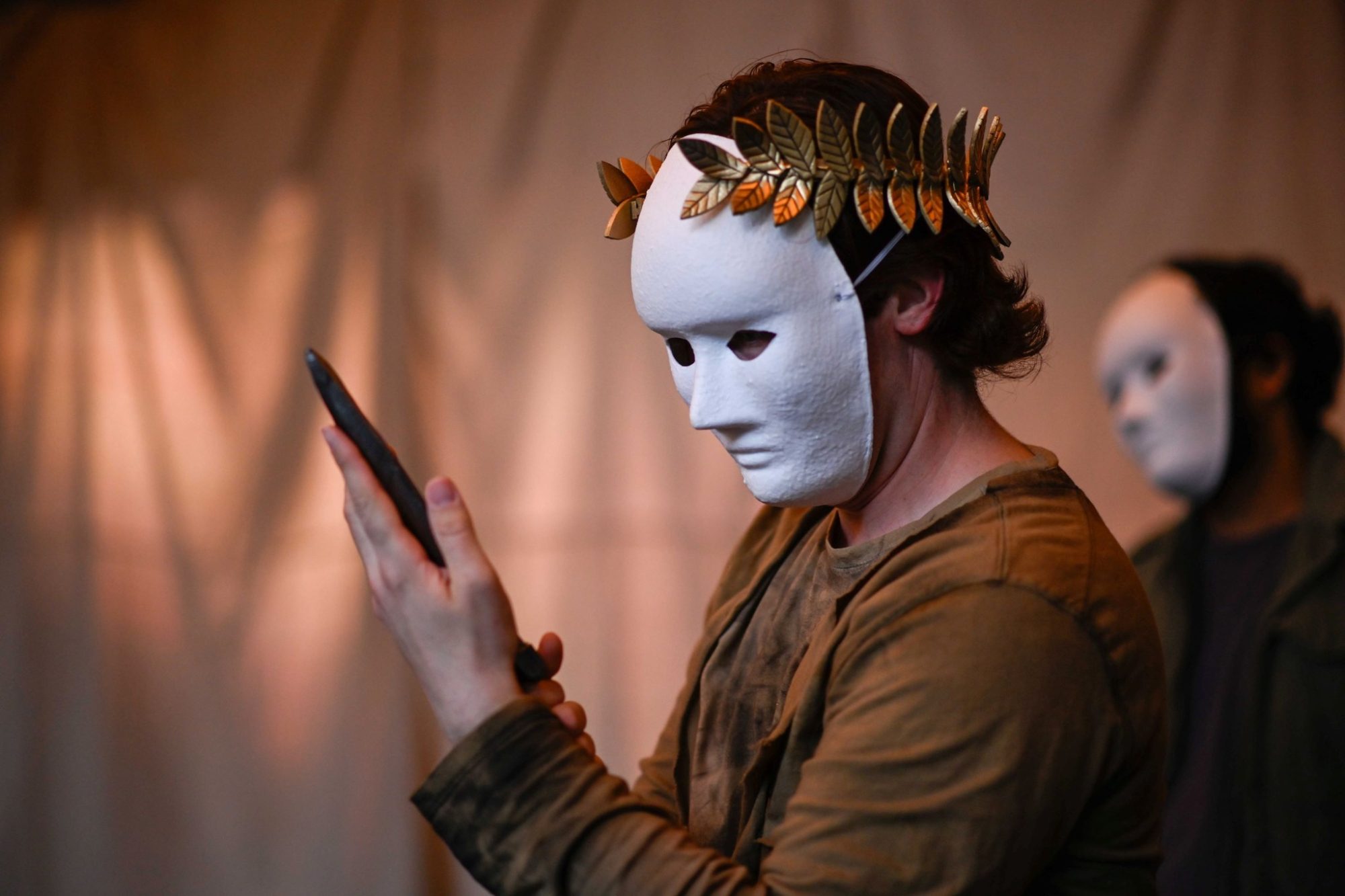
Mulgrew, who directed as well as adapted this play, made this sense of inevitability almost suffocating by using a theatrical device traditional to Greek tragedy: the chorus, which she deployed confidently and creatively. This group of masked faceless bodies moved with unsettling silence through the background, never speaking, never intervening, but never allowing the audience to forget them as they seemed to anticipate every moment of collapse.
They began the play by embodying the story of Oedipus, physically tracing the origins of the family’s suffering, orienting the audience through controlled, expressive, and often unsettling movement (Maree ReMalia did the movement direction). From that point forward they reappeared periodically, circling characters as they made decisions, closing in on them in eerie ways that felt both protective and predatory, as though the past itself were watching and waiting. The moment of Antigone’s death near the end of the play was marked not by a grand gesture or a noble speech, but by the simple extinguishing of a light surrounded by the chorus: a quiet, almost ritualistic act that made her death feel both inevitable and hauntingly impersonal, as though it has been decided long before she stepped onto that stage.


One theme of Sophocles’ play that emerges powerfully from this staging—merging fixed, old stories with dynamic present time, both narratively and visually—is the idea that families do not simply shape us, but can contaminate us, filling future generations with grief, hatred, and a sense of obligation to continue on paths they have not chosen. By layering ancient imagery and movement with distinctly modern dialogue and inflections, the production reorients inheritance as “burden” as much as “legacy.” Mulgrew reiterated that theme clearly through the character of Citizen (later identified as the seer Tiresias), played with a quiet and grounding but commanding presence by Tine Beyaert, who often sat with the audience and spoke to us directly. “Children betray their parents, but are often betrayed first,” Citizen proclaimed: a tragic truth that echoed through the lives of the main characters who each, in their own way, attempted to reckon with the violence they inherited.
The story of Antigone & Ismene centers on a sacred rite that has everything to do with that kind of generational haunting. The sisters’ brother Polynikes (Aniq Zoha) has been declared a traitor by the blustering King Kreon (Thomas Hunt), condemned to remain unburied after death and thus never to know peace. In the face of Kreon’s promised death sentence for anyone who attempts to bury Polynikes, Antigone’s defiance of his command, often framed as naive stubbornness, felt here like something far more fragile and necessary, a desperate attempt to restore a sense of moral order in a world where law has become detached from justice. Mulgrew did not hesitate to have her characters speak plainly on these matters; lines like “some acts are so undeniably right” hit less like abstract philosophical statements and more like revelations of the profound subversion required to stay human in a society like this one.
Antigone’s choice to forgive her brother, to honor him in death, is one of the few moments in this ancient story that resists the logic of violence rather than reproducing it. What makes her choice so devastating is that it cannot exist without consequence. Antigone (Natalia Rojas, in a performance that balanced fierce conviction with emotional vulnerability) interrupts the cycle rather than merely resisting it, and in doing so she makes herself incompatible with the political world around her. Her death, marked so starkly by that extinguishing of light, is the cost of refusing to carry forward what her family has passed down to her.

This adaptation’s Antigone finds an unsettling parallel in Haemon (Caleb Stirewalt), her fiancé, whose arc unfolded with a similar sense of tenderness and inevitability, rendered through a performance that grew from restrained devotion into a devastating resolve. His final confrontation with his father Kreon briefly but powerfully disrupted the play’s temporal ambiguity, bringing its resonance fully into the present. For much of the production, the language and staging moved fluidly between antiquity and modernity, allowing the audience to seemingly occupy both spaces at once. But here the shift became sharper, almost jarring, as Kreon’s language took on a distinctly contemporary tone; his explicit reference to Antigone and Polynikes as “terrorists” flashed through the room as he tried to ground his authority in a rhetoric that felt uncomfortably familiar.
The violence that followed this confrontation was equally disorienting in its immediacy, as Kreon’s anger spilled over into something physical and personal. Father struck son to the ground in a moment that left the room in a suffocating silence, as if the audience was granted access to an intimate moment executed with shocking force that it wished it hadn’t seen. Kreon’s contemporary language created an uncomfortably modern scene as he towered over his son’s cowering body, cursing and threatening him, shouting “bring the bitch out” so he could kill Antigone in front of his son, before finally calming. In Hunt and Mulgrew’s rendering, these words shot right past conventional theatrical effect and into something raw and disturbingly recognizable: the language of someone eternally and entirely consumed by his own hatred. In contrast to this visceral rage, Haemon carried a steady, heartbreaking clarity. “You are not the father I know,” he quietly said—a line delivered in acknowledgement that the person standing before him has long been lost to the very violence he perpetrates.

As with Antigone, Haemon’s refusal to participate in that violence ultimately costs him his life. The image of Kreon leaning over his son’s corpse at the end of the play, hands bloodied, created a stark and haunting visual symmetry against their earlier confrontation, underscoring Kreon’s culpability in his son’s death, both figuratively and literally. If Haemon succeeds in breaking the cycle, he only does so by removing himself from it entirely, refusing to live within a system demanding his complicity.
Ismene’s trajectory, however, lingers in a different emotional register, one that feels even more unsettling precisely because it culminates not in death, but in endurance. In Mulgrew’s adaptation, which gives this sister a far greater role than Sophocles’ original play did, Ismene’s fear and hesitation early on read as an acute and embodied awareness of the limits placed on her and Antigone, rather than as weakness. These limits are practical as well as ethical; when she reminds Antigone, “We are women. That means we are alone,” she is reflecting on the lack of legal protections afforded to them, recognizing that going against the state, against man, will result in certain death. She recognizes—in a way that Antigone initially ignores in her determination to act against Kreon’s order—that survival itself is a kind of burden, especially within a family so entangled with loss. Evans delivered that line with a quiet, almost resigned intensity, her voice carrying the weight of lived experience.
In fact what makes Ismene’s arc so compelling is that she gradually moves through her fear, so that she and Antigone begin to inhabit the same moral world. After Antigone is put to death for disobeying the king and assuring her brother’s release into the next life, Ismene’s life remains saturated with memory and responsibility, which leaves her to carry forward the memory of the violence that shaped her family and the fragile attempt to resist it.

The production’s fluid movement between ancient and modern approaches felt like a quiet insistence that the story cannot be contained merely to the past, and that what unfolds on stage is not distantly resolved, but persistently alive and resurfacing. The shifts in language and staging—sometimes subtle, sometimes jarring—created a kind of instability that mirrored the emotional core of the play, forcing the audience out of the comfort of historical distance, and allowing for a recognition of how familiar these dynamics of inherited hatred and grief remain.
In all this, Mulgrew’s adaptation succeeds with striking clarity and emotional force, using the stark physicality of the chorus to embody the inescapable presence of the past; grounded but volatile performances to render inherited violence viscerally immediate; and the deliberate blending of contemporary and classical language to collapse any distance between antiquity and the present, ultimately making its central questions feel urgent, unsettling, and yet deeply human.
Is breaking a cycle of violence possible without such loss? Antigone and Haemon’s deaths offer a kind of resolution, but one that feels incomplete and unsatisfying because it requires their removal from the world rather than its transformation. The burden then shifts onto Ismene—and by extension, the audience—as witnesses who must decide what to carry forward and what to leave behind. Antigone & Ismene left me thinking less about the inevitability of injustice and more about the ongoing effort of resistance: while cycles may not be easily or cleanly broken, the act of confronting them may be the closest thing to purification one can achieve.


