


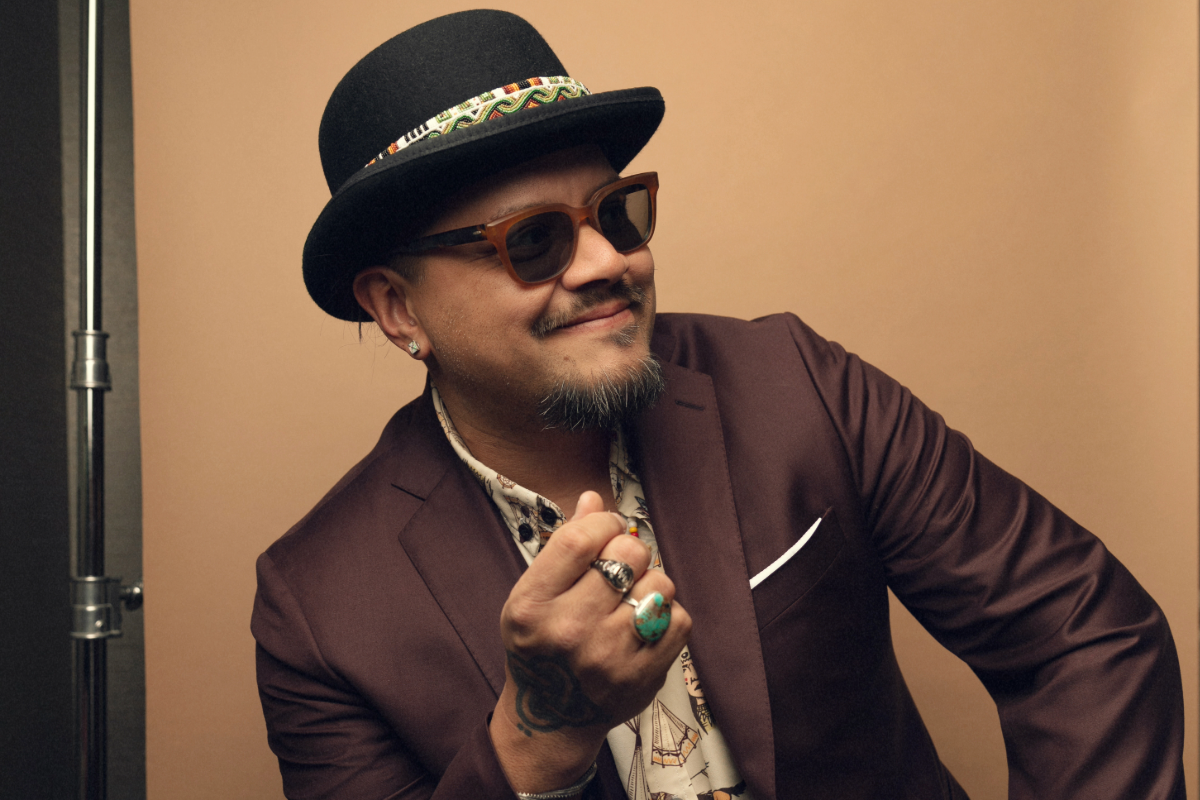
Look, you don’t need me to introduce Sterlin Harjo to you. He’s certainly the most famous person you could plausibly bump into shopping for cereal at the Reasor’s at 15th & Lewis.
Originally from Holdenville, the creator of Reservation Dogs has called Tulsa home for 18 years now—he’s on the record in The New York Times saying it’s his “favorite place in the world”—and that warmth of feeling colors every frame of The Lowdown, his latest series for FX that drops its season finale this week.
Now that we’ve all seen the show—with its efflorescence of Tulsa textures, characters and cultural touchstones—I wanted to ask Sterlin about some of the big-picture themes that run through The Lowdown, as well as his burgeoning Oklahoma mythology. Sterlin and I spoke on a video call Monday morning before the season finale aired on Tuesday.
Matt Carney: First question. How does it feel knowing that the season finale is about to air?
Sterlin Harjo: I mean, it's really exciting. I'm really proud of the finale.
I'm actually excited to not be in the place of waiting for each episode to come out. That anticipation for me, like, I'm ready to be beyond that and let people binge it. I think that that's where I'd rather be with the show.
Matt Carney: To just have it all out there.
Sterlin Harjo: Yeah.
Matt Carney: So The Lowdown is a pretty pulpy, raw depiction of Tulsa. I'm curious to know what people you know outside of Tulsa have made of it.
Sterlin Harjo: Everyone wants to visit Tulsa. I get that a lot.
I think that it's a pretty accurate depiction. I mean, there's not shots of, like, children playing in the water fountain at Guthrie Green. But that's just not the genre, right? It's not what we're focused on.
But one of my favorite compliments was somebody said “You made Tulsa look like Tulsa,” which I thought was pretty awesome, because that was the goal … to show it for what it is.
Stay in touch
Sign up for our free newsletter, The Talegate
Matt Carney: You mentioned the noir genre and in the lead up to The Lowdown, you did these screenings at Philbrook of some classic American noirs.
Sterlin Harjo: Have you watched the finale yet, by the way?
Matt Carney: Yes.
Sterlin Harjo: So you know that Philbrook looks amazing on screen.
Matt Carney: Yes, it’s beautiful, very cinematic.
You screened The Long Goodbye, Night Moves, The Drowning Pool. These are all films made in the 1970s as this new skepticism was taking form in the American character.
Sterlin Harjo: Yes.
Matt Carney: How did that skepticism find its way into The Lowdown? And I wonder what are some things that you in particular are skeptical about?
Sterlin Harjo: Everything. You should see my algorithm.
Matt Carney: [Chuckles]
Sterlin Harjo: It comes down to the truth, right? We’re starved of it. I mean, like, I could turn on the news or go to a website right now, and you're gonna see lies all over the page, or things that you can't decipher as truth or lies. [Truth] feels like the most noble thing to be fighting for right now. The need for truth comes out of skepticism, I think.
I think I grew up with that, too.
My whole career has been to be a truthstorian, basically. I mean, like, Native people were portrayed as something that we were not up until Reservation Dogs, to be honest. There were a couple other projects, too, but it’s amazing that Reservation Dogs was so revolutionary. And it was in 2021. You know, it's like, how does that happen?
So my whole life, I grew up knowing that mass media, Hollywood and the government are lying sometimes. And I had to try to decipher what is truth and what is lie.
When you grow up very prideful to be an American and you're sitting there with your classmates and you're saying the Pledge of Allegiance and you’re the home of the brave and all of these things, and then you realize at some point, “Oh, like, all of your ancestors were marched here by gunpoint and a lot of them died.” And that's how we ended up in Tulsa?
There was just an event two days ago where Tulsa gave back the Council Oak Tree and park. And it's hardly known that Tulsa was founded by Muscogee people. You would never know that unless you're looking.
So I grew up with all of this. So that's where the skeptic in me comes from. It's just a lifetime of having to decipher what's true and what's not.

Matt Carney: And so Elliott Gould [in The Long Goodbye] must have been a big deal for you. You latched on to the character.
Sterlin Harjo: Oh yeah, all of that.
If you’d have asked me ten years ago if I'd have done a noir, I would have probably said no. I was a kid of ‘90s independent film, and, like, personal stories were king, you know. I wanted to make the next Down By Law or Stranger in Paradise or something. But I learned to love genre because you could say so much in it. And movies like The Long Goodbye had a really big impact on me.
Later in life after I started making films, that's when I really fell in love with [genre films].
I remember watching Ozu films when I was in college. I just couldn't get into it. Like, I get it, the camera's low and we're looking through rooms and whatever, but, like, now I watch them and I love them. I remember watching 8½ when I was in college and just going, “What is happening?”
[I] hadn't been long enough away from Holdenville, Oklahoma to really enjoy 8½, but now I can watch it over and over. Elliott Gould is the man.
Matt Carney: So we’ve been writing about The Lowdown, and as we’ve been watching the series, we've been really captivated by the mythology that you've created by blending fact and fiction in your treatment of Tulsa.
Sterlin Harjo: Yeah.
Matt Carney: Examples being like, the Lee character, Heartland Press, the close ties between the state and the energy industry. But one thing that kind of came up late in this series that we thought was especially interesting was the land run reenactment scene, which in the show is interrupted by Native American protesters. But I think a lot of people outside of here don't realize that, like, that's a very common Oklahoma thing.
Sterlin Harjo: Yeah.
Matt Carney: It was banned by Oklahoma City Public Schools in 2014 and been widely criticized as being dismissive of Indigenous peoples. Can you take me into the writer’s room for that?
Sterlin Harjo: That was an early-on idea I wanted to do. I just had this idea of these images of kids really wanting the land. Even though it’s performative, they're really into it.
I wanted to show, you know, there's this racist preacher in church [played by Paul Sparks] intercut with Donald [Washberg, played by Kyle McLachlan] doing the land run. I don't think Donald's racist, inherently racist. I don't think that he means bad or means to be racist, but he is participating in something systemic that is inherently racist. But also people don't realize it's racist. It’s an interesting thing to try to like, show the nuance of, but that's why it's intercut with the preacher and this church.
And then Irene the protester comes up and he calls her Irene, first name. So it tells you already, like they're on a first-name basis. He knows her. They've probably had conversations before. He's seen her around town enough that he feels bad and they're friendly.

And that is a nuance that can happen in Oklahoma that I really wanted to tell. [It’s] the same thing in Jacob Tovar's scene in the last episode when he’s talking to Marty and he says, “Don't go to that church. I wouldn't go to that church if I were you either.”
Well, we needed to see that it's not like all white people here are a part of a racist church. There is a specific church and then there are white people, whether they're conservative or not conservative, that would never mess with that church.
So those little things were important for me as an Oklahoman to parse out and show, you know. But yeah, the land run … early on I started thinking about those kids and then I was like, well, I gotta have [Kyle McLachlan] dress like Will Rogers because it shows you how mixed up it is.
He’s a Native American1 and he's putting on a land run. And the show's also about how history matters and the truth of history matters.
It's just so complex and it's hard to — you know, it's Oklahoma.
Matt Carney: Yeah, it’s in our character, in a way.
Sterlin Harjo: [Laughs] Yeah.
Matt Carney: I participated in one of those [land run reenactments] in elementary school and so seeing it onscreen was a little like “Whoa.”
Sterlin Harjo: Isn’t that crazy as a kid, we could be like “Wow, this is just the land run.” Then you see it on screen and you’re like “Oh shit, everybody else is going to see this too.”
Matt Carney: I think we’re running out of time, so I’ve got one last question for you. I contacted somebody who’s known you for a long time who told me to ask you about The Skunk. So who or what is or was The Skunk?
Sterlin Harjo: Wow. You're gonna have to tell me who it is. This could be multiple things.
Matt Carney: They were talking about The Skunk, the vehicle.
Sterlin Harjo: Oh, that was Chuck Foxen you talked to.
Matt Carney: [Laughs] Yes.
Sterlin Harjo: That was my car! It was a ‘69 Camaro Supersport. It was my first car. And I painted it just like Wooderson's on Dazed and Confused.
I pretended I was Wooderson and I would punch the gas and the gas would just [makes gesture indicating declining fuel indicator]. One time, me, Chuck and my cousin ran out of gas in the McDonald's drive through at Holdenville. [Laughs] I was always out of gas and I never had enough money to put gas in it.
Matt Carney: Have you met Richard Linklater?
Yeah, I met him with Ethan, he introduced me to him at a restaurant in New York. It was great. We hung out. I'd actually met him at the Munich Film Festival years before, but then kind of really met him then. And then we were on a panel together a couple years back in Austin and we hung out. Yeah, he's definitely a hero.
Matt Carney: Did you tell him about The Skunk?
Sterlin Harjo: Oh, yeah, I told him I had the car. I told him that I started smoking pot because of that movie. I lived my life like that movie for a few years.
Matt Carney: That’s beautiful. Sterlin, thanks for your time.
Sterlin Harjo: Thank you, man. Good talking to you.
Footnotes
- Editor’s note: Being very close to deadline, I’m pretty sure that Sterlin was referring to Will Rogers here, rather than the Donald Washberg character. Rogers was a citizen of the Cherokee Nation.Return to content at reference 1↩


