

The Pickup's Culture coverage is brought to you by Tulsa Artists' Coalition Gallery, 40 Years of Empowering Tulsa Artists. Visit TAC Gallery to see American Highway Revisited by VC Torneden and Melinda Harvey Green, June 5 – 27, 2026.

"Celestial Waters" by Tessa Richardson
TAC Gallery
"Entangled Ecologies" by Shawn Smith
108|Contemporary (through May 23)
From cosmic dust to fungal bloom, the works in Celestial Waters and Entangled Ecologies trace the invisible systems that bind creation and decay. While artist Tessa Richardson reached toward the unknowable vastness of space and artist Shawn Smith burrows into the earthly intelligence of insects, both artists are interested in transformation: how matter shifts, collapses, regenerates and mirrors itself across different scales. In ceramic loops, pixelated carcasses, and cathedral-like termite towers, the familiar world is made anew, revealing the hidden geometries that shape the cosmos above and the dirt beneath our feet.
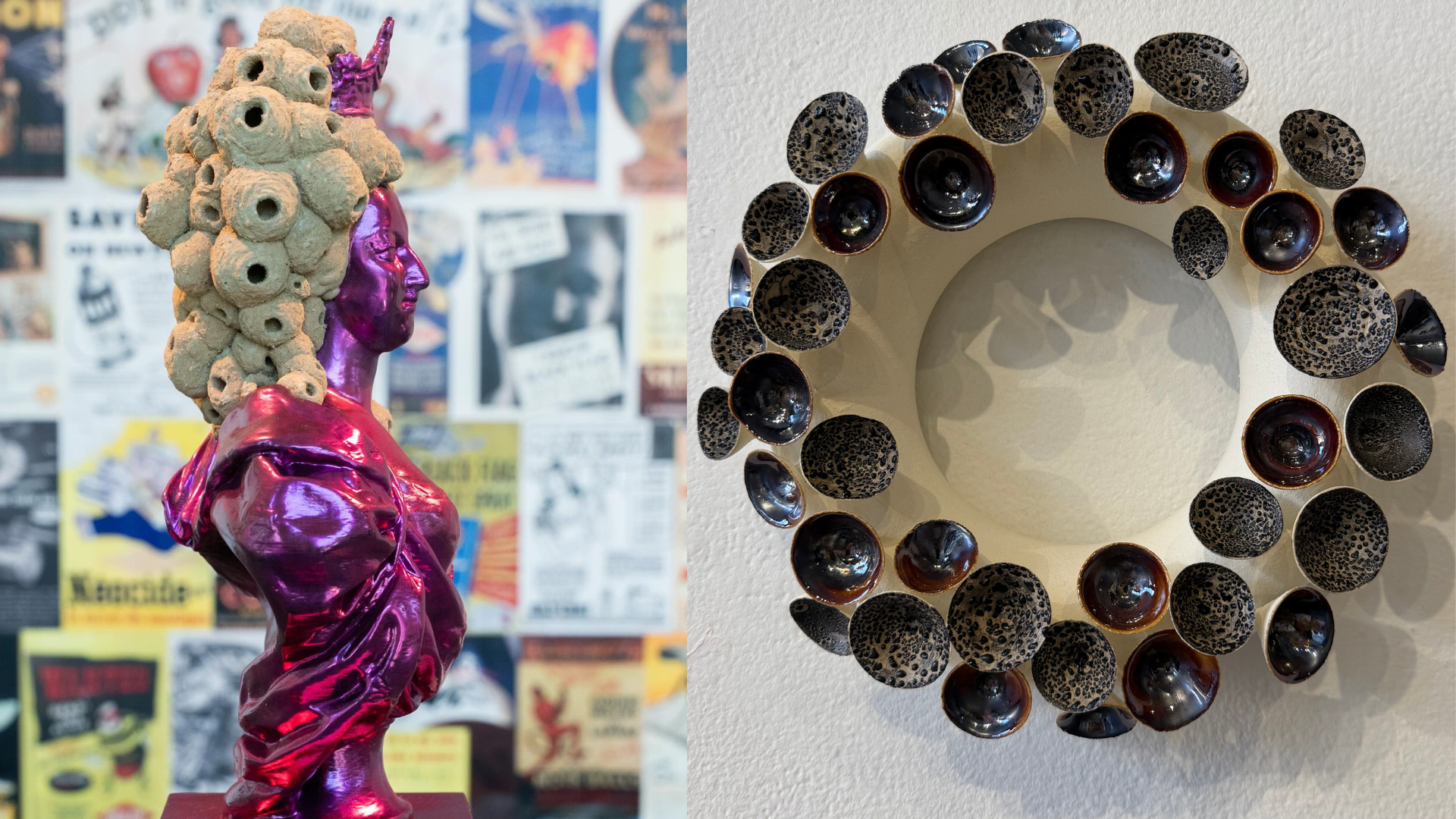
During an artist talk at Tulsa Artists Coalition last month, Richardson couldn’t resist touching her first wall hanging sculpture, Nebula Loop 105, as she spoke. This black mirror glazed torus was a striking example of contrast in both texture and form. Taking up almost a foot in diameter, one side of the ring was smooth and reflective, then transformed into a textured black matte glaze interrupted with raw white “witch fingers” that protruded and wrapped around its edges. Richardson made these appendages by squeezing coils of clay in her hands and pressing them into the circular wheel-thrown base.

This work took its name from the swirling nebular “loop” left behind by an exploded star that can faintly be seen in space, as well as digital screensavers popular in the ‘90s featuring spiraling colors. In her Checkered Loop wall hanging, she carved a black and white pattern into portions of the coil, a nod to the checkered computer chips present but not visible in many of the items with which we interact. Giving form to phenomena rarely seen, Richardson’s loops considered how objects emerge and dissolve, visualising our connection to spaces that remain beyond reach.
Six blue ink paintings separated the wall hangings from one another, their quieter presence emphasizing the bolder bearing of the surrounding sculptures. Further down one wall, glossy mushroom-shaped forms sprouted from three raw, ring-shaped clay surfaces. Named after the scientific theory that life emerged from nonliving matter, Origin Loop 102 continued the celestial rhythm throughout each of Richardson’s ceramic works. A close look revealed where the natural raw New Mexico clay ended and the dark, man-made reflective glaze began to cover the fruiting caps.
Richardson’s exhibit explored the microcosmic patterns that make up the objects and spaces surrounding us with sensitive intuition. In this process-based work, not focused on perfection or meaning, she refreshingly gave herself permission to get lost in the act of creation, and revealed her discoveries after taking time to consider what she’d made in this meditative state.

I was in a meditative state myself as I exited the gallery, not quite ready for the night to end. At Guthrie Green, I came upon an outdoor screening of Interstellar, a film about a NASA mission in search of a new planet as earthly resources dwindle. Just a few weeks earlier, American astronauts like the ones portrayed in the movie voyaged the farthest distance humans have ever travelled from Earth in Artemis II, also looking for ways to visit a new planet. I sat beside a sleeping dog to watch tiny astronauts evade an otherworldly tidal wave.
My eyes drifted above the outdoor screen, past the towering buildings and into the violet nothingness of space. Below, on the lawn, geometric patterns glowed across the ground from the lit structures above, as if continuing Richardson’s exhibition into the real world. I was ready to return home.
But as I walked toward my car, I peered through the glass windows at 108|Contemporary, where a chrome pink bust of Marie Antoinette was blooming with wasp nest poufs above and below her crown. Removed from its menacing outdoor presence and absent stinging bugs, this insect architecture became newly interesting when safely displayed as a work of conical precision fit for a queen.


This was my first glimpse of Entangled Ecologies by Shawn Smith, on view through May 23, and it stopped me in my tracks as it glowed in the darkened gallery. Nearby, in a stained glass “Cathedral” the same height as me, hundreds of triangular glass shapes are pieced together, inspired by the soil skyscrapers built by cathedral termites in Australia. Smith’s colorful replacement provides a familiar and comforting texture through which to study the intelligence and complexity of insects’ solution to keeping cool in the desert.
Beyond the glowing ant church, colorful mushrooms sprouted from Harmony of Decay, an architectural, pixelated rhino sculpture that lay supine on the gallery floor. The geometric animal form, made of earth-toned rectangular plywood pieces that compose a dead beast, nods to how much of the natural world we experience through our phone and digital media—including perhaps the news, reported while Smith was creating this piece, that the last white rhino on earth had died. In the contrast between colorful, organic growth and flattened shapes, the joy of life sprouts from a decaying form, reminding us that even in pixelated disarray, there is a system forming a new vibrant existence.

Together, Celestial Waters and Entangled Ecologies extend beyond their gallery walls, drawing attention to the hidden patterns shaping our natural and constructed worlds. Though one reached up toward the cosmos and the other reaches to the soil, each exhibit reminds us that creation and decay are always unfolding around us. Walking between them as day turned to night, I felt like part of a larger, more interconnected whole—carrying the uncanny sense that the same forces shaping stars, spores, and cities were quietly shaping me too.


