


Ethel Cain
Cain’s Ballroom
May 16, 2026
My first Cain’s Ballroom show, or at least the first one I can remember, was Bob Dylan. I was six, standing tall on my godfather’s shoulders, unaware that I would grow up on that dancefloor. In the past two decades, I’ve seen probably a hundred shows at the Cain’s, mostly concentrated in my teenage years, when I’d wait at the stage door for my favorite artists to take photos long lost to discarded digital cameras and broken laptops. I’ve two-stepped at the Cain’s, I’ve moshed at the Cain’s, I’ve thrown up in the bathroom (let’s face it, who hasn’t). A few nights ago, I returned to the Cain’s for the last night of Ethel Cain’s sold out three-night run, and I gotta tell you—I felt like a teenager again.
Hayden Silas Anhedönia, originally from Tallahassee, Florida, is a southern-gothic pop star who exploded in popularity after the 2022 release of her critically acclaimed album Preacher’s Daughter. The breakout album draws from the singer’s Southern Baptist childhood, and follows a character named Ethel Cain as she escapes her deep south town and hitchhikes across America, eventually falling into a fatal relationship which results (spoiler!) in the young girl being cannibalized. A cult following quickly developed around the album and its dark religious themes, with extensive Reddit threads debating its narrative and young women in white lace prairie dresses descending on Anhedönia’s concerts in droves.
At the Cain’s Ballroom on Saturday night, there were indeed white prairie dresses galore. Coincidentally, my friends and I also wore white, so we fit right into the line that stretched like a snake down Main Street. The dress code felt like an ode to the Baptist themes in Preacher’s Daughter, but I couldn’t stop thinking everyone looked way too virginal.
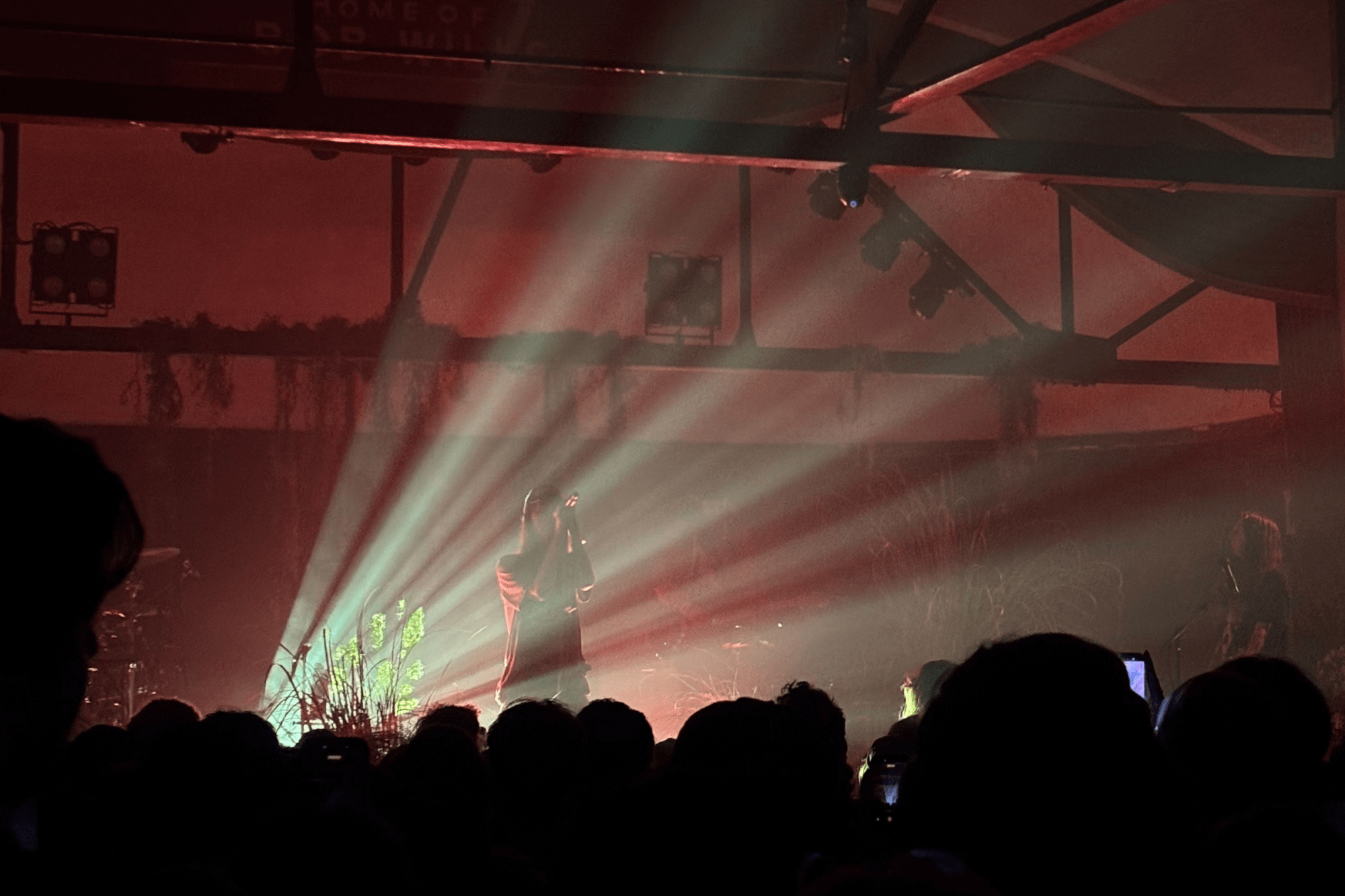
Inside, the venue was already scorching hot, bodies weaving in and out of the crowd to get closer to the barricade. The stage was lit with cool, low light, crowded with tall prairie grass, hazy from a fog machine so intense it garnered backlash on nights one and two. Illuminated from behind, Ethel Cain towered not unlike a god, or a queen. Tall, thin, with blackout tattoos and waist-length hair, her presence was truly mesmerizing. As the well-timed mushrooms hit, her ambient dark-pop filled the room I knew so well. Opening with an old track from her 2019 debut, “Sunday Morning,” Anhedönia seemed to float out to the center of the stage. As she moved into the lead single from Preacher’s Daughter, “American Teenager,” the crowd hung on her every word, pulsing together in the humidity, singing along with a spiritual fervor.
As a goth southerner with a penchant for Lana Del Rey, I’m quite drawn to Anhedönia’s dark, narrative-driven music. Her follow-up to Preacher’s Daughter is a slow-core, noisy album called Perverts, with few lyrics and fewer melodies. It’s weird, difficult at times to listen to, and a fabulous choice to follow a commercial success. Her fans seem to overlook it, mostly, in favor of 2025’s Willoughby Trucker, I Will Always Love You, which returns to the poppier, ambient aesthetic, and expands the Ethel Cain narrative. For my part, I’m a fan of it all.