


Skip to Content
Culture

I Blew Out My Central Nervous System Watching Streamer Storm Content

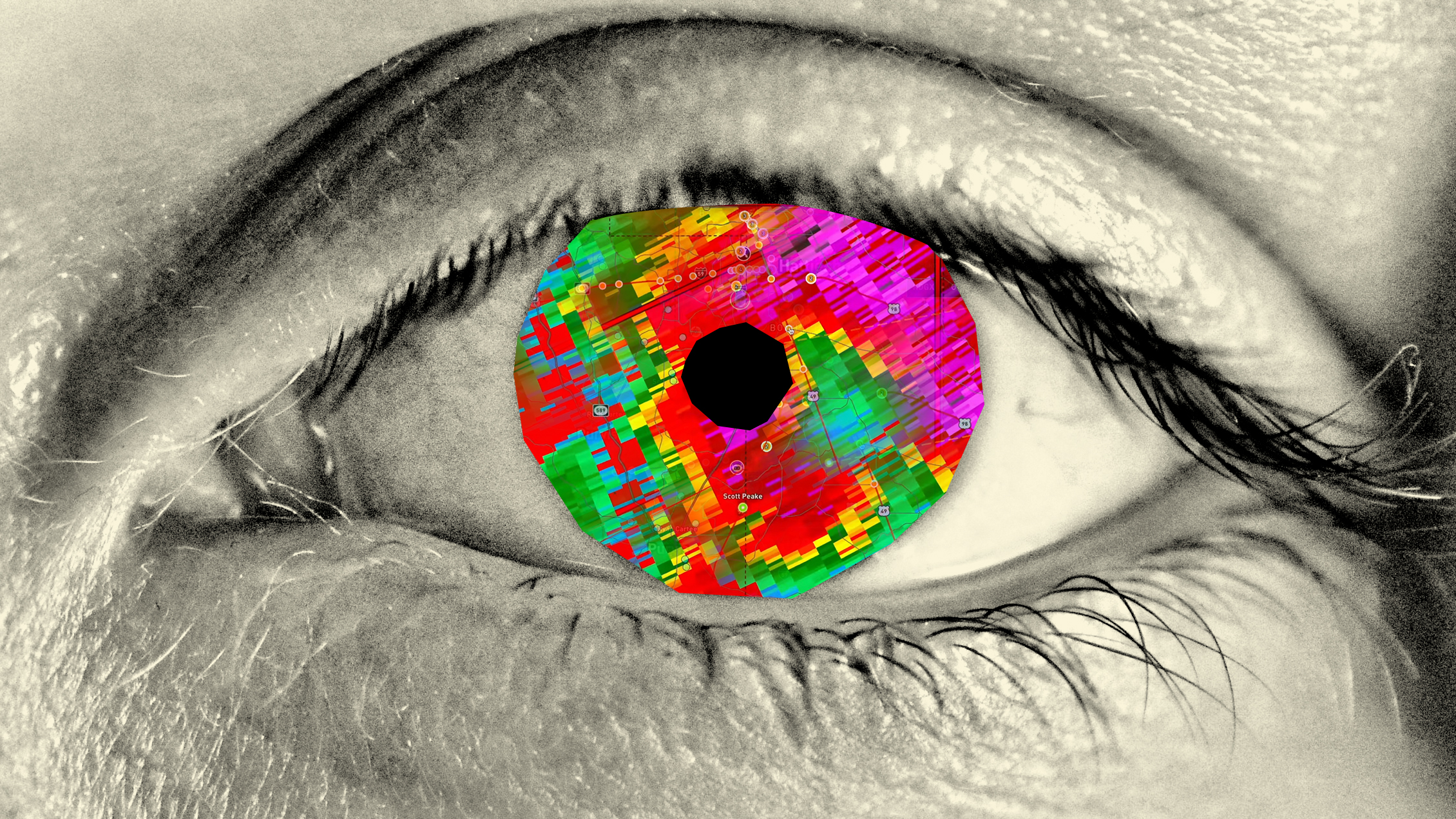
Today’s severe weather forecasts are thriving on hype. But do they help?

The Pickup graphics department

The Pickup's Culture coverage is brought to you by Tulsa Artists' Coalition Gallery, 40 Years of Empowering Tulsa Artists. Visit TAC Gallery's 5x5 Show and Sale, running from May 1-May 16.

I remember falling asleep in the hallway of our house growing up, covered in pillows and blankets, listening to the soothing voice of Jim Giles on KOTV as he talked my mom and dad through the movement of a tornado, our first since landing in Oklahoma. Through half-opened eyes I could see the TV glowing dimly from the living room, with murmured words and sirens mingling in the dark. Dad would go out the front door now and then, check on things himself, then come back in to continue the vigil. He’d been a farmer, back in Nebraska, but these were different and more dangerous skies. 

My family had moved here when I was four, and listening to these broadcasts from the brown-carpeted hallway was part of how I learned to speak Oklahoman. Here’s KOTV meteorologist Mike Anderson in a 1990 broadcast, using a soft-spoken dialect that, for me, eventually started to feel like the language of home: the Cherokee and Muskogee place names instead of Norwegian or Swedish, the pronunciation of “cloudy” as “claddy,” “winduhs” for “windows.” He’s looking forward to going down to the Okmulgee Christmas parade on “Saturdy.”

Gas prices were $1.18 in that broadcast. The AIDS Quilt had made its way to Tulsa. Canned corn was 29 cents at Skaggs Alpha-Beta. Anderson is mostly static in front of the weather map, looking and pointing; once, he does a beautiful gesture that looks like he’s pulling a cloud mass down and across from Idaho and gently setting it over the midwest. 

Earlier this spring, in my own children’s childhood home, we huddled in the middle of the house to watch the weather. Tornado sirens were going off, but making the call to go to the basement is part vibes, part watching the storm track, and part hearing Travis Meyer say “take shelter now.” What was on the screen, though, could not have been more different from the low-res radar map and pointer stick that old Jim Giles relied on. It was a radioactive blast of red: stop light red, red so red it's turning purple, red like bleeding eyeballs. (“That’s … a lot,” said one of my kids.) I couldn't tell the difference between where it was bad and where it was worse. The map had so many polygons and screens layered on top of each other that it looked like a nightmare geometry class, pixels shattering across the Osage hills like something from Rust Cohle’s hallucinatory nighttime drives. 

YouTuber Ryan Hall, Y'all livestreams during a Mississippi tornado warning.Ryan Hall, Y'all

And then, the language. Hook echo. Circulation feature. Debris ball. This year, a new one to me: RFD, which I had to look up later because by the time I tuned in it was already being used exclusively as an acronym. I develop little verbal tics around these phrases after a severe weather event: the echolalia of storm mechanics, the muttered incantation that could mean the difference between being okay and being too late. The words come to mind unbidden after the fact, floating in the ambient atmosphere in the lulls between storms, like backdraft from the meteorologists and trackers in rain-soaked trucks saying them hundreds of times in a single night. A voice says: “If the cap holds. If the dryline stays to the west.” The severe weather color scale blooms behind my eyelids as I drift to sleep: green, yellow, red, purple, fucked

***

I still don’t understand what “rear flank downdraft” or any of those other weather science phrases actually means. Meteorology is a science, and these terms have been around for a while: see the Wikipedia list of tornado terms, which reads like the glossary of a smut fic for weather nerds. But I don’t recall the local weathermen of the past talking about cyclokinesis; they were just telling us how things were moving and when to go get under something. 

The further you get from local coverage—onto big-time YouTube weather accounts like Ryan Hall Y’all, Max Velocity, and “extreme meteorologist” Reed Timmer—the more the niche terminology, the Rush Limbaugh intonation, and the eyeball-blasting visuals take over. These are guys who sound like podcasters and operate not from newsrooms but from solo chairs like video game streamers. 

A gentler tornado watch from an earlier era.

In January, NPR raised concerns about this way of doing weather. “All three experts interviewed … see the downsides in the way social media algorithms push the most sensationalized—not always the most accurate—information to the forefront. ‘The brightest colors, the most outlandish information will always get more following than actual truthful information,’” one expert said. 

There’s also a trust issue here, with online meteorologists capitalizing on the decline of local media by hyping up their streams with big teases, all-caps headlines, and threats of collective destruction. “As TV viewership wanes and as salaries come down, it's easier to make up that money by posting crazy stuff online,” NPR’s expert continued. “Meteorologists use a number of different numerical models as they predict the possible outcomes of an extreme weather event. Because of this, people can ‘cherry-pick’ one model and sensationalize a forecast.”

Stay in touch

Sign up for our free newsletter, The Talegate

I’m no media guru, but I know this: these guys with veins popping out of their foreheads couldn’t be further from the calm dad voice and practical effects of Jim Giles, much less the broadcasts so zen that one viewer on a 1992 Weather Channel video commented that “I love putting these videos on in the background when I draw, have lunch or go to bed. Half the time I find myself just watching them. I'm not even from America, but I just find these so fascinating.” 

Oklahomans pride themselves on having meteorologists who can stay chill while it’s getting serious, who also know the probability of viewers in a certain area living in manufactured homes and what our closest landmark is likely to be. Do these internet weather people even know us? What are they in this for, anyway? The streamer era of weather coverage is real, and it is unpleasant, and I’m not convinced we’re safer for it. 

***

The word “weather” was first documented in the year 795, according to The Oxford Etymologist. Its origins are contested; its meanings ran from “high wind” to “friendly breeze” to “storm” to “a cloudless sky.” Later it developed an abstract meaning (“a condition of the atmosphere”) but initially, it was more along the lines of “whatever the air is doing.” 

In the U.S., we used to get our reporting on air activities from two sources: the post office and the Farmer’s Almanac. The latter, started in 1792 during George Washington’s presidency, relied on a forecast methodology codified by Robert B. Thomas, who believed that solar magnetic storms were the primary force impacting weather conditions. The Almanac provided young America with long-range predictions that helped stabilize agricultural production and strategize military movement, and for almost a century it was the primary means of learning about the weather. 

Americans once got their weather from the Farmers' Bulletin.

Going to pick up your mail in the late 1800s? You’d have had a look at the weather bulletin while thumbing through letters from your little lady. A compilation of barometer and thermometer data and observations from the Army Signal Corps arrived by telegraph and was posted for public perusal several times a week. 

Starting in 1890, the federal Weather Bureau coordinated the burgeoning field of meteorological observation. In 1951, the Severe Weather Warning Center was launched at Tinker Air Force Base. 1964 saw the establishment of the National Severe Storms Laboratory in Norman. In 1970, the Weather Bureau became the National Weather Service, and a $4.5 billion overhaul of the agency launched in 1989 brought more and more powerful weather science (and terminology) into common use. 

In the ’90s, advances in tools like NEXRAD meant we went from static images on local meteorology screens—with dollops of bright colors like a kid’s coloring book of a map of Oklahoma—to colors that moved in jagged diagonals. The Moore tornado in 1999 has been called “a turning point in both meteorology and media, as real-time storm chasing and live warnings helped save countless lives” while documenting a real-life terror for viewers across the nation. 

The Weather Channel debuted its “Storm Stories” series in 2003, launching the ongoing genre of narrated “extreme weather” TV shows. By the early 2010s, both the graphics and the language in local weather broadcasting had advanced dramatically. You’ll find “debris ball,” “double box,” and “velocity couplet” here; at one point the weather team goes “live via Skype” to the scene of destruction. But the main drift of this era’s emergency coverage was still around where storms were moving and how fast, some time projections, and stuff like “if you live near this part of town, you need to take shelter.” 

Did the shift in visual weather graphics—the multi-screen setups, the live feeds, the clicking and zooming capability, the amygdala-activating colors—push broadcasters toward more extreme, granular, terrifying language when it comes to how these storms are described? YouTube brought weather forecasting fully out of classic newsroom mode and into the extreme streamer’s seat. The internet knows that there are few forces stronger than the craving for collective crashout, the dopamine hit of impending disaster followed by relief. We come back for hype words again and again, like a spell that will cover us in protection. The ambient dread, the hypervigilant tracking before the big reveal—these are horror movie tropes, and streaming forecasters tuck them into every post. 

One of the first to appear in this mode was Reed Timmer, whose combination of manospheric jaw muscles and an actual Ph.D. made him, like The Weather Channel’s Jim Cantore, a darling of the early-aughts extreme weather set. He has 1.65 million subscribers on YouTube and a tornado tank called Dominator 3. I counted fully 21 uses of “INSANE” in his video headlines in the past 12 months, closely followed by “MONSTER” and “VIOLENT.” A 2013 video promises “80 minutes of heart-pounding footage.” A “raw and uncut” compilation features storm chasers yelling “HELICAL SUCTION VORTICES!!!” at the top of their lungs. (This video currently runs with a Trump ad endorsing Jackson Lahmeyer in front of it.)

The younger generation is racking up even more influence. Though Ryan Hall pursued a degree in meteorology, he never finished it, but with 3.3 million followers on his Ryan Hall Y’all channel, viewers don’t seem to care. A few weeks ago, Hall streamed for over seven hours straight, tracking storms across Oklahoma, Arkansas, Kansas, and Missouri. His live chat buzzed with grateful comments, including one from a trucker parked in Joplin who wrote, “I am heading inside now. Would not have known if not for you.”

A screenshot from a recent Ryan Hall stream.Ryan Hall, Y'all

Hall’s fast-edit style and short-form video vibe get amped x100 by Max Velocity (1.92 million subscribers), a guy in his early 20s who is a degreed meteorologist but operates more like an infodumping Twitch streamer. He’s clearly got an early-onset weather obsession going on, and his style features the incessant zooming, clicking, expanding, shifting that are hallmarks of Gen Z internet ways. His video thumbnails from the past week tell a story of harrowing eternal return, from “HERE WE GO” to “NOT AGAIN!” to “GET READY.” At six hours into this stream from a Missouri tornado last year, he notes that he’ll be missing Wrestlemania later that day to study for his finals. 

Max Velocity just … never stops talking. It becomes word salad after a while, a low-level background panic noise delivered with the affect of a conservative talk show radio host. More soothing, and possibly more disturbing, is the voice of Hall’s Y’allBot, also sponsored locally by Trump For Lahmeyer. Backed by smooth jazz, this cute little AI guy calls listeners “folks” and relies in part on people reporting in via an app (location services on) to generate its 24/7 reports. 

Thus does weather coverage come full-circle in 2026: a vaguely male voice almost as comforting as Jim Giles’ gathers information from reports sent in, telegraph-style, from around the nation. People gather in the Y’allBot chat (“no politics, no drama”) like 19th-century Americans around a post office signboard, asking after each other’s health, waiting to see if their town will be mentioned by faceless sources as lying in the path of some disaster.  

***

The meteorologist is always a latent hero in Oklahoma, one properly-identified shear away from literally saving lives. We know that functional siren systems are essential, and the Trump Administration’s staffing cuts to the National Weather Service will be disastrous. We also know that the signs and signifiers of When To Get Serious often involve nothing more than the removal of sport coats and the rolling up of sleeves.   

I wouldn’t necessarily want to go back to weather coverage that doesn’t have hook echoes and bomb cyclones in it, nor do I think, as the weather itself becomes more terrifying, that we should do away with visual tech that helps us see more of what’s happening. I like hearing local meteorologists use science words in a tone of casual competence while they’re also letting you know that if you’re situated south of Turley and east of the fairgrounds you’re probably good to go to bed. 

But I think I’ve reached the limit of how much I want to know. My circuits are blown from two decades of looking at screens and listening to commentators; the line between the fake and the real is now so scrambled, every take equally authoritative and insistent. Trying to keep up with RFDs and polygons is becoming as stress-inducing as the storm itself. But this is where we’re at: we grab onto terminology that’s way out of our skillset as a way to feel in control, the same way we now “do our own research” to figure out why we have brain fog and joint pain. Does a forecaster’s use of intense weather jargon make them more trustworthy? Does our knowing what a cap is and whether it’s going to lift by 3pm really help us feel safer? 

Not to sound like “old man shakes fist at (literal) sky,” but I’m glad I was taught how to hang with storms in an earlier age. During tornado season now, the kids and I will go on Facebook, hop on the live local station chat so we can see our Tulsa homies pop up and eyeroll at everyone asking if their kid’s baseball game is going to be canceled. Sometimes we fire up a local weather YouTube stream like a yule log video, sound down low. If it’s really bad, and we’ve gone to the basement, we shift way back to first gear and turn on the radio. We’ll close our eyes and let the voices guide us: the guys in cars on country roads in Osage County, the tonal shifts that signal rising urgency, the language that, even in naming a thing, can never tame it. 

What words help us track the monsters, predict the future? At the end of the day we’re all facing the same mystery, in front of a phalanx of screens or from the front porch, clouds tinted green. Across meteorological coverage past and present—no matter how sophisticated the tech, how specific the science, or how shocking the video headline—you’ll hear the same language time and time again. Recitations of place names. Descriptions of falling debris. Words that measure distance, speed, height, depth. Instructions for what to do, where to go. Just the voices of people standing in the weather, talking us through the dark.

If you liked this story, please share it! Your referrals help The Pickup reach new readers, and they'll be able to read a few articles for free before they encounter our paywall.

Stay in touch

Sign up for our free newsletter

More from The Pickup

Severe Storm Watch

Heroes rise from the McDonald's drive-thru under the Oklahoma sirens.

May 14, 2026

Yes, ‘Twister’ Still Slaps

Let’s all take a minute to appreciate the most rewatchable Oklahoma movie of all time.

May 12, 2026

The Weather

A dispatch from the guy who did the funny weather bits on the radio.

May 12, 2026

‘I Gotta Go Julia, We Got Cows’: Why Twister Will Live Forever

30 years. A fandom that spans TikTok, Roblox and Wakita, Oklahoma. One perfect movie.

Weather You Care

On filmmaker George Kuchar's obsession with Oklahoma's turbulent skies

May 12, 2026

Only Monkee Left Alive Kills At Tulsa Theater

Nostalgia? Sure. But after 60 years, Micky Dolenz proved this is still really great music.

May 12, 2026
See all posts