


We’re on sale! New subscribers get 40% off from Black Friday to Cyber Monday. At The Pickup we write stories for real people, not AI scrapers or search engines. Become a paying subscriber today to read all of our articles, get bonus newsletters and more.
Here’s the thing: a few months ago when I signed up for Paramount Plus specifically to watch Tulsa King for this story, I couldn’t find anybody—not a single person—in my life who’d watched Tulsa King all the way through.
I found people who’d started watching it and quit. I found people who met cast members during production of the show in Tulsa and Oklahoma City and expressed no interest in actually watching it. I even found people who worked on the show’s production and quit their jobs midway through. But mostly I found other people like me, who were keenly aware of Tulsa King’s existence but uninformed as to its content. A void in our collective Tulsa knowledge had formed, taking for itself the ovular shape of one of Sylvester Stallone’s pectorals.
How could this be? How could a TV show that opened to 3.7 million viewers register a cultural dud among the citizens of our modest hamlet, which served as the show’s setting? Especially when it used incentives created by the Filmed in Oklahoma Act of 2021 and boosted the state’s economy before relocating to Atlanta to shoot its second season?
The plainly obvious answer to this question is that Tulsa King is a Taylor Sheridan property, which is to say not for us. Sheridan’s a libertarian Texas theater kid known for cranking out pages at an untenable pace.1 He made the rare jump from actor to mogul by developing massively popular entertainment properties, namely Yellowstone, its attendant spinoffs 1883 and 1923, Landman, and Mayor of Kingstown. He’s also written and directed movies, holding credits on Sicario, Sicario: Day of the Soldado, and Hell or High Water, to name a few. What these titles all share is an appeal to the male gaze. Sheridan’s tendencies are macho, western, rigid in their idea of masculinity and often willing to indulge cruelty toward his cultural enemies.
Tulsa King is noticeably less ambitious and less serious in tone than other Sheridan productions. If Yellowstone is The Godfather in Montana, as Sheridan reportedly pitched it, then Tulsa King is Dallas for the streaming era: a melodramatic soap about a small business and the people who run it. And while Sicario proposed the big, terrifying idea of an endlessly violent, perpetually surveilled American frontier, Tulsa King invites the fellas to unwind and enjoy a few cheap laughs at the end of a long day of work. This is schlocky TV for the sixth-largest American video streaming platform, which recently bent the knee to Donald Trump.
What I was most curious about when I committed to watching Tulsa King in its 19-episode entirety, was its depiction of our city within the show—how Tulsa actually appears onscreen. The whole viewing experience was dreadful, but this aspect was particularly strange. Let’s start there.
Dud Meridian
Credit where it’s due: Taylor Sheridan’s central working conceit—that the new west is devouring the old west—has the juice. Cormac McCarthy made a career telling much better versions of that narrative than Yellowstone and its spinoffs, but the two writers’ catalogs do share a lexicon: war stories, the anxieties and regrets of old men, a tenderness for horses and an abiding respect for the power of the natural world.2
But this working thesis simply does not fly in Tulsa. Our history is not that of a western city, endlessly renewing itself on the bloody, undulating frontier. We’re an oil outpost incorporated and exploited by Ivy Leaguers whose investments hit so big that the city, improbably, still stands over a hundred years later, their fancypants Art Deco skyscrapers still intact. Unlike the rural towns and outposts of the old west, Tulsa quickly developed organized crime and a wealthy ruling class, sometimes with overlap between the two. Sheridan could’ve picked up a history book3 when he was developing the show, but that probably would’ve slowed down his notoriously fast writing process.
And so with Tulsa King, we have a Hollywood creative straying beyond his range, who has chosen the wrong setting for his fish-out-of-water story, which he quickly dumped onto a different showrunner, Terence Winter. The show was originally supposed to be based in Kansas City, and I wish it had been, because then I wouldn’t have had to watch it.
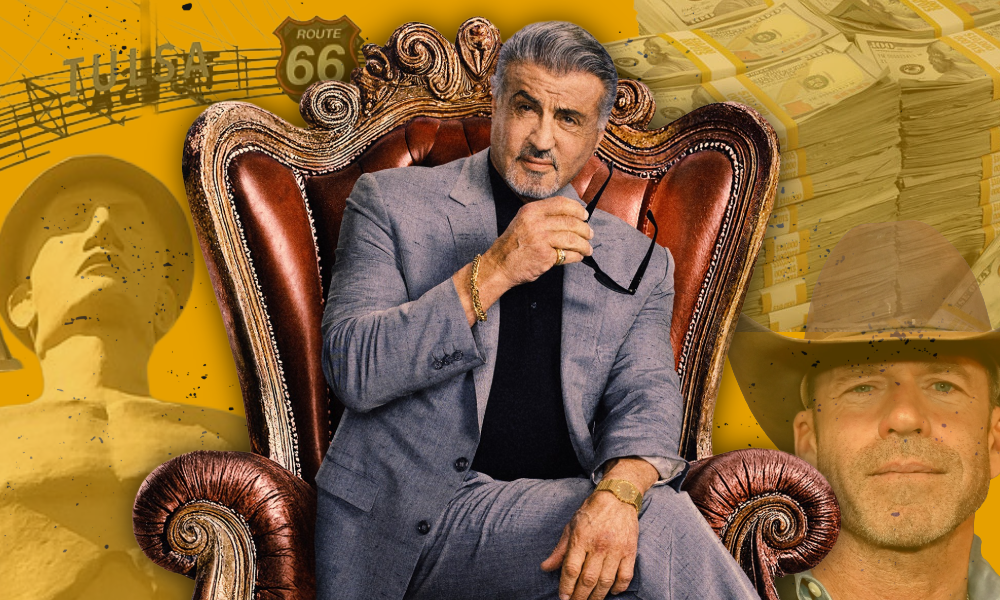
Tulsa King begins by introducing us to Dwight “The General” Manfredi (Sylvester Stallone), a former mob capo who is fresh out of prison and clearly dismayed by modernity. In his first appearance, we see Dwight shaking his head as young people ride scooters, do Soulcycle and use virtual reality headsets.4 Oh, the humanity!

Dwight’s coming off a 25-year bit, which he spent gaining virtue by reading Middlemarch and not ratting out his associates.5 For his dedication to the cause, Dwight is assigned to go to Tulsa by the boss of the New York Invernizzi crime family and start doing organized crime there, as if we didn’t have it already.
Dwight arrives at the airport, and here I’ll admit a genuine thrill at seeing our real airport depicted: Hey, I’ve been there, too! But the thrill did not last, as it was soon undercut by a shot of Oklahoma City’s farmer’s market building later in the episode.
This choice to shoot Tulsa King in Tulsa and Oklahoma City created a bizarre pastiche and produced in me—a person who has lived for years in both cities and travels regularly on I-44 to visit friends and family—an effect of whiplash. There’s a particularly egregious shot/reverse shot that still lives in my head: Dwight, standing in front of Tulsa’s Mayo Hotel, talks face-to-face with his driver Tyson (Jay Will), who’s standing in front of the Civic Center courtyard in Oklahoma City. Tulsa King viewers who’ve never been here must think our downtown buildings each have a big, beautiful front yard instead of big, open parking lots.
Pastiche can dazzle when it works6 but it requires the steady hand of an auteur7 and more than a little creative chutzpah, neither of which is Sheridan’s calling card. But the premise that Oklahoma City could stand in for Tulsa betrays an ignorance of both cities’ history and architecture, and I don’t buy that the show’s producers were intentionally aiming for pastiche at all. It comes across as sloppy, not imaginative.
Freshly equipped with a driver, Dwight proceeds to assemble his team of misfit Tulsa toys by intimidating a weed shop owner named Bodhi (Martin Starr) and forcing him into a protection deal. Dwight settles into his room at the Mayo, where he winds up in bed with a woman named Stacy (Andrea Savage), who is smart enough to work for the ATF and yet needs him to explain what the word “idiom” means. I wish I was making that up.
It’s at this point that I notice how weirdly cast Sylvester Stallone is. As of publication, he’s 79 years old. His stodgy gait and mushmouth pronunciation bring the color and east coast Italian gangster authenticity to Dwight, but these qualities clash horribly with Sheridan’s petty Texas libertarianism: Why does this formerly incarcerated mob lieutenant constantly gripe about clerks, administrators and bureaucrats? He lumbers through the series attracting younger women and dispensing wisdom from Machiavelli and Patton, a GILF-status Frankenstein of ideas better articulated in characters like Tony Soprano, Nucky Thompson, Walter White and Mags Bennett.
Dwight negotiates a better deal with Bodhi’s weed producer by showing up to the farm, where he gets stoned with Jimmy the Creek8 (Glen Gould), a point where the writer’s room does deserve a little credit. Sheridan strikes me as a good technical fiction writer of the chapter-novel variety, who has the instinct to move his characters around and show what’s going on inside their heads9 by putting them in unusual or counterintuitive situations. For instance, we learn that Dwight loves The Rolling Stones, which is confusing. Is he supposed to be a prissy throwback nostalgic for Sinatra and the old country? Or just a regular white boomer?10
We return to the Mayo, where Dwight looks up11 his estranged daughter, initiating a family reunification subplot I found borderline unwatchable. She hangs up on him and he walks12 to the Center of the Universe at night to lament. In another scene shot at the Center, Dwight’s offer of free cash is refused by a panhandler (an experience I have to say is unique to my years working at an office nearby). This is a writing tic of Sheridan’s: In his world, the poor are these magical, blameless people who always seem to be helping the hero along on their journey. Similarly, small towns like Tulsa are mythologized as authentic, real places where—as Benecio del Toro’s character says in Sicario—”the rule of law still exists.” Of course this is ridiculous—Sheridan wants the rule of law without a robust bureaucracy—and so Dwight’s decamping of New York City for Tulsa is totally shambolic.

Here—just a few episodes into the first season—is where I abandoned hope of any compelling regional specificity or idiosyncratic fun from Tulsa King. Maybe I was expecting too much from a crime soap for dumb guys, but I don’t think so. Other series have pulled it off: look at Justified, which captured lightning in a bottle for FX in the 2010s by taking on Harlan County, Kentucky’s whole mythology of coal mining, labor struggle, meth dealing, bootlegging and end-times Christianity.
Stay in touch
Sign up for The Talegate, our free weekly newsletter
Take for instance Mags Bennett, the many-layered villain from Justified’s second season who’s played expertly by Margo Martindale.13 Like Dwight, she’s a manipulative outlaw and a kingpin (queenpin?) with a unique idea of what constitutes justice. She isn’t the show’s protagonist, but she’s just as shrewd and ruthless as Dwight in her business dealings, and deceptive enough to stay ahead of law enforcement and keep her marijuana grow operation thriving. Her family’s lore and connection to the land of Harlan County bring a color to the show that Tulsa King lacks.
There’s similarly ripe storytelling fodder here in Tulsa that Tulsa King either mentions in passing, misunderstands or flatly ignores: tribal sovereignty, the destruction of north Tulsa, women’s incarceration, end-times Christianity. Instead we get a lot of gangster machismo cliché and Sylvester Stallone resembling a tenderized steak. There’s definitely still an opportunity for somebody out there—prayers up for The Lowdown—to do a Tulsa show that uses this real Tulsa stuff in its characters’ backstories, plot and setting.
But for now we’re stuck with Tulsa King, where the acting isn’t particularly inspired and no visual style emerges. Set design and set decoration budgets appear to be minimal. The lighting is even, consistent and professional, but little more than that. The plot doesn’t hold us in any real tension or rise to any real climax, unless you consider grown men jabbing their fingers into each other’s chests and threatening each other climactic.
And while the show was meant to be a lighter, funnier accompaniment to Yellowstone, its humor comes with a cruel streak, punching at the audience’s cultural enemies without aim or power. Mostly the targets of these jokes are the aforementioned clerks, administrators and office bureaucrats, but occasionally Tulsa King aims downward. In one scene late in the first season, one of Dwight’s henchmen, Manny, comments on the Art Deco style of Oklahoma City’s Santa Fe train station, saying “My wife, Clara, she knows all about this shit, she took design classes … fuckin’ waste of money, she works at Walmart now.” It’s cheap and rude, and shows Manny as boorish and dull. It also raises the question of why state boosters would want to work with a Taylor Sheridan production when it holds our beloved architectural style—not to mention women and education—needlessly in contempt.
The only thing the show really seems to take any joy in is the occasional act of violence. One season, Dwight and the boys dispense rough justice to bikers at the fair, soundtracked to “War” by Edwin Starr; the next season they’re beating up Chinese weed protection guys to Golden Earring’s “Radar Love.” Both seasons end with bloody conflict that exacts no toll on Dwight or his men.
And to read even more closely, a particular word, “interloper,” caught my attention, in an episode written by Terence Winter. A rival mob boss uses it to little effect, but it popped for me because it has more syllables than the typical word in a Tulsa King script, and, as I quickly confirmed with a pair of Google searches, I had heard “interloper” in a Winter script before. A powerful politician played by James Cromwell calmly uses it to put Steve Buscemi’s Atlantic City bootlegger Nucky Thompson on his back foot in “The Pony,” one of the best episodes of Winter’s HBO show Boardwalk Empire. Nucky, humiliated, repeats it later in a moment of rage, revealing just how badly this dismissal hurt him. What Winter used expertly in Boardwalk sticks out like a sore thumb in Tulsa King.
“If You Were Dyin’, You’d Already Be Dead!”
Plot-wise, plenty else happens over the course of the show, and it’s mostly very boring. Later in the first season, Dwight and the guys bury a biker’s body outside what looks like the abandoned Evans-Fintube site. Dwight’s girlfriend Stacy leaks it to him that the FBI is on his trail in a scene that I’m pretty sure takes place at Dust Bowl in OKC. A baffling subplot with a possibly magical horse recurs on the street outside Coracle Coffee in downtown Tulsa. Dwight and Bodhi start selling nitrous to teenagers at the state fair, running afoul of a skinhead biker gang that’s attracted the attention of the ATF, where his girlfriend works. This sets up the “climactic” final confrontation of the first season, and Dwight’s gang prevails.
One way you know you’re on a bad TV show is when something you say outside of the show becomes the most famous line. Sylvester Stallone did exactly that with "Being in Oklahoma has definitely prepared me for a lifetime in hell if I ever got sent there!" before production of Tulsa King moved to Atlanta for season two.

And so while the OKC-Tulsa pastiche disappeared, it was replaced by the thinnest shred of regional specificity: familiar Tulsa drone footage B-roll. We see establishing shots of the Mayo Hotel sign, Riverside Drive, the downtown skyline, westside oil refineries, only to see the shows’ stars in otherwise generic settings, with Atlanta posing as Tulsa.
So, sure: Tulsa King establishes no Tulsa mise en scène and tries to pack more into its protagonist than Sylvester Stallone (or any other actor) can bear. But what about the other characters who work for Dwight? Every mob don needs a crew, after all, and a deep bench of supporting personalities can carry a show that’s weak in other ways. One of the many strengths of The Sopranos, for instance, was how uniquely funny, complicated and duplicitous the guys in Tony Sopranos’ crew were.
That is not the case here, as Dwight’s associates all act and sound more or less like slightly different versions of him. Bodhi helps Dwight expand the weed operation into wind production and also dabbles in NFTs and cryptocurrencies. Tyson’s association with Dwight endangers his own family. An Invernizzi lieutenant, Goodie (Chris Caldovino), defects to Tulsa. Mitch (Garrett Hedlund), a bartender down on his luck, helps Dwight navigate the local landscape. Dwight’s daughter warms back up to him, and a sister joins them in Tulsa by season two, part of a theme of coastal expats enjoying Tulsa’s lower cost of living and bigger homes. But Tulsa King ultimately gives a lot of its screen time to that boorish ranchhand, Manny.
Like Dwight, Manny is a former mobster seeking a new life in Tulsa. He lives in midtown with his wife and kids in a modest house whose lawn gets pooped on by his neighbor’s dog. Eventually Manny’s wife initiates divorce proceedings against him, making Manny a more direct stand-in for a considerable subset of Tulsa King’s audience.
Thinking Dwight’s been sent to Tulsa to kill him, Manny targets him first but fails, instead wounding Dwight’s driver’s ed teacher, which prompts Stallone to shout one of the goofiest lines in the whole series: “If you were dyin’, you’d already be dead!” Dwight tracks Manny down and presses him into the service of his growing crime enterprise, which now has a headquarters at a roadhouse called the Bred 2 Buck. They drink whiskey and talk about their problems in the warm, dusky barlight. This is where the guys get to be the guys.
But much like Stallone’s lurching presence, there’s something off here. The guys don’t do what average middle class men do in American bars, like watch sports all the time and bet money away on DraftKings. I guess the realism would’ve been too much. Instead they use their time at the Bred 2 Buck listening to Dwight as he plots how to expand his operations and opines on how much better things were in some earlier age when men were allowed to be men. In other words, the Bred 2 Buck is their safe space.
It’s moments like these that the show whimpers when it could roar. Dwight is supposedly a Great Man who brings an antiheroic order to chaos, like Nucky Thompson. But far from overcoming hardships or gaining solidarity with his friends and family through suffering, he simply avoids consequences of any kind. And for all the celebration of his genius, we never see Dwight do any productive labor. Mostly, he gets driven around, makes business deals and tells his henchmen to dispose of the bodies of his enemies. His tragic flaw is that he’s greedy, but we never see his greed truly backfire on him.
The second season14 of the show is built around Dwight’s burgeoning Tulsa empire and its attendant growing pains, as well as the men who vie for his attention and favor.15 Tyson dresses more like him, a hierarchy in the crew emerges, Mitch kindles a relationship with Dwight’s daughter, and rival crime lords begin to circle.
Dwight indeed becomes the Tulsa King, but his kingdom is a kingdom without character, built without sacrifice. It could’ve been in Little Rock or Kansas City or Tucson. Unfortunately for us, it’s in Tulsa.
If millions of people are out there streaming Tulsa King, they’re probably getting a pretty weird impression of Tulsa, which calls into question the real value of the dollars its production brought in. Mostly they probably don’t think much about our city at all. It’s a generic backdrop for Sylvester Stallone to stand in front of when he’s pretending to be James Gandolfini, after all.
Footnotes
- Perhaps to pay for an expensive ranch in Texas?Return to content at reference 1↩
- Not gonna lie – I love this shit.Return to content at reference 2↩
- Credit is due to The Watchmen here, a just-okay TV show that at least put some effort into its reading of Tulsa history.Return to content at reference 3↩
- On second thought, I’m with Dwight on the headsets. Those things look stupid as hell.Return to content at reference 4↩
- I’m calling bullshit on this one. You don’t have to read far into the history of organized crime in America to learn that guys like Dwight squeal on each other about as often as they take their morning coffee.Return to content at reference 5↩
- See Wes Anderson’s delightful Asteroid City, where he built retro-future Americana sets in the Spanish desert and called it Nevada.Return to content at reference 6↩
- Speaking of which—holy shit, have you guys seen Eddington?Return to content at reference 7↩
- Admittedly, a pretty good name for an Indigenous weed farmer in a show made for old white guys.Return to content at reference 8↩
- I use the plural here generously, as it’s mostly just Dwight whose interior ever gets considered in this show.Return to content at reference 9↩
- The following season, Dwight requests that a band play Bobby Darin’s “Mack The Knife,” which I find much more believable for a 75-year-old member of the Italian mafia.Return to content at reference 10↩
- He sure seems pretty confident using a laptop for a septuagenarian who’s been in high-security prison for the last 25 years!Return to content at reference 11↩
- Hey, at least part of Tulsa’s walkable!Return to content at reference 12↩
- Martindale won a Primetime Emmy for the role.Return to content at reference 13↩
- To be fair to the Tulsa King writer's room, one of my favorite jokes from the series showed up late in the second season, which was an Indian elder pronouncing Stallone's character name, Dwight Manfredi, as "Da White Man Freddy." I find that inability to resist a dad joke charming.Return to content at reference 14↩
- Shoutout also to local actor Josh Fadem, who has a scene at the very end of season one where he tells a couple of investigators to jump into Lake Yahola. I would’ve written it as the Arkansas River instead, but nobody asked my opinion.Return to content at reference 15↩


