

Editor's note: Originally published in This Land, Vol. 4 Issue 20. Oct. 15, 2013, Mitch Gilliam goes deep into the world of "Weird" Al Yankovic's 1988 film UHF. Shot in Tulsa and comprised of a vast majority of Okie talent, the film, like Al himself, has created a devoted cult following since its release. The burning question remains however – Why the hell did he choose to make this in Tulsa?
“You don’t know what life before Al was like,” said my longtime co-worker Kevin “Okie” Okey. He’s delivered pizza from the downtown Tulsa Mazzio’s since it was a Pizzettis, “since Alapalooza and before Bad Hair Day,” he said. That’s 20 years, for the uninitiated.
Okey is right; I can’t imagine life before Weird Al. For me—and many others—Al is, has, and always will be around. He’s the guy with the goofy versions of pop songs. He’s the guy with the hair and the accordion. Weird Al Yankovic is as American as Cheez Whiz on a hot dog in a Twinkie. I don’t know how life before Al felt, but Okey remembers accepting him into his. “I saw the video for ‘Eat It’ first,” he recalls. “Nickelodeon was airing Turkey TV at the time, and I remember seeing more of his videos on there. When ‘Dare To Be Stupid’ came out, I thought, wow, I need to get into this guy.” There may be crazier fans, but Okey was my hierophant to the world of Al.
Before I met Okey I didn’t know there are people who listen to comedy rock 90 percent of the time. He may be among the less fervent, but his overall existence is Yankovician in itself. He has heterochromatic eyes, practices Fushigi, and married a woman with the same first and middle name as his sister. He’s a homunculus of the Weird Alchemist, a thoughtform made flesh through pure wacky willpower. “There will be two Elizabeth Anne Okeys at Weird Al’s anniversary show,” he proudly told me.
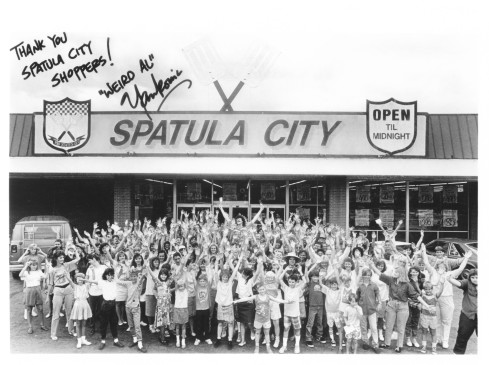
UHF, Weird Al’s only feature film, was shot in Tulsa in 1988. It’s a goofball movie with characters as odd and endearing as Okey. A love letter to public access television and social outcasts, it follows a barely there “band together and save our ship” narrative over a UHF station, U-62. Cowritten by Al and manager/director Jay Levey, it bombed at the box office, but became a cult hit. More acclaimed films may have been shot in Tulsa, but none of them have UHF’s ring of Dadaist documentary edge. Kevin Okeys are still buying whoopee cushions and writing Klingon versions of “Who’s on First.”
Specters from the shoot permeate Tulsa. Poodles fly from an apartment by Okey’s Mazzio’s. Al flies from Billy Ray’s BBQ on east 15th street. Karate students fly from the windows above Downtown Lounge. From U-62’s antenna near Sand Springs to Ernie Miller Pontiac by 41st and Memorial, nearly all of Tulsa is humorously haunted. Even mundane locations seem important to Al. He rattles off every address on the DVD commentary, allowing the less astute to make the UHF pilgrimage of the pious. Tulsans pick out locations when they watch the film, but some realize they’re watching them from the inside.
“We were watching UHF at the 401 Club when we realized the room we were sitting in was Al’s apartment,” said Jeff Pierce, the defunct punk venue’s owner. But why Tulsa? The answer to that is innocuous enough: convenience. Tulsa’s half-vacant Kensington Galleria was a mall/hotel that the crew could film and sleep in. Executive Producer Gray Frederickson acknowledged the facility’s importance to me. But then there was the niceness.
“I have a story I tell folks in Hollywood,” Frederickson told me. On The Outsiders, which he also produced, Frederickson had a run-in with the Teamsters Union. Francis Ford Coppola had cut half of their trucks from the production, and the head of the Tulsa Teamsters at the time, Coleman Davis, confronted Frederickson. “He was gonna fight. He pulled out his front teeth and put them in his pocket,” remembered Frederickson. They came to an agreement, but Frederickson avoided the union altogether when he returned to Tulsa for UHF. The first day of filming was sweltering, and had the crew working outdoors. Frederickson spied Davis approach, and the union boss let him know he was standing in front of the Teamsters’ hall. Frederickson thought Davis would pull out his teeth again, but Davis invited the crew out of the heat instead. The nonunion group ate lunch in unionized air conditioning, and Davis was given a part in the film.