


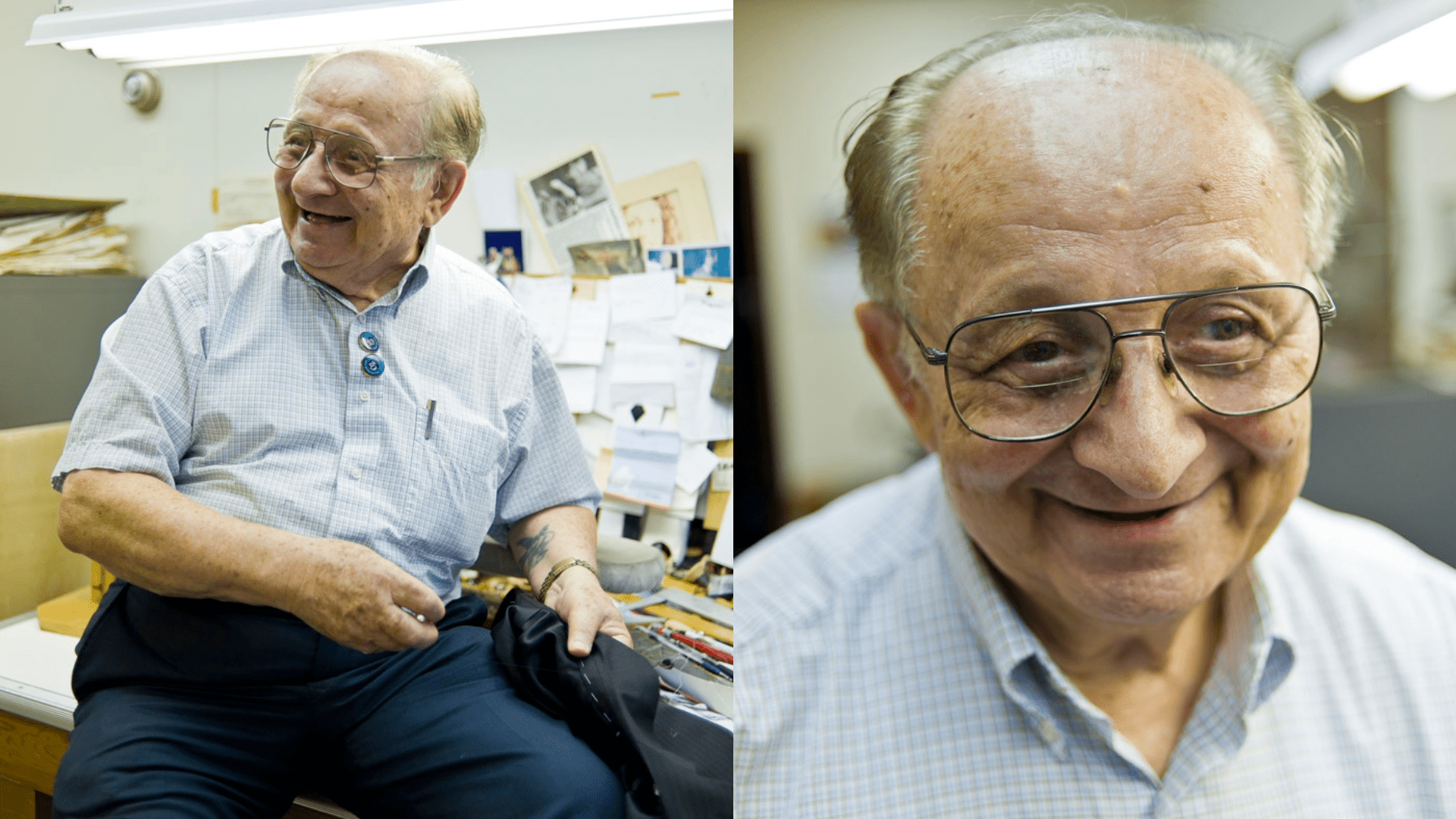
Editor's note: Sherman Ray's tailoring skills saved his life. Originally published in the January 15, 2012 issue of This Land, Michael Berglund's stunning profile of Ray, a Polish Jew who survived the Holocaust, is the story of an ordinary man braving extraordinary circumstances.
When I walk into Ray’s Tailor Shop, I immediately notice the ordered disorder of the two-room store. Directly in front of me, too near the front door, sits a table stacked with files and mail and a small radio propped up on a box. Towards the back of the room, I see a fabric-draped Singer sewing machine, circa 1950--the first sewing machine, I later learn, that Sherman Ray purchased when he arrived in Oklahoma City from Germany. Next to the changing room, a small step stool is positioned between three large mirrors. The last table I see is loaded with scraps of tweed, herringbone, and different varieties of worsted wools. And sitting on the table, in the middle of the material, is Ray, who when I enter is negotiating a thimble and needle to add a scrap of cashmere to a blazer.
He runs the thimbled hand over impeccably slicked back hair and looks me over through large-framed glasses that magnify his eyes, which knowingly search for details that often go unnoticed in casual conversation: Does one shoulder hang slightly lower than the other? Does my neck crane forward to make my spine curve? Does a 30-year habit of standing into my left hip make the left leg slightly shorter? All of this occurs instantaneously as I introduce myself. He’s not sizing me up for a mano a mano fistfight. He’s measuring me.
I tell him that I’d like to have a suit tailor-made and that I was interested in gray tweed or a suit with a similar texture. He tells me that he stopped building suits because of the amount of energy it takes, but he’d be happy to alter a suit for me. He chuckles and riffles through a manila folder full of photos, newspaper articles, letters, and trinkets. Ray pulls out artifacts that show me the man he has become: champion weightlifter, avid rower, accomplished tailor.
“I’ll tailor the suit so good for you, it’ll fit you like a glove,” Ray says in a thick Polish accent.
I ask him what kind of suit I should get and he sets down his folder and takes his measuring tape from around his neck and guides me so that my back is facing him.
“Drop your arms,” he says. He measures me with lightning speed. “42 is too tight, and 43 they don’t make. You’ll have to go to a 44. 44 might be a little bit too large but it’ll have to be tailored.”
He grabs my hand and energetically guides me to the stepstool in front of the mirrors. He checks my inseam and then whips the tape around my waist. “You need about a 351⁄2 or 36 pant. Don’t get 34, 36 on the pants. Go to Woodland. Then tell them, ‘I will buy it but I will take to my tailor for approval.’ See, when you cut it up then you cannot take it back. Then just come over. I’m always open.”