

The Pickup's Arts & Culture coverage is supported by Brut Hotel, featuring a rooftop VIP after party for Tulsa Irish Fest on March 14.
When Tom McCarthy isn’t giving tours as a docent for the Tulsa Foundation for Architecture (TFA) or featuring in their new series of Instagram Reels documenting Tulsa buildings, he’s probably reading about Bruce Goff. The retired newsman who worked for the LA Times and Associated Press, among others, has recently been researching Goff for his volunteer work with TFA. “They asked me to dig into him and report back on what I found,” he told me, “And I’ve never been heard from since.” I met McCarthy in the Lobby of the Tulsa Club Hotel to learn what he had found.
Z.B. Reeves: What about the Tulsa Club makes it a Bruce Goff?
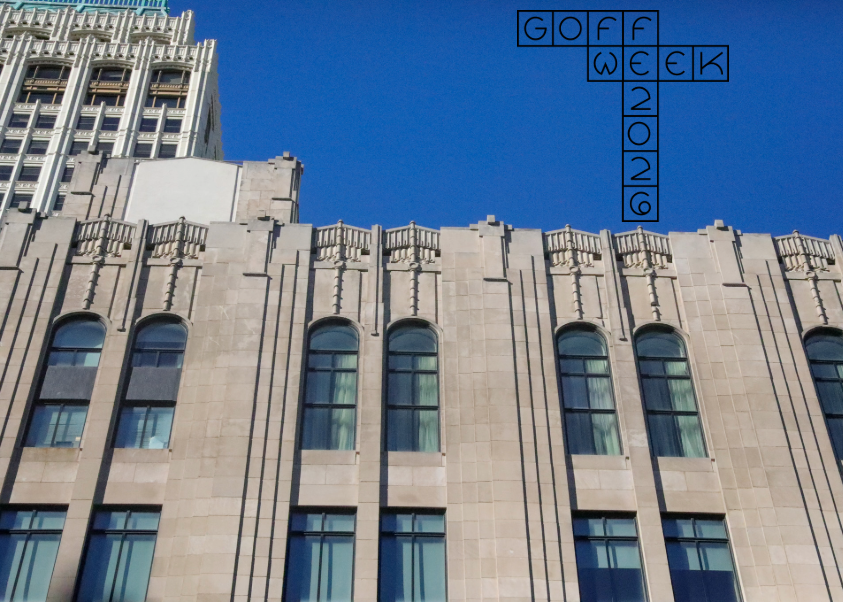
Tom McCarthy: Goff designed this building and it was completed at the end of 1927; it was a sensation. There was nothing in Tulsa like it. He designed it in a style that was very modern at the time.
It wasn’t a hotel at the time. It was the offices of the Chamber of Commerce and the Tulsa Club, which was a businessmens’ organization and athletic club, sort of like the Harvard Club in New York, you know, where men could sit around and smoke cigars.
If you look around Tulsa and look at most of the other buildings that were built in the mid-20s, those traditional classical and historical styles, [Tulsa Club] was one of the rare ones and the big ones that was not [done in that style]. It looked very different.
But in the 1950s, architectural tastes changed. Mid-century modern came roaring in. Everything that was designed in the style of the Roaring Twenties was considered old-fashioned, so [it] was redecorated. They completely changed it, but there were some facets of it that remained.
Tulsa’s oil economy tanked in the 1980s, and this building closed in 1994, and was vacant for 20 years. And what happens to vacant office buildings happened here: People started living in here, starting fires in the winter. It was ravaged, looked like it was going to have to be demolished. But in 2014, it was bought by a local development company, who restored it, and they did a marvelous job.
What they restored was heavily damaged. A lot of what survived was the midcentury modern stuff, and they did go to some trouble to restore some of Goff’s most individualistic aspects.
This building, as he designed it, was really Goff coming into his own, developing a style that would later make him famous.
McCarthy shows me the photographs framed in the hallway of the Tulsa Club’s lobby, pointing out a picture of Tulsa Club next to Philtower.
TM: So, these were built pretty much at the same time. [Philtower] is built in a very classical style—it’s beautifully classical; it’s Gothic. [Tulsa Club] is [in] a style from the 1920’s. And Goff’s version of it would have been quite striking for what it did not have on it. He was doing things that were unusual and remarkable here—things that became, to this day, features of Tulsa that many from that period don’t have.
He’s a very young man at this time; he’s in his early twenties. He had very much bought into the idea that American architecture should be American. It was foolish and inappropriate to be copying ancient Greece and Rome and London and Paris. America was its own place with different people, different climates, a different setting. This was a mature country. The United States should have its own architecture.
He pursued this idea, this genre, called “organic architecture.” If you look at some of these classical buildings, they’re designed to be set anywhere you would set them. Some of these Beaux-Arts [a French style from the 1800s] around here, they look just like buildings in Rome or Paris. Goff did not believe in that. He believed that every building should be original, because every setting was original, and that buildings should grow out of the place they are, and reflect the people who own them and the culture of the time.
ZBR: How did Bruce Goff come to be in Tulsa? He was born in a small farm town in Kansas, yes?
TM: Yep. They move around a bunch. He arrives here when he’s in sixth grade. His father’s not that big into employment, but he notices his kid has drawing talent. Goff was at what was Lincoln Elementary School, now a little restaurant complex on 15th Street. [His dad] decides to take his kid to an architectural firm, seeing if he could intern there, and maybe get some value out of it.
And the architecture firm, Rush, Endicott and Rush, which is one of the more formidable ones here, agrees to take him. Tulsa is growing—at this time it’s the fastest growing city in the country; buildings are going up everywhere. So they decide, sure, we’ll find something for him to do. And they park him next to a draftsman.
Before long, his talent becomes apparent to them. He’s writing to Frank Lloyd Wright; he’s writing to Louis Sullivan, who’s another famous Chicago-based architect. And Rush, Endicott, and Rush, their chief business is doing big commercial buildings. But there’s a terrible shortage of housing here. So this kid who looks like he’s pretty good, they start giving him house commissions.
Stay in touch
Sign up for our free newsletter, The Talegate
At this point he’s in high school, and after school every day he would come over and design houses. People liked them, and they started approving them and building them. At the age of 14, he started designing houses that stand in this city today.
By 1925, he’s gone even beyond that. He’s the most creative, most talented designer at this architectural firm, and they start having him submit their entries in design competitions for commissions. In 1922, which is the year he graduated from high school, he wins a competition to design the new Chamber of Commerce building.
The Chamber wanted its own building. They had been staying in other places. But that building doesn’t end up being built, because they wind up getting together after a while with this Tulsa club, which is a men’s business club: affluent guys who want to hang out and talk business and stuff like that. And so they decide to go in together on a larger building. They come back to [Goff] and say, well, we want a bigger building, not like the smaller one that you designed before.
And this is what he does. Now, this is tricky. [It’s the] Chamber of Commerce—a bunch of oilmen, mostly. And [Goff] is very original. So he sells them on the idea that, [since] this is the roaring twenties—1925 at this point—[their] building should stand out. It should embody the spirit of this city, which is not like other cities. He convinces them that that’s the way to do it, but he doesn’t want to overdo it and lose the commission.
So the exterior of the building is different, but it’s mostly different for what it doesn’t have. It doesn't have all of the classical ornamentation. It doesn’t look like the Louvre; it doesn’t look like Versailles; it doesn’t look like any cathedral in London. But he goes a little nuts on the inside.
[This ballroom is in] hotel colors right now. [But when it was built,] the colors he was working in were mostly violet, green, and gold. These were the primary colors of an Austrian painter he liked.
You’ll notice there are no busts here. There’s nothing representational. There are no pictures. Everything is abstract, and everything is moving. Lines everywhere. And angles everywhere. You wouldn’t have that in a normal building.
When the Ross Group bought this place as a wreck, they decided to replicate this particular [ballroom]; they decided that it would work with the hotel that was going to be here. So they went to a lot of trouble to make it look like this.
You’ll notice angles all over the place. It’s got sort of a Native American feel; you’ve got these wiggling lines coming down the side. It’s very art nouveau: sinuous, like plants, or snakes. You’ll notice hexagons, triangles, zigzags.
ZBR: Is all of this the original Goff? Or did they remake it?
TM: This was all ruins; there were two big fires in here. But they had some remnants of it, and there were photographs. So they paid a company to build panels like this. So these were crafted in a factory, but, I mean, they’re dead-on. They’re exactly what they looked like.
So this is very much Bruce Goff. You’ve got abstract art. Lines everywhere.
Goff was very disciplined about what he wanted to do. He wanted every building to have an idea. And the idea of this building is Tulsa, 1920. And we wanted everything in it to essentially work with that idea. So it’s very unified. You’ll notice the arches on the left sort of match [the arches on the right].
[Most people] don’t pick this kind of stuff apart, necessarily. But it provides a certain kind of feel. You come in here and it has the grandeur of a ballroom. But it doesn’t look like the Waldorf Astoria in New York. This is kind of Tulsa, you know? He had things like that all over the hotel. Now, there are bits and pieces of them left, and some of them are in guest rooms.
So, all of us architecture nerds would love to have the original Goff [building] back. But the fact that this building survives at all, and that it’s a living building with people coming and going and appreciating it for what it is is still a big win.
It’s kind of funny, though; you talk to people about this, and these other large structures around here, and it’s hard to understand the impact that [Tulsa Club] had in 1927 when it opened. If you go back through newspapers.com, and look at the coverage, there was a big dedication, and there was an over-the-top effusion of reaction. Futuristic, fresh, original, dazzling—look how cool we are! Tulsa loved it, and it had a real cultural impact.
This was branded as “Art Deco,” but that term was not used until quite a bit later. Every new style was called “modern” when it came out. And all of the Art Deco you’ll see in Tulsa is after 1927.
ZBR: So how do we know what all of this looked like when Goff built it?
TM: Goff, fortunately, was a pack rat. He kept everything, and all of his files and archives were given after his death to the Art Institute of Chicago. I’ve been there several times, going through these things, and they have photographs of the rooms. I really wish the hotel people would replicate one of those old rooms and make it a Goff room, so people could see the Bruce Goff who dazzled the world.
Remember, in 1927, this was a tall building. This is an 11-story building, or 10, depending on how you number the floors. 10 story buildings were unusual here.
ZBR: It was a skyscraper.
TM: It was a skyscraper; it was his first skyscraper, one of his few. And he was 21, when he designed this!
He got to be more and more daring because of the positive reaction to this. Think about the Riverside Theatre! People were driving from miles around to see that building; there’s nothing like it.
And increasingly it kind of worked against him. In later decades, people who just wanted something that would be dazzling encouraged him to just come up with anything he could think of. And I think that created an unfair impression that he was just too weird for some people. There’s never been an architect who was more accommodating to residents and customers as him. He wanted buildings to be organic, to look like they fit the environment they were in. And the people who were living there were a big part of that environment. So he wanted it to serve their purposes, and he wanted it to reflect their personalities.
He designed probably more than 500 buildings. Probably 150 of them were built. And that’s not a low number, considering that he was in the Service for a while; he went through the Depression, where nothing was built in the United States; and he was doing work that was out there, on the edge.
ZBR: What does the average Tulsan get wrong about Goff?
TM: I don’t criticize people for [not knowing about Goff]. I do tours that involve important things that happened in the early decades of Oklahoma; everybody who was around then is long dead. And everything that was happening was happening at warp speed. So this was an extremely chaotic situation here. It doesn’t surprise me that somebody’s achievements would disappear.
Now, I grew up in Tulsa. I didn’t know about Bruce Goff until I lived in Chicago. When I told people where I was from, [they’d say], “ah, Bruce Goff; did you see this Goff building? And that Goff building? And his gravestone? I mean, Chicago is more obsessed with architecture than any American city. When the great Chicago fire happened in 1871 and the city was decimated, city leaders wanted to convince the world that they weren’t dead and that there was a great city here. Architects came from all over the world to rebuild the city.
About the time Chicago was built, the teens, this oil boom happens here. And Tulsa not only decides it wants to make a lot of money from oil; it decides it wants to be the capital of this new industry, and it wants to be a big city like Chicago or Kansas City or St. Louis. So there’s this intense marketing effort and pressure to build flashy buildings that make people think this is a capitol. So we have all these famous architects come down from Chicago. And all this cool stuff is happening.
It really stands out because the east coast [at this time] is still stuck in traditional architecture. If you look at the Art Deco that’s in New York, it was all built after our best ones were built here. [Tulsa] was really cutting edge.
When I was living in D.C. when I moved there in 1987, they had the National Architecture Museum. My wife and I walked in there, and there it is: "Terra Cotta City: The Art Deco Of Tulsa, Oklahoma.” I thought, wow, I had no clue about that!
I think inside that rarefied world, we’re known nationally and internationally. But we need to be more known here. It’s almost like a parallel of Route 66—if you talked to people 20 years ago about Route 66 here, how many people would have had any consciousness of it? So I don’t think it’s surprising or negative that a lot of people haven’t heard of him.
Why is he not more famous? I mean, the first famous architect, the “starchitect,” was Frank Lloyd Wright. He was an enormous self-promoter. But architects weren’t somebody that the average person would know. And Goff was soft-spoken, and he wasn’t a big self-promoter, and his designs were more out-there than Wright’s. But he was a fascinating man; his life was fascinating. I just wish I had met him.