


The Pickup's Arts & Culture coverage is supported by Brut Hotel, featuring a rooftop VIP after party for Tulsa Irish Fest on March 14.
Theatre North: “Nat Turner in Jerusalem”
Tulsa Performing Arts Center
February 21, 2026
I sat outside for a long time when I got home from Theatre North’s Nat Turner in Jerusalem last weekend, looking at the stars in a velveteen night sky, the branching silhouette of a winter redbud reaching across it. I was thinking about Nat Turner’s visions, the signs he saw in the trees and the sun that told the preacher to lead a revolt among his enslaved brothers and sisters in 1831, the same elemental forces he calls on even as he sits in a cell awaiting execution in Nathan Alan Davis’ play. I was thinking about faith and obedience, violence and love, truth-telling and storytelling under the shadow of white supremacy. And I was thinking about Tulsa, where narrative control over Black histories has been its own battleground for more than a hundred years.
The Jerusalem in the title of this 2017 two-man play is far from any holy land; it’s in Virginia, where Turner’s successful slave revolt left 55 people dead and the South in a panic. It’s Turner’s last night on earth, and a lawyer named Thomas Gray is coming to the jail to wring out a few more details for The Confessions of Nat Turner, the book he’s set to publish—ideally, details that will raise his own standing (and ensure his financial security) by providing the authorities with information about other slave rebellions Turner might have set in motion. Gray and Turner have talked before, and Turner claims to have no more to tell him; he knows nothing except what he himself was told to do by God, and did. During the play’s razor-sharp 90 minutes, from sunset to sunrise the following day, Turner and Gray are inhabiting the same room, but they operate in realities that do not, maybe cannot, cohere.
The collision between these two characters—parrying, deflecting, insisting, collapsing—takes us further into that dark split. Instead of setting up a duel between straw men, the play invites the audience into a richer question: that of doubt, which carves quietly, like a trickle of water, through the rock of many kinds of faith. For some, it cracks that rock open, exposing the dark places, letting them fill with more light. For others, it signals the need for reinforcement by whatever means necessary. We hear Turner’s doubt right away, in his opening lines, addressed to his own chains, whose clank and clatter in the dark are the first sounds we hear under the sensitive direction of Keith “Sneak” Daniels. (“Have I misread the signs?” Turner asks.) We feel the tension under Gray’s urgency early on, but it takes until the end of the play for his own righteous justification to fall apart.
Davis’ play suggests that the fullness of what happened or may happen as a result of the uprising, even when held in a jail cell or a memory or a book, may ultimately be ungraspable. Who is to be believed, and by whom, and why? But in a play that arguably takes us further into the dark, the streaks of illumination throughout are as irrefutable as the sun through the bars of Turner’s cell.
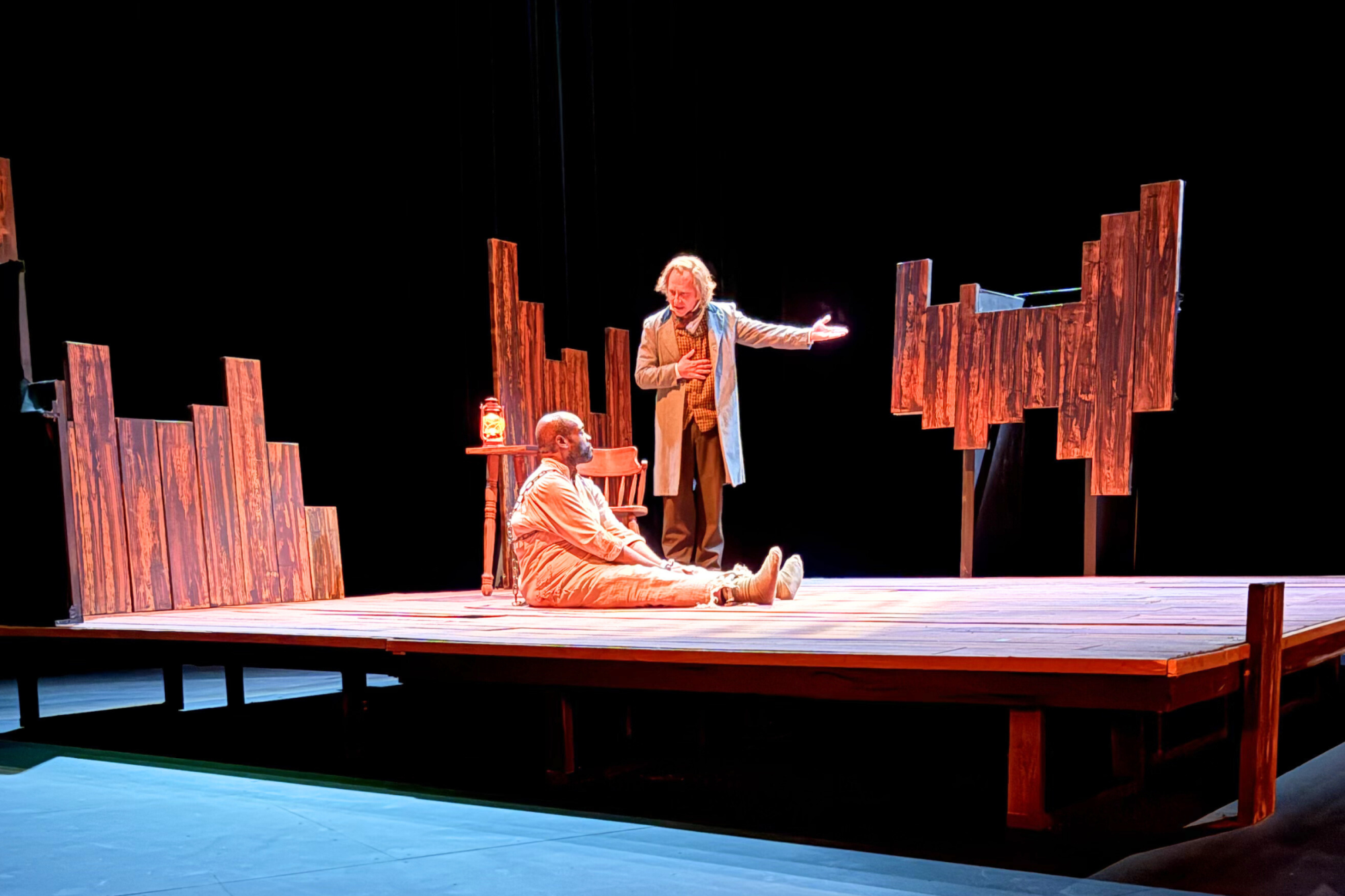
Theatre North’s production allows the audience clear entry into the world of Nat Turner in Jerusalem. The set (designed by Devin Meadows) is a platform of wide wooden planks, its square shape offset 45 degrees, with abbreviated walls rising up from its floor on two sides—a brilliant suggestion of a prison cell that’s open to the sky. Turner repeatedly mentions that sky throughout the play, and the light (designed by Frank Gallagher) is almost another character here, spilling from a window across the floor, diminishing, suffusing a world just out of reach. “I brought a lantern,” says Gray as he enters at dusk in scene one. “It’s dark in here. I blame the sun. It’s always going somewhere. Always on its way to some other place it has to be.” “You’re standing in my sunset,” says Turner, a few beats later.