


Tulsa Ballet: Sleeping Beauty
Tulsa Performing Arts Center
February 15, 2026
If I’m being honest, few things sound more romantic these days than going to sleep for a hundred years and waking up in a forest bower alongside all my friends and family, none of us having acquired a single new wrinkle. The prospect of powering this whole thing down and relaunching in another era—like Aurora in last weekend’s Tulsa Ballet production of Sleeping Beauty, which set me off on this daydream in the first place—is yearn-worthy.
You know the story: Sleeping Beauty’s birthday girl, Aurora, is cursed by a fairy who’s mad about being left off the party guest list; the curse, delivered via knitting spindle, is softened from “death” to “sleep” by the Lilac Fairy; Aurora is awakened by a kiss from a prince; they get married; happy ever after. But there’s a whole archetypal interpretation that makes this more than just a fluffy romantic fantasy tale. What the story’s really about, say the likes of Carl Jung and Marie-Louise von Franz, is a personal or cultural awakening of consciousness; a maturation of passive fragility into active, enduring power; a movement from rose-colored innocence to integration. And you’ve got to go through that liminal, dormant state—chrysalis mode, you might say—to get there.
The ballet Sleeping Beauty itself has time-traveled through a century to arrive here and now, in an age when it’s still being performed by companies around the world. In addition to telling an ancient, deeper-than-it-looks story, it’s also the big kahuna of classical ballet, the apotheosis of the art form’s evolution in the late 19th century. The original production, which premiered in St. Petersburg in 1890, packed in the complete Charles Perrault/Brothers Grimm story as well as characters like Puss in Boots, Tom Thumb, and Little Red Riding Hood—basically a three-act live-action encyclopedia of Europe’s fairy tale lore and ballet’s own triumphs. All of this is threaded together in the warp and weft of Tchaikovsky’s score, festooned with audience-pleasing folk rhythms, character-specific motifs, and stately slow builds that erupt into ecstatic releases.
Weighted with history and folklore and archetypes and Russian music as it is, Sleeping Beauty might sound like it’s ready-made to put you to sleep. But in a rendering as good as Tulsa Ballet’s, it’s both an enchanting spell and an invigorating wake-up call.
Tchaikovsky's prologue starts the journey with what sounds like a lightning storm, which softens into a woodwind breeze and ends with a wall of horns and strings, urgently mounting toward resolution. Tulsa Symphony Orchestra—playing for nearly three hours with unity, clarity, and vigor under conductor Peter Stafford Wilson—was key to the success of this production. Light, dark, boisterous, menacing: they found every color in this glorious score, including the glimmer of “are we really doing this?” anticipation that makes the wedding pas de deux music so special.
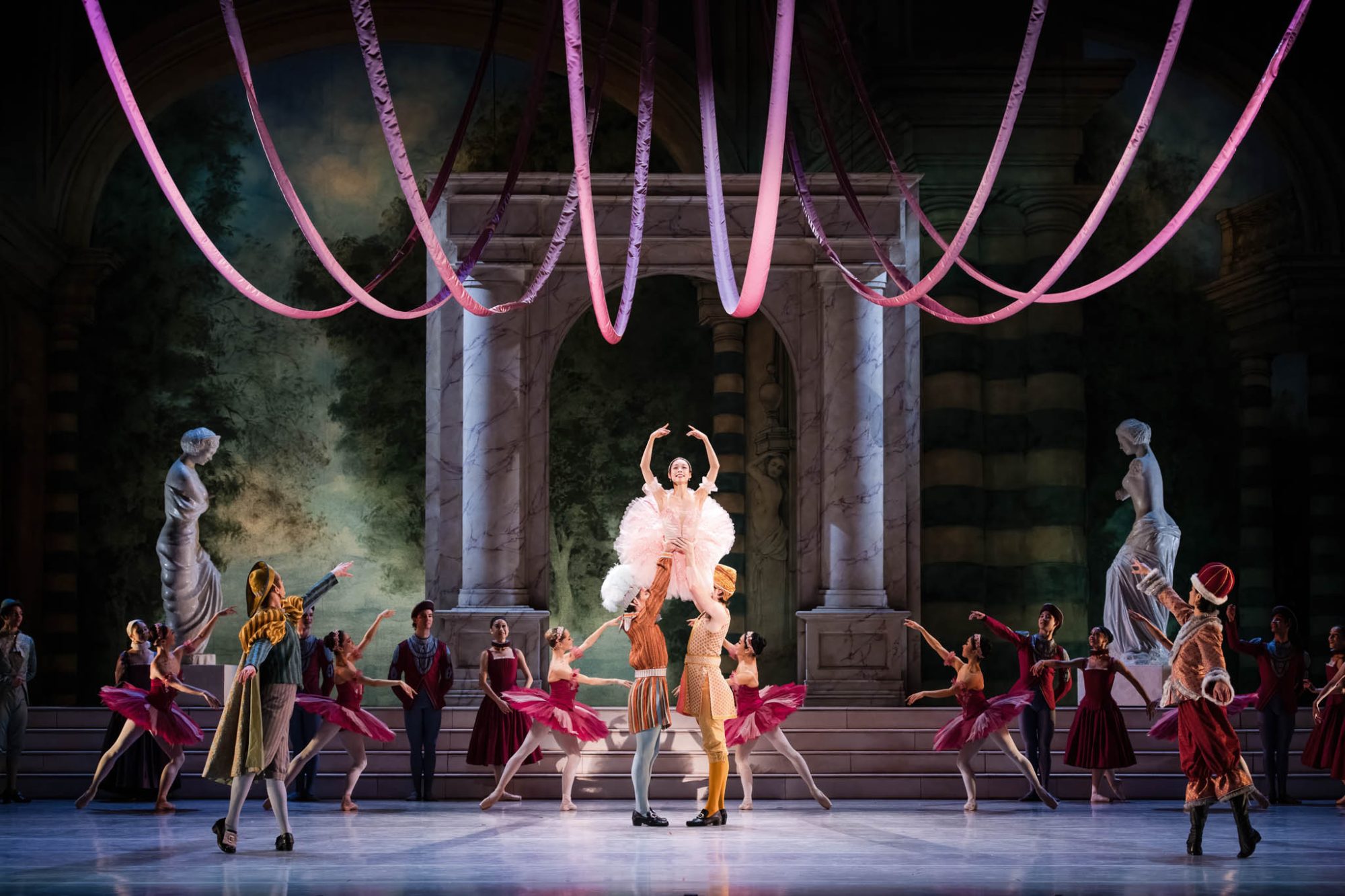
The possibility of transformation ran like a subtle thread throughout Emma Kingsbury’s intelligent designs (custom made for this production), starting with the drawing of a sleeping woman in a rumpled bed that adorned the curtain; Aurora, it suggested, could be any of us. Some Sleeping Beauty productions build out a pastel-heavy candy floss world or coast on familiar 19th-century forms. But this was a realm of folk magic, feathers and shadows, tulle skirts encrusted with gems like gifts from the sea, wide ribbons at the neck, giant draped marble nudes, and colors that met somewhere between Piero della Francesca, Bruegel, and Magritte.