
Menace and beauty, vigilance and innocence, tenderness and terror—Clayton Keyes hit all of these emotional registers in Subterfuge, his recent solo show at 108|Contemporary. Walking through the exhibit, I experienced the same humbling, disarming range of feelings that often hits me when sitting in, say, an Advent service, where hope and joy intermingle with other presences in the room: fear, longing, the specter of death.
With more than a dozen ceramic sculptures that were technically extraordinary and conceptually resonant, Subterfuge considered the ways that religious, political, and corporate powers both manipulate and degrade life on earth—and performed a subtle subterfuge of its own. Spatially arranged so that the gallery’s vast white space became a sort of cathedral, the work never named its villains outright; instead, it explored their methods and mores, while insisting on the dignity of the beings damaged in their wake.
The deliciously unsettling power of Keyes’ work comes in its exposure of the ways in which polarities—good and evil, preservation and decay, the sinister and the precious—often dwell together. Two icons flanked the entrance to the show, setting a gentle yet ominous tone: an infant and a baby deer resting together (“Do Unto Others”), and a young man holding open a gash in his side from which oak leaves and acorns emerged (“Walk Lightly”). Along one wall, a series of panels (“Casual-ties”) hovered over candles like Stations of the Cross—a dead mouse with one paw extending from the panel’s surface, haloed with a whorled roundel; an eagle grasping a snake in its talons; an exquisitely detailed pelican—each punctuated with dowels or jointures whose wood grain made a beautiful counterpoint to the rough clay surfaces. These entrance panels and stations, like the ones in a Catholic church, served as focal points for meditation, inviting viewers to consider the twinned realities of vitality and violence, softness and savagery.
Larger sculptures positioned throughout the center of the space brought these meditations into full-figured—and profoundly moving—action. Keyes makes clay feel alive and urgent, as if it were on the verge of breaking into speech. I heard the voice of watchful caution in the alert body of an owl, whose feathers blended in with the lichen-encrusted textures of the oak branches arranged behind it. I felt the interest and then the panic of a fish and a frog being lured irrevocably toward the prehistoric jaws of a snapping turtle. With one hand shielding his eyes from the sun and the other pointed down towards the earth—a bi-directional gesture that guided the viewer to prepare to consider more than one thing at once—a boy stood like a young prophet in a pool of light, his pajama pants softly wrinkling around his knees, his eyes full of something between dread and trust.
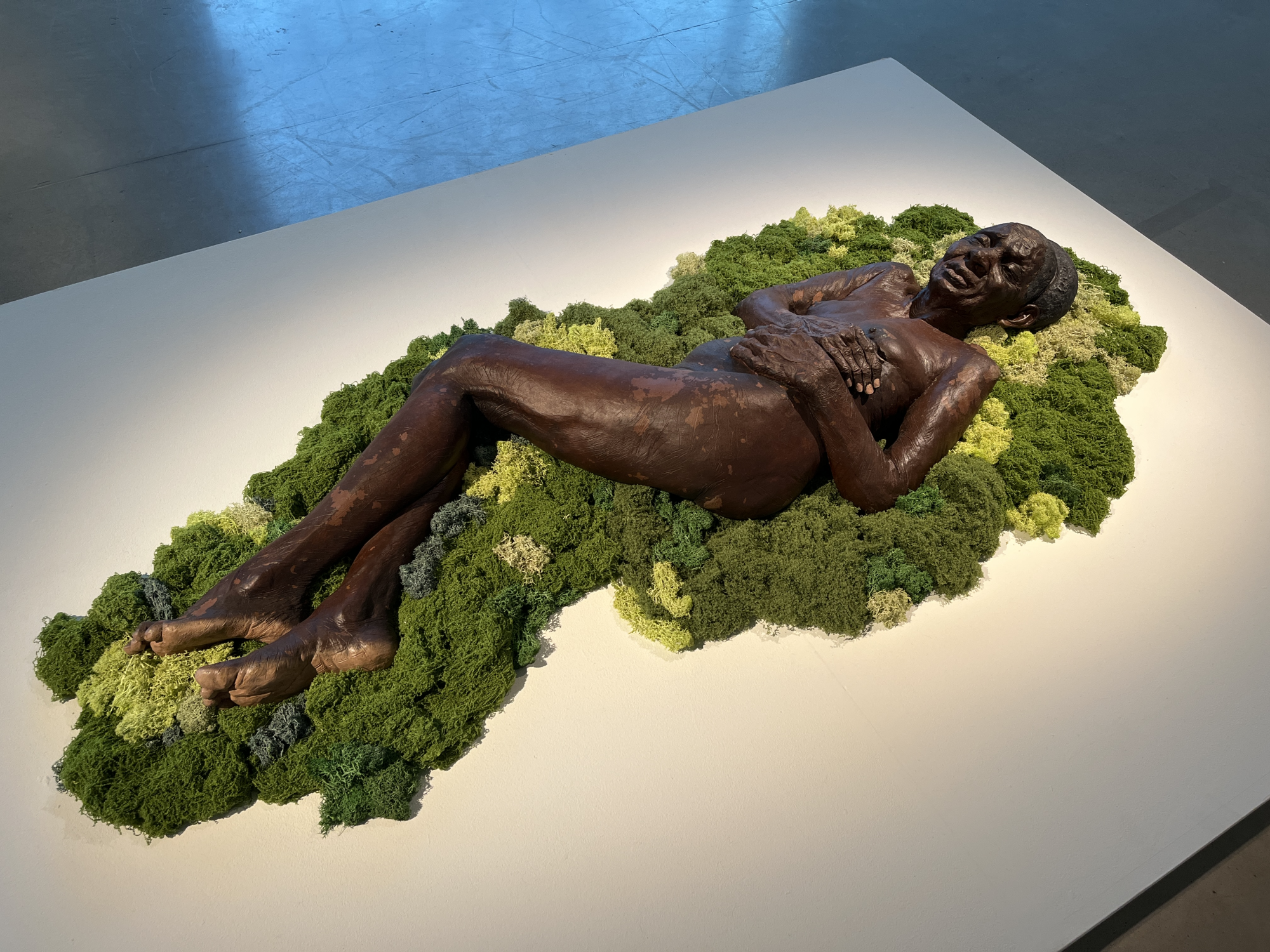
Far behind this boy lay a figure called “Mitochondrial Mother” on a vivid green bed of moss, her skin literally weathered; after sculpting her, Keyes placed her on some friends’ land for several months, and photographs from the weathering process were also part of the exhibition. What does she remember of how humanity has devastated the earth, even as her own body becomes part of it? Far from being coldly conceptual or cringily on-the-nose, this piece and the others in Subterfuge drew the viewer into the realm of flesh and root and bone—into ancient and very present elements that demand our honor.
I wanted to bury my face in the curls of the sculpted lamb’s pelt hanging next to this figure, but could not: it had been sacrificed, splayed head-down on the wall with iron hooks, plus its title (“Pull the Wool and Follow the Leader”) served as a warning. As in most of the works in Subterfuge, many archetypes and art-historical references coursed through this piece, from the Lamb of God to the Golden Fleece, and I enjoyed letting them flood my brain as I stood in front of it. Similarly, the snakes coiling within and around the familiar shape of a rose window—a hallmark of Gothic religious architecture—sent out a plume of suggestions: the sinister note lurking within a symbol of divine order, the promise of regeneration, the luxurious beauty of nature, the venom that waits to kill.
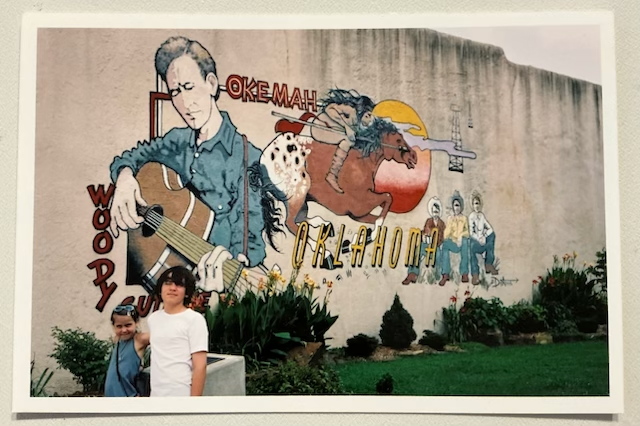
Ironically, the piece that made perhaps the most direct statement in the show—“Big Bad Wolf”—had the strangest real-world journey. Its two mourning doves, delicately tinged with blue and captured in mid-flight, were purchased by Bono when the U2 singer was in Tulsa to receive the Woody Guthrie Prize. Its startlingly elegant and baleful maned wolf, poised to move toward its next kill, was accidentally damaged during a private event in the last week of the exhibit. When I saw Subterfuge on its very last day, only the doves remained, as if forever escaping from something unseen.
Subterfuge presented the viewer with a set of ideas as intricate and compelling as Keyes’ ceramic work itself. Deeply felt and rigorously executed, the show as a whole and each piece within it held both mystery and a kind of frankness, offering the chance to sink into meaning and interpretation or simply stand in awe of the artist’s mastery. Confronting us with the ongoing presence of violence amid the fragile beauty of life, Subterfuge subtly urged us to be more mindful of what’s precious, to watch the mighty with more vigilance, and to recognize the disruptive power that exists in precisely the kind of attention Keyes brought to his work.
Stay in touch
Sign up for The Talegate, our free newsletter<br>Fresh stories delivered every Tuesday and Friday