


The Pickup's Arts & Culture coverage is supported by Brut Hotel, featuring a rooftop VIP after party for Tulsa Irish Fest on March 14.
Roughly Right by Alicia Kelly
108|Contemporary
Through March 21
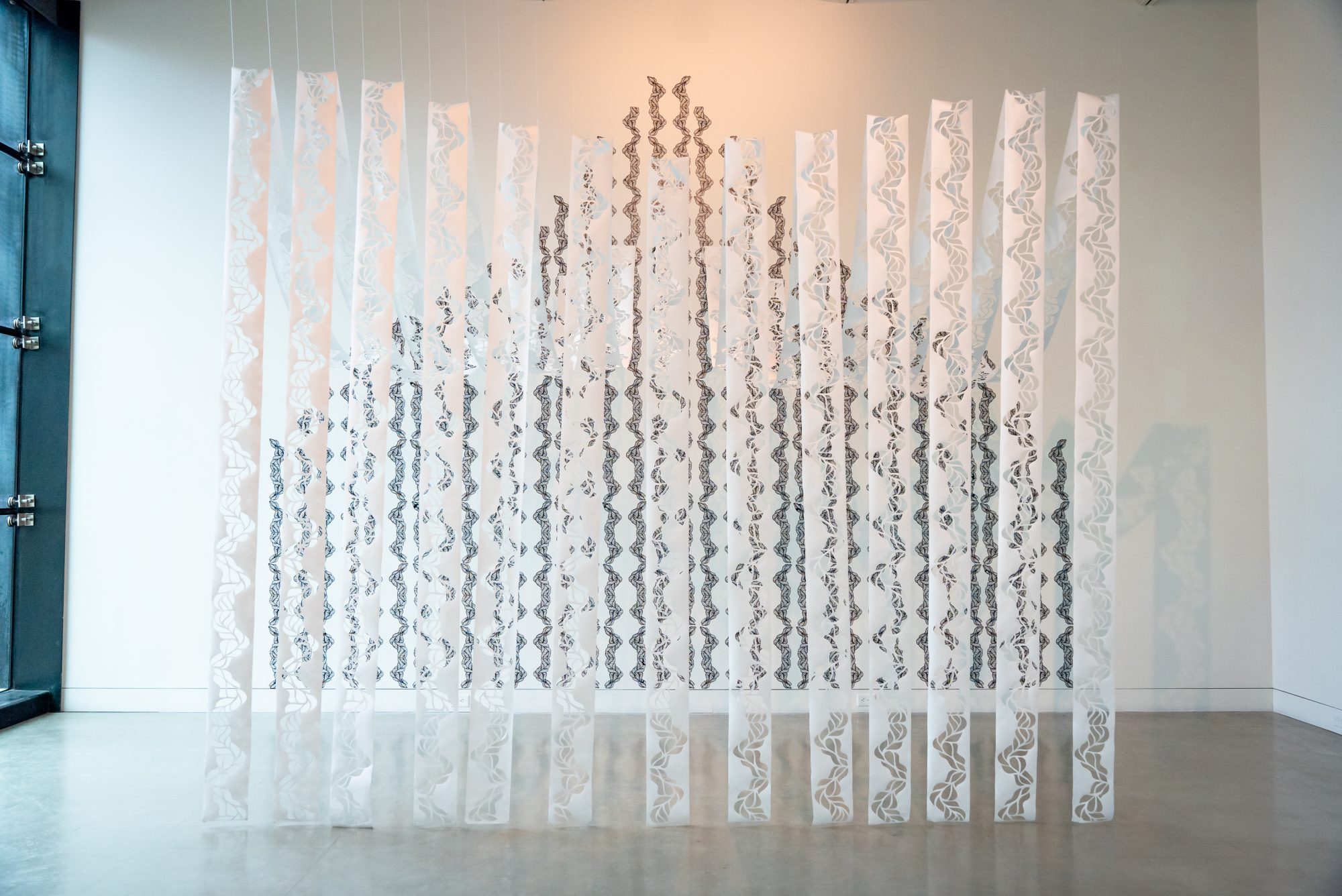
The floor to ceiling windows at 108|Contemporary allow visitors large gulps of sunlight while inside. That light is an active participant in the current show by Alicia Kelly, Roughly Right, casting shadows that reframe elements of the works on display.
On a recent visit with my art students from Cascia Hall, 108’s executive director Jen Boyd Martin walked our group into the gallery and introduced us to several highlights from the show. Dancing Alone, Together is a large monochromatic work with three snake-like shapes cascading from top to bottom, never touching. Small curved lines are cut from the paper’s surface, revealing spaces behind and in between. I peeked into the darkened openings the way one might sneak a look through blinds, catching a little glimpse of someone else’s private world.
The title shot me back to my high school poetry class, where I stood at the front of the room one day reading a piece I had written with a similar name (Together Alone). I was so nervous I inadvertently skipped over the middle third of my poem, leaving the few classmates following along with raised eyebrows. Those same arched shapes echo throughout Kelly’s work, a reminder of my error carved into memory. This impulse to recognize meaningful forms, especially facial ones, in unrelated patterns is known as pareidolia, a term the artist came to know in her carving process.
As if reading my thoughts, Martin revealed that Dancing Alone, Together contains a mistake. Our noses moved closer toward the glass, scanning the raised shapes to find the artist’s error. Kelly’s disregard for perfection unlocked a new way of viewing her work. Her seemingly perfectly carved patterns were not what we initially thought them to be.
“I’d rather be roughly right than precisely wrong,” a contractor once told the artist. In Kelly’s exhibition statement, she writes that she “emulates this mantra” by “abandoning the weight of perfectionism” for entrance into a meditative state. A process video of Kelly plays by the gallery entrance, showing her deliberate carves into paper made quickly, not precisely, using an X-acto knife as her drawing tool. Her smooth, rhythmic slices make it hard not to get spun into her hypnotic process.