


Editor’s Note: This essay first appeared on John Paul Brammer’s Substack.
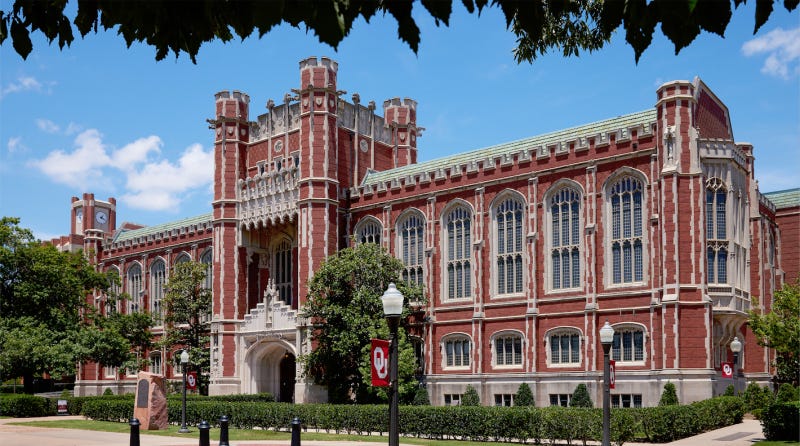
As a proud graduate of the University of Oklahoma, I know firsthand that most people don’t go to college to learn how to think. For many, college is a time to experience the opposite of thought. It’s a four-year window in which the goal is to murder as many brain cells as possible with rubbing alcohol, black out, and wake up with a perfunctory diploma, a spouse, and a potbelly or a bob haircut in some suburb where an enhanced capacity to ruminate would only cause trouble.
It’s with this in mind that I feel a little bad for Samantha Fulnecky, the junior psychology major at OU currently embroiled in a national controversy of her own making. After receiving a failing grade of zero marks for her essay on the subject of stereotypes and gender roles, Fulnecky, who is Christian, claimed religious discrimination. My alma mater acted swiftly, placing the graduate assistant grader on administrative leave while it investigated.
It’s unclear what kind of investigation it needs to perform, given that Fulnecky’s 650-word essay is available for us to read and has all the textual depth of a discounted “He Is Risen” throw pillow at Hobby Lobby. I don’t feel great about bullying a college student, but, as Fulnecky herself implies in the closest she comes to an argument in her essay, bullying children is sort of okay if it contributes to a healthier society, and my personal belief is that, if we let shenanigans such as these slide, we accept an even stupider world than the drooling mess we occupy now, and, ironically, cede yet more ground to the identity-first grievance politics that Fulnecky’s supporters claim to hate so much.
Per reports, the assignment was meant to be a reflection on how gendered expectations and stereotypes can affect children. It’s a hot-button issue, and Fulnecky, though I disagree with her, takes an interesting stance, especially in the context of a college classroom: in a functioning society, it’s required to pressure children into certain norms, and while this might induce discomfort in some children, there’s a degree of strain we must deem tolerable on that front if we’re to maintain a healthy polity.
“I do not want kids to be teased or bullied in school,” she writes. “However, pushing the lie that everyone has their own truth and everyone can do whatever they want and be whoever they want is not biblical whatsoever.”
Ignoring the “not biblical” thing, this is a position most people have. We would probably not allow, for example, for a child to be racist on the grounds that racism is their truth. We would want to intervene, to correct the racist child, even if doing so brought the racist child personal discomfort, because we recognize that the world would be better off if a racist child were not racist. Shame and fear of rejection are powerful tools to mold young people into well-adapted adults. I would agree with Fulnecky that, yes, we do tell kids they can be whatever they want, and that, in practice, no, we don’t really mean that.
But Teresa of Ávila, Fulnecky is not. Though she claims to be the victim of discrimination, the only victim here is the medium of the college essay. Fulnecky doesn’t offer any quotes to support her claim. She doesn’t even quote the Bible. What we get instead is Fulnecky’s personal truth.
“I live my life based on this truth,” she writes, “and firmly believe that there would be less gender issues and insecurities in children if they were raised knowing that they do not belong to themselves, but they belong to the Lord.”
This is not an argument. This isn’t even an attempt to complete the assignment. In much the same way that turning in a doodle of an archaeopteryx on a skateboard with a machete in its mouth would receive a big fat zero for a grade, so, too, should whatever this is. This is not an exercise in Christian thought, but an assertion of Christian identity. For Fulnecky, being Christian is both an argument and an unassailable truth. By virtue of having a belief, by being a believer, Fulnecky occupies an unimpeachable position. She identifies as unimpeachable. I could be wrong, but I think this is what right-wingers have claimed blue-haired queer Muslim Latinxs or whatever have been getting away with for years now on college campuses: demanding a “safe space” free of criticism where they’re coddled and praised simply for “being.”
Fulnecky has, in other words, and seemingly without the help of an unbathed Marxist professor, embraced identitarianism, an ideology that with each passing day takes on yet more properties of vibes-based mysticism. My critiques of this school of thought go beyond right vs. left. People of all political stripes have taken to the notion that some identities are innately gooder than others, be it by the accident of their birth or by the righteousness of the emojis in their social media profiles. It’s a convenient moral arrangement for a population that’s embraced intellectual lassitude, skims instead of reads, and has a collective panic attack at the thought of having to tackle any subject more complex than “is Wicked woke, or racist?”
The college campus has long been a combustion chamber for our national discourse. Even still, I think that in the not so distant past, a student like Fulnecky would have better understood the jig. Undergrad is a fake bother and people who take it seriously (as yours truly did) are kind of sad and will probably never have sex. There’s an incredibly popular machine available now that can churn out filler text in the blink of an eye for precisely her demographic, and that will shoo them along into an internship without much fuss. One point I’d award Fulnecky: her essay wasn’t written by AI. At least, not according to the sentence: “He created us with such intentionally (sic) and care and He made women in his image of being a helper, and in the image of His beauty.”
Turning Point USA all but certainly shoulders some blame here. The American college campus, aspiring to be more than a Ponzi scheme, has seen a heightening of preexisting stakes. Under Trump 2.0, it’s a battleground for the nation’s soul. There’s a demand for martyrs. The left, for all its shortcomings, has students disappeared in broad daylight by the state for speaking up about a genocide, the fires of which our government is shoveling our pensions into. The right has Charlie Kirk, which was undeniably a huge get for them, as well as people who feel uncomfy about the tone of certain protests, and, I guess, someone who made an F on a paper because she ignored the prompt and wrote about her personal life instead.
This is to say that the right hasn’t actually made a substantive rebuttal to the campus identity politics they claim to have murdered by reelecting Trump. What they have instead boils down to “mom says it’s my turn with the DEI.” They’ve accepted the terms of the conflict to be a martyr-off, a contest to produce the most compelling victim. Such a contest can only be emotional and reactionary in nature. It can’t be intellectual. But the strictures of the arena demand we pretend otherwise.
Here are things we know: Fulnecky’s essay is bad, and she had no interest in writing a good one. She had no interest in making a compelling argument, nor in convincing anyone to her side. What she was interested in was an avenue to express her identity. The meat of this expression is not in the essay, but in her ensuing victimhood, a victimhood I don’t doubt she anticipated. It would not surprise me to learn it’s what she wanted. One might argue that’s right from the “Woke Playbook,” but I’d argue it’s a longstanding Christian American tradition. A cultural norm, even.
I know better than to try to convince anyone of their own hypocrisy. This essay has about as much potential to accomplish that as Fulnecky’s does in convincing me to go to her church and be baptized in an above-ground pool, or whatever they do in her culture. What I’d say instead is that perhaps there’s something in this controversy that might bring us together as Americans: our victim fetish.
It’s not the most impressive observation to make about a culture that worships a battered, wounded god who was murdered by his haters, but America places a premium on victimhood. In our culture, we can’t practice outright aggression without first calling it self-defense. This doesn’t stop us from being aggressive, but it allows us to feel better about it, to feel justified. It’s an emotional arrangement, not a logical one.
Speaking as a DEI hire myself, I’ve seen it on my “side.” I’ve seen people who think having struggles in life grants them permission to exploit and abuse others. But this isn’t a practice exclusive to any one group, and if we’re going to improve the material conditions in this country, we’re going to have to go against our programming and stop prioritizing catharsis over intellectual rigor. It’s a daunting task, but we ought to give it the old college try.


