

Skip to Content
Arts & Culture

Meet The Composer Turning The Spotlight Theater Into A Living Soundscape 

In “Architectural Counterpoint,” Bruce Goff and Olinka Hrdy's designs become part of the composition

photo courtesy of Todd Woodlan

The Pickup's Arts & Culture coverage is supported by Brut Hotel, featuring a rooftop VIP after party for Tulsa Irish Fest on March 14.

You might think there's not much in common between Bruce Goff's Art Deco 1920s aesthetic and experimental music in 2026. Enter Todd Woodlan, who's been helping Tulsa rethink quite a few well-worn categories since he moved here five years ago, both with his own music project A Thousand Plateaus and with the radically welcoming, community building open mic noise events put on by ONE AUX, which he co-founded with Carl Antonowicz. (Read our review of just one of that organization's many musical adventures here.)

On March 13, at 7pm and 11pm, Woodlan will premiere a composition he wrote specifically for the Tulsa Spotlight Theater. "Architectural Counterpoint"—featuring Tulsa musicians Ashley Apodaca, Chazlen Rook, Cheyenne McCoy, Matt Ziegler, and Nathan Glaser, all of whom play in multiple local music projects—takes inspiration from the building's design, its century-old history, its lost murals, its community lore, and the quirky realities of its current-day life. This immersive musical experience, made with support from the Artists Creative Fund, will take listeners throughout the space (even into the basement), and it promises to be as thoughtful, whimsical, and generative as Goff's own work. Ahead of the show, we spoke with Woodlan about the process of making music for—and with—the Spotlight.


Alicia Chesser: How did you first encounter this space? What was your response the first time you walked in there?

Todd Woodlan: I came to Tulsa with Tulsa Remote in 2021, and one of the things on their list of stuff to do is to go to the Spotlight Theater and see The Drunkard. So I went and said, oh, this is a really cool little theater, and then forgot about it for a little while. It was always on the back burner—like, it'd be cool to do an event there, because it's a neat, historic space. Then a couple years ago, I went to an event there with The Links and some other people, and the space was totally transformed: indie band, noise, lights and fog machines. It was packed with people, really cool. Later I got a tour of all the rooms that were upstairs that were the old living quarters, and got to go down under the space and see the tunnel. There's so many other parts to this building beyond just the stage. A lot of them were kind of in disrepair, but you could tell the kind of magic that was there and all the history that was in the building.

And I was like, this is wild. This feels like a “space activation” sort of art project that needs to happen.

AC: Have you done this kind of site-specific composition in the past in other places?

TW: I have a background in installation sculpture, so I would make site-specific sculptures. A lot of the music practice that I do is improvisational, so it's not necessarily site-specific in that it has to be in a particular place, but each performance is unique in the sense that it's like one point in time in a place, wherever it is. I've done performances doing things like running microphones from outside into the building and processing that, or taking field recordings in a particular place and looping over that. So it's kind of an opportunity to merge those two practices a little bit more, in a more meshed way. The Artists Creative Fund grant has allowed me to do this at a larger scale than what I've done before.

AC: And part of the scale is popping into parts of the building that are underexplored and underappreciated.

TW: It's fascinating. I had this idea initially that it would be cool to have a couple of people playing in a room and you could kind of come across it, like you're coming across something intimate or hidden. But then we actually started rehearsing in the building, and it's interesting how much you can bring into the composition that's unique to the space. So, for example, the basement, same thing—like, this is just going to be cool. There are parts of it where we are going to mic things in the room and use the room and bang on stuff. But then you start looking around, and there's this huge shovel, there's this huge piece of metal, so you take the fact that this was a storage area and bring that into the piece. And then you're down there and you're like, this is a very live room in the sense that it is right underneath where everybody is sitting in the auditorium. If somebody's up there walking around, you're hearing it downstairs in the walls and the creaking floors and everything. 

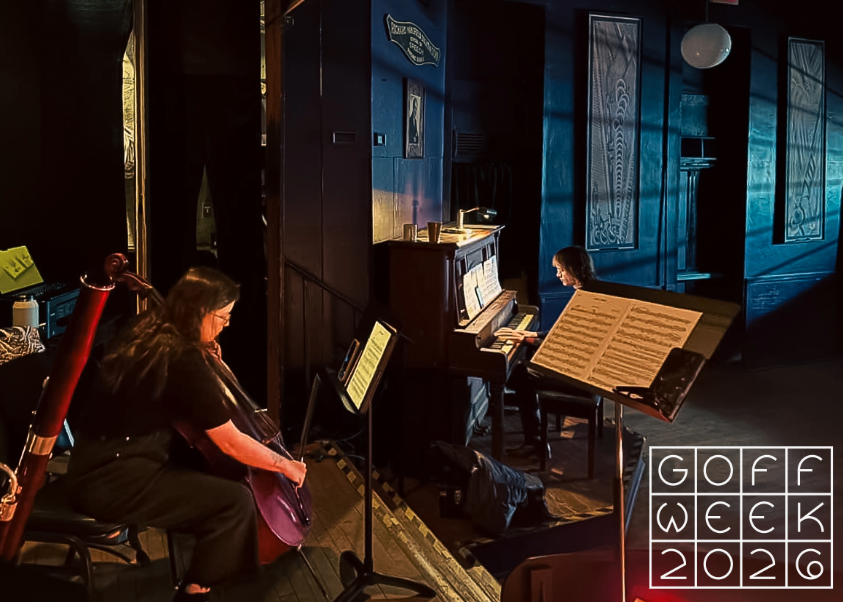
We’re working with that in the way the music moves through the space. For part of this, the audience will be moving through the building. So you’ll be coming downstairs and hearing the music in the basement before you see it, and then you’ll turn a corner and it'll be this big cacophony of stuff. There are two rooms on the second and third floor that we're going to use, with two separate pieces that are being performed at the same time in those rooms. On our first day in there, I thought, okay, it'll be like a standard building, it'll be muffled sound or whatever, but there is not a muffled sound. The two rooms are actually playing with each other; because there is so little sound absorption in between the rooms, somebody banging on the floor [upstairs] becomes percussion in the lower room. Or somebody playing in the lower room is something that somebody in the upper room is responding to because you can hear it so clearly.

I took recordings of all the rehearsals, and in the very first one, the guy on the third floor was by himself, trying to learn the scoring. He was like, oh, I hear them playing. I hear them banging around. Are they communicating with me? I guess we are! I guess we're communicating. Then he started doing that, and it was just kind of fun. We realized we can’t bang too hard otherwise stuff from the ceiling will fall on people’s heads, so we had to make a note about that….

AC: But it reinforces that the building is a living organism. It's part of the composition.

TW: It's going to be super exciting to see it come alive.

AC: It’s a really fun way to integrate the literal, tangible history of the building through time with the improvised, “here today only” kind of experience. 

TW: It seems to fit with what Goff is trying to do with his architecture, too, which is that the architecture should be built for use and purpose and whatever's in the room. It was fun doing the research and learning that he made this as one of his first buildings, for his piano teacher, Patti Adams Shriner. So it was initially a music site. We're bringing the music back. 

One of the performers, Chazlen, was like, "I'm excited about this project because I've actually been doing a bunch of research on Bruce Goff's music." I was like, excuse me, what? It turns out Goff was hugely influenced by and corresponded with a bunch of musicians. He was talking to Harry Partch. He got an album of Ravel or Debussy or something when he was young, and it kind of blew his mind. He was very, very engaged with all these late 19th century, early 20th century, more experimental, more out-there composers. He was drawing lines between what some of them would do in terms of taking melodies and repeating them and modulating them each time, and then in the architecture, having elements that are not just very clean lines that have to be exact and repeated, but actually taking an idea and modifying it throughout the building. 

The more I got into it, I was like, that's actually very appropriate all of a sudden, because that was the type of music that I was using for inspiration for the piece. So I thought, okay, this is all coming together somehow.

Stay in touch

Sign up for The Talegate, our free newsletter<br>Fresh Tulsa stories delivered every Tuesday and Friday

AC: That's incredible to uncover that as part of your project in the process of making it.

TW: And there's other fun little things. Goff got Olinka Hrdy to make the murals inside the building, which are gone now, but there are the reproductions throughout. The score of the piece that I'm putting together is based on one of them, “The Music of the Future.” I don't think it made it into the original building, but there is a copy up by the women's bathroom at the Spotlight. My score overlays a geometric grid onto that mural and uses that to determine chord progressions. 

It was a fun thing to be able to do—take Goff’s work with Olinka Hrdy and her amazing murals and turn that into the basis for the music. An anecdote that I thought was really, really funny was that I guess the piano teacher hated jazz. And she was like, "You can make murals about music as long as it's not jazz." So they're all strings and chamber music. But I guess Olinka Hrdy was sassy or something and added, in one of the murals, a hidden “jazz.” Like, she wrote “jazz” in it. My score looks like a typical score, but it's got a lot of notation and stage directions and stuff. Part of the instructions throughout for the performers is to hide some jazz in as much as possible. It's a little nod to that. 

AC: Did you discover anything else that took you by surprise in other parts of the space?

TW: I think the obvious one is the tunnel. It's not a Goff original. It was added to the space in the '60s after it was sold to the theater, and they dug it out so that the actors could get from one side of the building to the other. It's fascinating to me because it's a functional thing. It's also not done with an aesthetic sensibility by any means. I kept calling it the cave. And everybody's like, no, it's a tunnel. But it's got exposed rock and all sorts of stuff. It feels very organic. It's functional because it is a straight line from the back of the theater to the front of the theater and vice versa. And it is organic because they just dug out what they needed to dig out and just left it, because nobody needed to see it. 

Going up into the rooms is fascinating too, because it is a fairly narrow stairway. There’s a really cool, very long, thin, vertical window on one of the stairways, and then the rooms themselves are fairly small. I believe they were living quarters. There wasn't anything amazingly architectural about the rooms themselves, but I think it's just the way you flow through it—through this very narrow, very vertical-feeling side of the building, which is different from the rest of the building, which feels very flat, very wide, expansive. You go from this wide stage where there is no up and down, off into this turret citadel situation that feels more narrow and confined. It's an interesting contrast. Those rooms are very straightforward and functional, but they still do have a feeling of movement or life to them—they don’t feel sterile somehow, I think because of that odd sizing or the verticality. 

AC: I'd love to hear more about the composition. How do you make music for or with a building?

TW: The composition, like I mentioned earlier, is based on the Hrdy mural “The Music of the Future.” In the background of the event flyer, the circles you see are an abstraction of parts of the mural. And these triangles are essentially triads, so they're C, E, G, or whatever; they represent the notes. There's a way of deciding how you're going to do the chord changes versus doing like, 1, 4, 5, or something like that: you change one of the notes by flipping this triangle around, essentially. It's a way of having chords that are related but not in a way that you would normally hear. The relationships between the movements and the chord changes are kind of unique. There's a lot of dissonance in the piece, too, in a lot of the chord voicings, like how Eric Satie does his chord voicings. When you merge that with some of the keys, it sounds a little dissonant, but hopefully in an interesting way. 

image courtesy of Todd Woodlan

That’s the main structure of it. We also mic elements in the rooms and take some elements from Goff’s writings and speak to those. Then there are parts where the composition gives more guidance to the performers, and then they are to respond to the moment and what's going on, to create something that is in the moment. And you're never going to get the same thing twice. 

Everything's spread throughout the building. Folks will start in the main room in the auditorium and get more traditional trio playing for a little while. People will be asked to come out during that performance, and they'll be led to other parts of the building and then kind of given free reign. There'll be pieces playing in two rooms on the second and third floor, and then in the basement. And then everybody can move around as they want. The pieces are connected in some ways, like melodically and rhythmically, but they are three separate pieces. The performers will be switching rooms every few minutes as well. 

The idea is that from start to finish, throughout the whole performance, whoever is listening will be essentially constructing their own piece, because there's no way to listen to all three of them at the same time. Hopefully, no two people will actually hear the same performance. They might get the basement first and then decide to go to the second floor and the third floor and decide to go back to the basement or just stay on the second floor the whole time. They'll get to construct what they want to hear and how they want to hear it. And then, similarly, the musicians will be moving around. When you put all that together, everybody listens to something different. The early show at 7pm and the late show at 11pm will be totally unique experiences, and everybody comes together in a unique way at the end.

The duration is also very much tied to the space and the time of the year. About halfway through the first performance, the sun will be setting in the building, so people will get to have that transition from day to night from the beginning to the end of the performance. The last performance will be concluding around midnight on Friday the 13th, which I think is an exciting little timing note. 

A big part of it is writing the piece for the space, but also for the performers, because I've got a group of folks that are really, really good at this type of music. It's a group of musicians that all have a very strong music background, a very strong understanding of how to breathe life into whatever notes are on the page, and then to bring their own take on whatever it is in a way that all converses and talks to each other and works, and then to understand what it means to be in the space and activate that. I don't think I could ask for a better group of people to be working with on this. I'm putting the notes on the page for this thing and doing some admin organization, but I feel like they're real collaborators throughout the whole thing.

photo courtesy of Todd Woodlan

AC: How do you think about documenting a piece like this, which is happening in many places at once and isn’t just a single, unified experience? 

TW: That is something I think a lot about because a lot of art and performance now is made for Instagram, like, for people to pull out their phones and start talking. And you have people that are like, that ruins the experience and that sucks, everybody put your phone away. Okay, well, sure, but that's not practical. Also, I think there is a value in people documenting snippets in order to share with people that aren't there, because that generates interest and excitement around the sorts of things that I think people would enjoy if they knew they were there. 

You say “immersive, experimental musical performance” and there's a lot of buzzwords in there. If you do that in L.A. or New York, people have a box to put this in because this is done a lot. I think in Tulsa, you have some people that know that, and some people are like, that is word soup and I don't know what that looks like. You have other people, they're like, that's cool, but I don't know. I think there is an educational element for sure. This is cool. This is fun. You can show up and enjoy this and come in and hang out with us. The snippets and the photos and the Instagram and stuff help to do that. I think people can see that, get an idea for next time that they know, okay, here's what I'm getting myself into. It’s not scary, or it's not off-putting, or these people aren't going to be assholes or whatever. 

I'm kind of intentionally staging the piece to do that, too. It's written so you can dive in and out of the different pieces. You don't have to listen to the section that was in the beginning to be able to appreciate this one. I think it adds to what I was trying to go with in the piece, where you can never experience all of it. You're only going to experience a facet of it at some point. Having something that is only documented in little snippets also lends itself well to doing that, too, because you're in a cool space and, you know, a musician is banging on a trash can with a shovel or playing a medieval instrument in an older room in a historic building.

I'm approaching the documentation not from the question of “Will we be able to get everything in a perfect one-to-one way?” but more like, “Can you get snippets of it that give an idea of what the experience could have been if you had been there, understanding that even if you had been there, you wouldn't have been able to experience it all?”

photo courtesy of Todd Woodlan

AC: It's interesting conceptually, too: you can't experience the whole building, actually, because the original murals are gone. They're there, in reproduction, but they're gone. The original intent of the building is there, but there've been these additions. There's been this accumulation through a century that means you can't actually experience it as one thing.

TW: That is fascinating to me because it points out that there never was, like, a thing. Even if you went back to the original, you're going to miss out on everything that happened since then. That's also something I'm thinking about while staging this. There's a really attractive direction that's like, let's get everything out of the rooms, make it look like this nostalgic decaying building. We could do that. 

But what is exciting about this to me is that you go into those rooms and you see this accumulation of decades of intentional stage work and really nice furniture, and then work tools and plastic tables that they're storing and an old PA system, paint and power tools and some couches that are super comfy, and flyers from shows that were a long time ago, and a big old area of stuff they're getting ready for a sale that has a tarp around it that says “don't touch.” And then a pump organ in the back that everybody, when I was doing the initial tours, they're like, “I don't know why that's there, I don't know if it works.” And then we did a rehearsal and Cheyenne went “oh, cool, a pump organ,” and she pulled some stuff out of the way and started playing it and it was like, okay, well, that's going to be in the piece. In one of the other rooms, Trueson Daugherty and some people were doing a podcast, and I think they were using his masks with the big fluorescent puff balls, and some of that's up there. It's like, this doesn't fit with the early 20th century nostalgic thing, but it's here.

It would be so easy to want to pull all that stuff out and be like, “This is a green room.” But that is what the space is. I'm not going to stress about making it look perfect. I want people to be comfortable moving around in the space. But I also want to acknowledge that the rooms are used for storage for a puffball thing and a crock pot and old furniture—that's what made this building a building for decades.

Even if we were to stage the other rooms and put the tattered chair in or whatever, that's still sterile in a lot of ways. It's trying to feel like a worn old building, but it's still sterile. Sometimes the messy stuff is a little uncomfortable, but yeah, you're not like, “Oh, wait, this is supposed to be a fancy concert venue where we’re listening to stringed instruments and stuff.” I think it also puts people a little off balance, too. Like, wait, why is this here? What am I doing? And you have to be present with whatever's going on.

AC: Right. There's that anticipation of it. Is that going to be part of the piece?

TW: Yeah, maybe. Maybe!

AC: This is an ambitious project but also very simple, in a way: it’s basically sound, space, and people. What would you say to someone who might be thinking, “Maybe there’s another cool building in Tulsa that I could do something like this in”? 

TW: It was fascinating uncovering all this history and having it tie so well to the project and these ideas of uncovering hidden parts of the space. There's an element of hoping that people get a fuller appreciation for and connection to the building and hopefully, you know, become part of making the history of the building—whether it's donating for more restoration or volunteering or becoming involved with some of the plays or putting on an event day, to have it continue to live. 

In a lot of these types of venues, there's an audience and there's a stage and there's a pretty hard line in between. You go to this institution—whatever, Symphony Hall—and somebody maintains it, somebody plays the stuff, you go and you sit and you listen to some cultural thing, and then you go home and that's about it. In reality, even those institutions have people behind them, histories, all this sort of stuff that you can get involved in. 

One of the most enjoyable ways to get involved, I think, at least for me, is to feel like you're part of the music. What am I enjoying? What am I not liking? I don't have to have this massive background in music to be able to engage with it that way. I can just say, I like this or I don't, and that's cool, you know? Go talk to somebody afterwards and be like, you put on a great performance. Everybody likes to have people ask questions about their instruments, their music. What did they think about it? I’m trying to have a performance piece that also breaks that boundary down a little bit, where people can take a lot of ownership of the space and the performance in a way that they feel connected to it and part of it and responsible for its success in a lot of ways, too.

It takes a lot of work, but you don't have to do an hour-long performance with six musicians. You can do a five-minute pop-up somewhere and it'd still be a meaningful thing. I think as far as challenges go, one of the biggest ones is just having the time to stay with the space. Because I think any sort of site-specific work only works if you are actively engaged with the space over a period of time. We are doing all our rehearsals in the building beforehand, plus all this research, and I've been over and volunteered and I know some other people performing have as well. When you get involved with that sort of stuff you see this is a space that changes depending on when you're there, who you're there with. It's a very different space if you go on a Saturday night for a packed audience of The Drunkard versus if you're locking up by yourself at 11pm. 

So the biggest thing is just being able to find time, find engagement, and really be with the space and be open to it. That's something I think most people can do to some degree, because every space has something unique about it. It doesn't matter if it's a corner in Broken Arrow by a highway exit or a big historic building. There's always something unique about it and something to explore, and that just often takes time, and the openness to be like, what is actually unique about the space that you can amplify or engage with in a way that you can't replicate somewhere else? 

After that, it's just kind of a matter of what you want to do with it. For this piece, without the funding from the Artists Creative Fund, I wouldn't have been able to bring in all the awesome musicians I'm getting to work with, who are all adding a lot to the piece on their own, and we wouldn't have been able to have the venue. But if people wanted to do this on their own, it can be as simple as going out and whistling or doing a drawing on a corner in an engaged way. I'm a big fan of landscape sculpture stuff, so people arranging rubble or something is oftentimes, to me, a very interesting way of engaging with a space as well. I think the biggest challenge is just time, at the end of the day. 

Experience "Architectural Counterpoint" on Friday, March 13 at the Tulsa Spotlight Theater, with performances at 7pm and 11pm. Pickup subscribers can get 25% off their ticket with the code PICKUP25.


If you liked this story, please share it! Your referrals help The Pickup reach new readers, and they'll be able to read a few articles for free before they encounter our paywall.

Stay in touch

Sign up for our free newsletter

More from The Pickup

At The Spotlight, The Rivalry Between OKC And Tulsa Is Made Musical 

The historic venue hosted a night of rappers and DJs, put together by ThunderWof. and dj noname.

March 3, 2026

Welcome To Goff Week

We’re celebrating Tulsa's wild wizard of modernism with a full slate of stories

March 3, 2026

Tom McCarthy On The Goffness Of Tulsa Club

Tulsa was once on the cutting edge, and Bruce Goff was a big reason why

March 3, 2026

Let’s Dig Through TFA’s Trove Of Bruce Goff Material

Inside the archives of an “architect’s architect"

March 3, 2026

In Chicago, Bruce Goff Finally Gets His Due 

The Art Institute’s “Bruce Goff: Material Worlds” shows Goff as he was meant to be shown

March 3, 2026

The Best Tulsa Events: March 4 – March 10

Any 'Heated Rivalry' fans out there?

March 3, 2026
See all posts