It can be hard to make space in your life for art. You know you should, but in the mix of work, bills, family, and global collapse, art can feel like an unaffordable luxury, an unproductive use of time, something with no real connection to everyday life. Not to dismiss the value of inspiration, but when it’s over there, in a gallery or concert hall, and you’re over here, overwhelmed with everything, it’s understandable to skip the show and choose the grind—or the couch.
But what if art made space for you? Say you’re walking from a parking lot to your office downtown, and you run across a massive, strange, wonderful sculpture in a public park that you’ve never noticed was there. You sit for a second, taking it all in before you move into your day. Or: you’re on a well-deserved weekend bike ride, and you come across a bunch of musicians standing on the side of the trail, surrounded by swaying grass, serenading everyone who cycles by.
Envisioning art as an encounter rather than an object: that’s what the Tulsa Artist Fellowship has been up to since it was founded in 2015 as a residency program for visionary artists and arts workers from Tulsa and around the world. Now, a decade in, the Fellowship has become fully integrated with the city—both as load-bearing infrastructure in the arts community and as an example of creative work that’s accessible, sustainable, and embedded with people’s lives.
You might have stopped in to the Flagship gallery to see an art show, or chatted with an artist at the monthly First Friday open studios, but there’s more to the Fellowship than that. At its third annual Open House this weekend—which includes 14 events with more than 40 artists over three days—Tulsans can experience art not as something set apart, but as part of who we are together.
“A gallery is about presentation. Tulsa Artist Fellowship is about cultivation,” said Carolyn Sickles, the Fellowship’s executive and artistic director. “Our organization's role is to ensure artists can take risks, make ambitious work, and connect with communities without the pressure of commercial output. The result is a cultural ecosystem where programs emerge from sustained relationships, not just filling a calendar.”

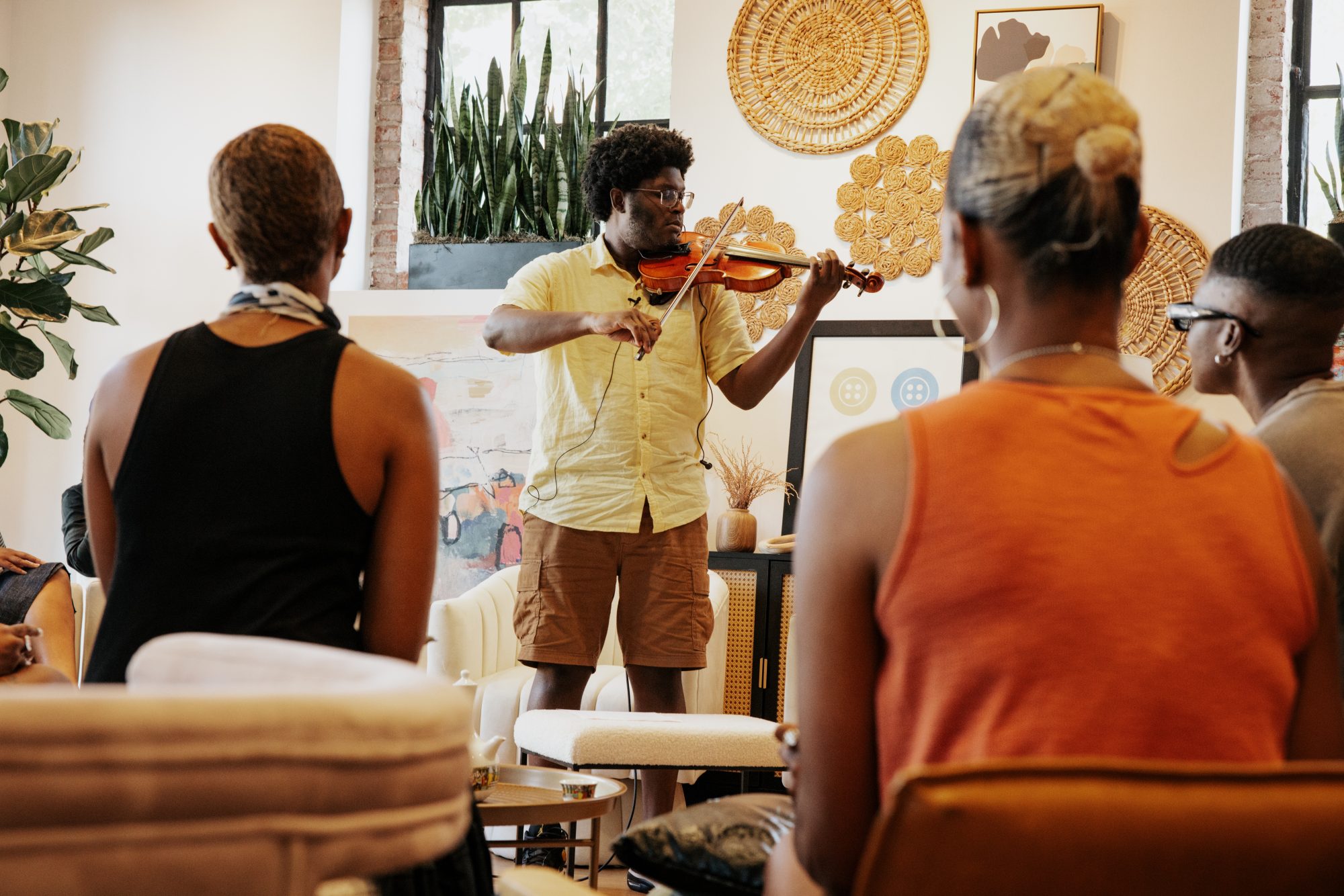
Open House weekend is a distillation of everything that happens at the Fellowship throughout the year: from public presentations by the Fellows (chosen from thousands who apply each year) to picnics and hands-on workshops, all reflecting ongoing collaborations across the city. Over these three days, art becomes a meeting place rather than something to consume—much like Tulsa itself is a meeting place of layered histories, diverse landscapes, and everyday traditions.
“For us, an ecosystem is not a metaphor—it’s a lived practice,” Sickles said. “It means awardees supporting each other across disciplines, institutions in Tulsa opening their doors to collaboration, and community members seeing themselves as part of the city’s cultural story.”
In other words, this isn’t just art for art people. As Sickles puts it, “Open House is not about passively observing—it’s about participating,” through everything from shared meals to unexpected conversations to after-hours parties. “This fluidity reflects what we believe art can do: expand the boundaries of where and how we connect, shift perspectives, and invite us into deeper relationships with one another.” Rest and reflection, creative and critical thinking, free expression, connection, fresh possibilities: artists need those things, and so does everyone else.

The Fellowship’s wide-ranging support gives artists time, space, funding, and other resources that allow them to close the gaps between the work of art and the work of living. In turn, those artists can sink deeply into this place and collaborate with its people—to make art an act of service.
“Artists find both inspiration and responsibility in working here,” Sickles said: think of Warren Realrider recording cliff swallows at the Tallgrass Prairie Preserve for a sound project, or Ashanti Chaplin creating art installations using dirt from Oklahoma’s historic Black towns, or Anita Fields and Yatika Fields collaborating with Indigenous activists on War Club: Native Art and Activism at Philbrook. "I’m excited to spend this time in Oklahoma immersing myself in the historical and contemporary political and social realities of Black life in the state,” said new Fellow Tatyana Fazlalizadeh. “This opportunity allows me to reconnect with the rich Black culture that thrives there and create work that amplifies and draws national attention to this unique and significant site of Blackness."

These artists aren’t just here to make art in their studios and put on exhibits—although that’s an important part of what they do. Fellowship awardees are drawing eyes to Tulsa as a thriving hub for bold, cross-disciplinary art; they’re also showing their made-in-Tulsa work in biennials, film festivals, and other arts events around the world. Sickles noted that “the impact is twofold: strengthening the local arts community while ensuring Tulsa’s voices resonate in global conversations.”
What really makes the Fellowship distinctive, though, is “our commitment to supporting artists as neighbors and civic partners, not only as cultural presenters,” Sickles continued. You might have already encountered a Fellowship artist in your everyday life in Tulsa; awardees teach in public schools, coordinate neighborhood events, collaborate with local leaders, and work with Tulsa nonprofits on issues from food justice to housing equity. “By living, working, and contributing as Tulsa residents,“ she said, “our fellows help ensure that art is not separate from community life, but an active force shaping the city’s future.”
First-year Fellow Lindsay Aveilhé, who’s organizing a printmaking workshop in The Heights Garden during this year's Open House, said she values this approach. “This is my first residency-style fellowship, which is pretty rare for someone working primarily as a curator and writer. What makes it especially meaningful is that I’m from Tulsa—so there’s already a deep investment and love for this place. The Fellowship supports a kind of embedded practice that’s not just about presenting work, but about living alongside the people and communities that shape it. It’s encouraged me to think more intently about the city’s ecologies, relationships, and histories as part of the creative process itself—as part of the fabric of making,” she said.
For Aveilhé, the moments that happen outside the walls of a gallery “often become the seeds of new ideas, programs, and collaborations. They ripple outward, sparking connections that wouldn’t have emerged in a traditional exhibition setting and ultimately deepening the fabric of the arts community.”

Whether you’re a foodie or a parent or a teacher or a metalhead (or all of the above)—in short, whether or not you consider yourself an “art person”—this Open House offers a place to belong. Many threads connect through this weekend: from downtown to the east side to the Osage Hills, between Fellows and local creators, between participants and their own stories. We’re all part of this work of art. Grab a thread and see where it takes you.
Everything is free, but an RSVP helps the organizers know how many folks to prepare for. In addition to exhibits and installations, there are opportunities for learning (a brunch talk about silence, erasure, and memory at The Oath Studio, or a conversation between Pat Gordon and the Center for Queer Prairie Studies at Philbrook); for practicing (a poetry workshop organized by Boris Dralyuk); and even for screaming a bit, if that’s what you need (an Indigenous horror film showcase on Saturday night).
Not sure where to jump in? Here’s the full list of events, and we’ve picked out a few favorites for you here.
For art lovers
Exhibit Opening: “Monument Eternal” by Le’Andra LeSeur
Friday, October 3, 6-9pm
Tulsa Artist Fellowship Flagship
Tulsans got a taste of Le’Andra LeSeur’s extraordinary work in “Drift///Hold” this past spring. Her Monument Eternal, opening during First Friday at the Flagship, kicks off Open House weekend with power and presence.
Originally presented at Pioneer Works in New York, Monument Eternal began as the artist’s personal reckoning with Stone Mountain, Georgia—the site of the Ku Klux Klan’s 1915 resurgence—through video, sculpture, photography, and sound. Her investigation into American landscapes where racial terror has taken root, and where its memory remains unmarked or distorted, continues now in Oklahoma through her fellowship.
The iteration of Monument Eternal you’ll see at the Flagship shifts focus to the 1911 lynching of Laura Nelson and her son, LD Nelson, in Okemah, Oklahoma. With no official marker on the site of their lynching, what remains is an online image: gruesome, persistent, and dehumanizing. Through five new sculptural and photographic works, LeSeur creates alternative memorials where quietude and refusal are intentional.
“My practice continuously considers ways in which art can transform violence into something beyond,” LeSeur writes in her artist statement. “Monument Eternal transforms memories of violence, remnants of violence, and even physical embodiments of violence into transcendences.”

Morning Assembly with Richard Zimmerman and David Broome
Saturday, October 4, 9:30-10:30am
Plaza de las Americas, 702 S. Denver Ave.
If you didn’t know there was a city park at 7th and Denver, you will now. Fellowship alum Richard Zimmerman has vividly integrated this spot into community life with “Assembly,” a group of 21 sculptures and three benches, built from thousands of discarded and recycled plastic and metal objects, all sourced locally. Each sculpture is wrapped in fiberglass cast tape, the kind typically used to mend broken bones.
Commissioned by the Urban Core Art Project, this temporary public artwork is delightful and provocative. Are these sculptures … an urban forest? Alien life forms? Monuments to what we tend to think of valueless and discardable? How can we think in fresh ways about public art and public spaces in general? Assemble at “Assembly” Saturday morning to enjoy the questions with your fellow Tulsans and musician David Broome, who’ll use custom-built photosensitive oscillators to create a site-specific composition on the spot, shaped by landscape, light, the sculpture, and those assembled.

For a hands-on experience
Woodblock Stamp Workshop, Led by Nic Miller and Alicia Smith
Saturday, October 4, 10:30-11:30 am
The Heights Garden, 1146 N. Cheyenne Ave.
You could almost see the 5,000 sq. ft. Heights Garden as a small-scale version of the North Tulsa neighborhood that surrounds it: built by community, tended through collaboration, and humming with life. The garden—a certified Monarch Waystation—naturally invites interaction, and its collective benefits are as manifold as its blooms. (If you’ve ever eaten lunch at Prism Cafe, you might have seen Chef Aimee Hunter stroll in carrying a bundle of just-picked fresh herbs from the garden for that day’s service.)
The Heights Garden is stewarded by Tulsan Lindsay Aveilhe, an internationally recognized curator who’s part of the newest cohort of Fellows. One of her cohort-mates, Alicia Smith, and guest artist Nic Miller will guide you in designing and printing a woodblock stamp and creating a take-home piece that reflects the collaborative spirit of the garden, the neighborhood, the Fellowship, and the season. Stop by the garden on Saturday for a mid-morning breath of fresh air, with Origin Coffee and light bites to enjoy.

'Modern Funk: Funk Is Form' Performative Glassblowing with Cedric Mitchell + Music Guests DJ NONAME and The Rowlands Band
Saturday, October 4, 4-6 pm
Tulsa Glass Blowing School, 7440 E. 7th St.
Granted, it probably won’t be your hands on anything during this experience, but that’s likely for the best: this is hot and risky work! The Tulsa-born, L.A.-based Fellowship alum Cedric Mitchell creates what he calls “kinetic glassware,” and he’s taking that term literally for this glassblowing-as-performance event. The elemental forces in motion here will include live music from one of the city’s best DJs and the Steph Simon-led Rowlands Band—also no strangers to turning funk and fire into art. Get up close and personal with all this action and bring your own groove to the mix: dancing, I imagine, will be encouraged (at a safe distance).

For outdoors enthusiasts
Wheels of Joy Community Ride, Led by Eyakem Gulilat
Sunday, October 5, 10am-12pm
Meet at: Osage Prairie Trail South Trailhead. E. Independence Place, OSU-Tulsa Campus
End at: Clark-Asberry Homestead Ranch, 6404 N. Osage Dr.
Commemorative map & optional return shuttle provided
Landscape / Skyscape / Cityscape: An Arts-Centered End-of-Harvest Celebration
Sunday, October 5, 12pm-2pm
Clark-Asberry Homestead Ranch, 6404 N. Osage Dr.

Wait—a community bike ride as an art event? Absolutely. The wind in your hair, the grass whooshing by, the shapes of the clouds changing overhead, good company: it’s got all the ingredients for an experience of being present, noticing the colors and textures of the season, and finding joy in what’s right in front of you.
Tulsa Artist Fellow and longtime community builder Eyakem Gulilat will lead you on a relaxed 7-mile roll along the scenic Osage Prairie Trail, where Tulsa’s autumn tapestry will unfold as its own work of art. Bring your helmet and the whole fam. There’ll be some celebratory surprises and even live performances along the way.
The ride will end at the Clark-Asberry Homestead Ranch, where Fellowship alum Rachel Hayes’ colorful sails will welcome you to an afternoon Harvest Celebration that includes a picnic by Chef Jacque Siegfried of NATV, cyanotype art-making, and a screening of the trailer for Fellowship awardee Melissa Lukenbaugh’s forthcoming film Forest in a City.

Editor’s note: This story was produced in partnership with the Tulsa Artist Fellowship, a place-based initiative by the George Kaiser Family Foundation. Special thanks to the dedicated staff, visionary awardees, artistic contributors, cultural partners, media platforms, presenters, culinary experts, and champions who support these ambitious annual open house weekends.
If you’re interested in hiring The Pickup content studio, contact Stuart Hetherwood at stuart@thepickup.com, or by filling out the form at the bottom of this page.


