

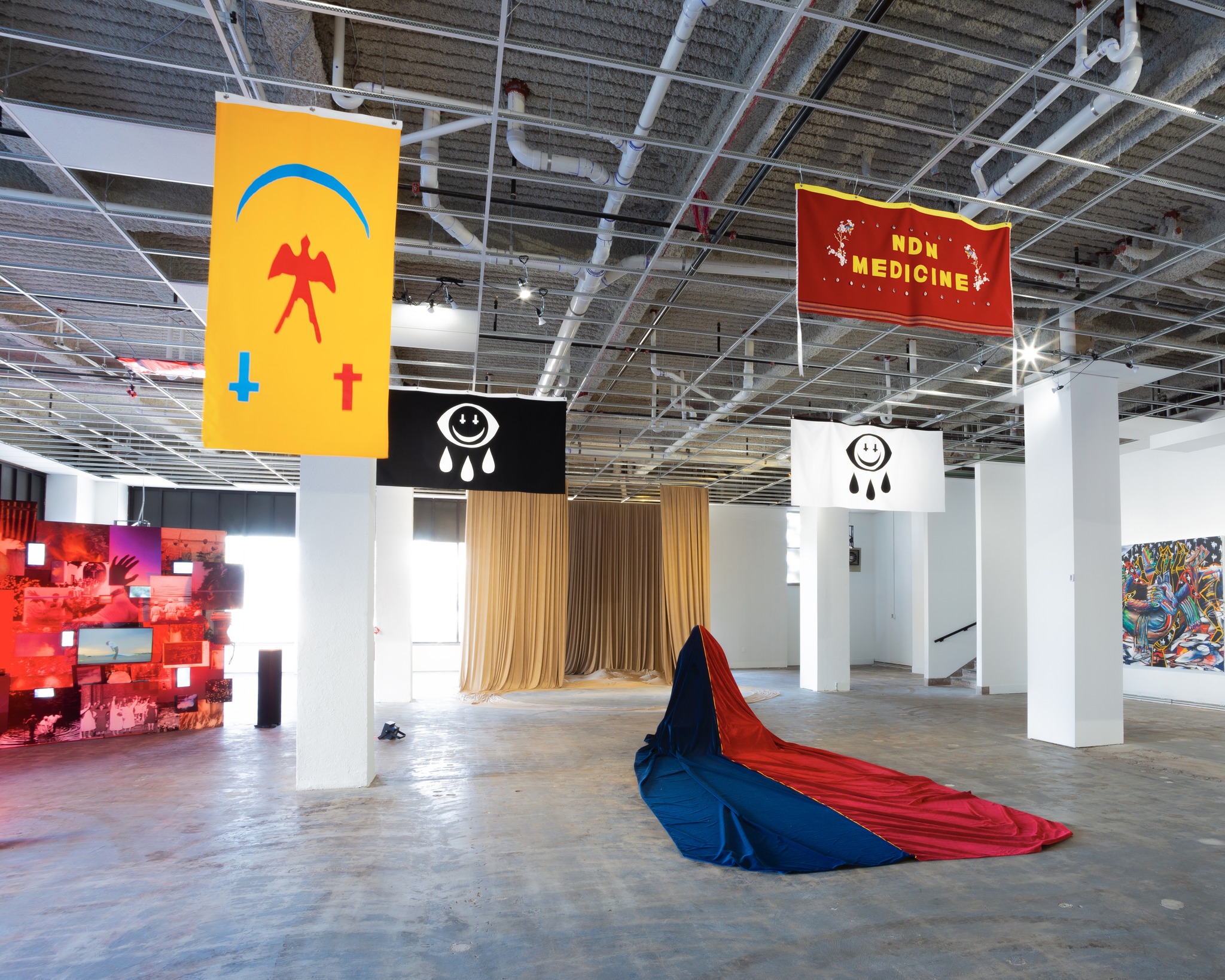
I don’t know how I’ve lived here my whole life and never noticed the ARCO building at 6th and Cincinnati. It’s one of downtown’s most stunning examples of the Zig-Zag and Streamline styles of late Art Deco architecture, built in 1949 for the University of Tulsa law school and later home to oil concerns like the Service Pipeline Company. When I walked up to its front door on a recent weekend, I spotted steel buckets and heavy curtains through the ground floor windows—part of the building’s current renovation into apartments, I thought at first. But these signs of transformation aren’t industry. They’re art: a new link between Tulsa and the wider world.
These objects are part of an exhibit called “Drift///Hold,” which features work by artists Warren Realrider, Nathan Young, Le’Andra LeSeur, Yatika Fields, and Ashanti Chaplin. Turning the corner into this show from the ARCO building’s marble lobby, it crossed my mind that there’s something delicious about a former oil company headquarters housing art that ranges across themes of nature, ancestral wisdom, and the portals between physical and metaphysical realities.
“Drift///Hold” is the first offering from the new contemporary art platform Central Standard, through which co-founders and curators Ashanti Chaplin and Lindsay Aveilhé hope to amplify the work of Tulsa-based contemporary artists and connect them with the global art world. Both Oklahoma-born, Chaplin and Aveilhé bring over 30 years of combined experience at art institutions worldwide to Central Standard. Chaplin is a Tulsa Artist Fellowship alum, a performance and installation artist, and formerly the inaugural Curator of Public Engagement at Dia Art Foundation in New York. Aveilhé is a new TAF fellow whose recent work includes editing the Sol LeWitt Wall Drawings Catalogue Raisonné and curating “The Soul Is A Wanderer” at OK Contemporary.
In conversations with local and international artists over the past year, they noticed a need for more spaces in Tulsa to highlight what Aveilhé calls the “really, really next-level” contemporary art being created here, especially art on a large scale like the installations in “Drift///Hold.” “We have some really great places to show work,” she says, noting that Positive Space has been an amazing addition to the local scene. “We kind of contrast ourselves to our museums, which are working in a range of time frames (so it's not all contemporary), and to [other art spaces] that are serving our local artists very well. We wanted to step outside of both of those things and create something a little bit different.”
As Tulsa strengthens its position as a place where groundbreaking contemporary art is happening, it’s a matter of scaling up the places where that art can be seen. “Ashanti and I come from contemporary museum or contemporary art backgrounds,” Aveilhé says. “Because of our connections to different institutions across the world, we thought that having exhibitions where we could invite people in from outside and really introduce ... an identity to the work being made in Tulsa and in Oklahoma would be beneficial to everyone working here.” When visitors from the Tate Museum’s acquisition team came to Tulsa recently, for instance, “Drift///Hold” was here for them to view.
While the artists in this inaugural exhibit are all Tulsa-based and TAF-affiliated, Aveilhé says that as it moves forward Central Standard will be a hub for wide-ranging collaborations and for shows that bring together emerging and established artists from Oklahoma and beyond. “It's really about continuing, with others in this community, to elevate together, to find these gaps where we can all complement each other in all the ways we're serving artists,” she says.
* * *