


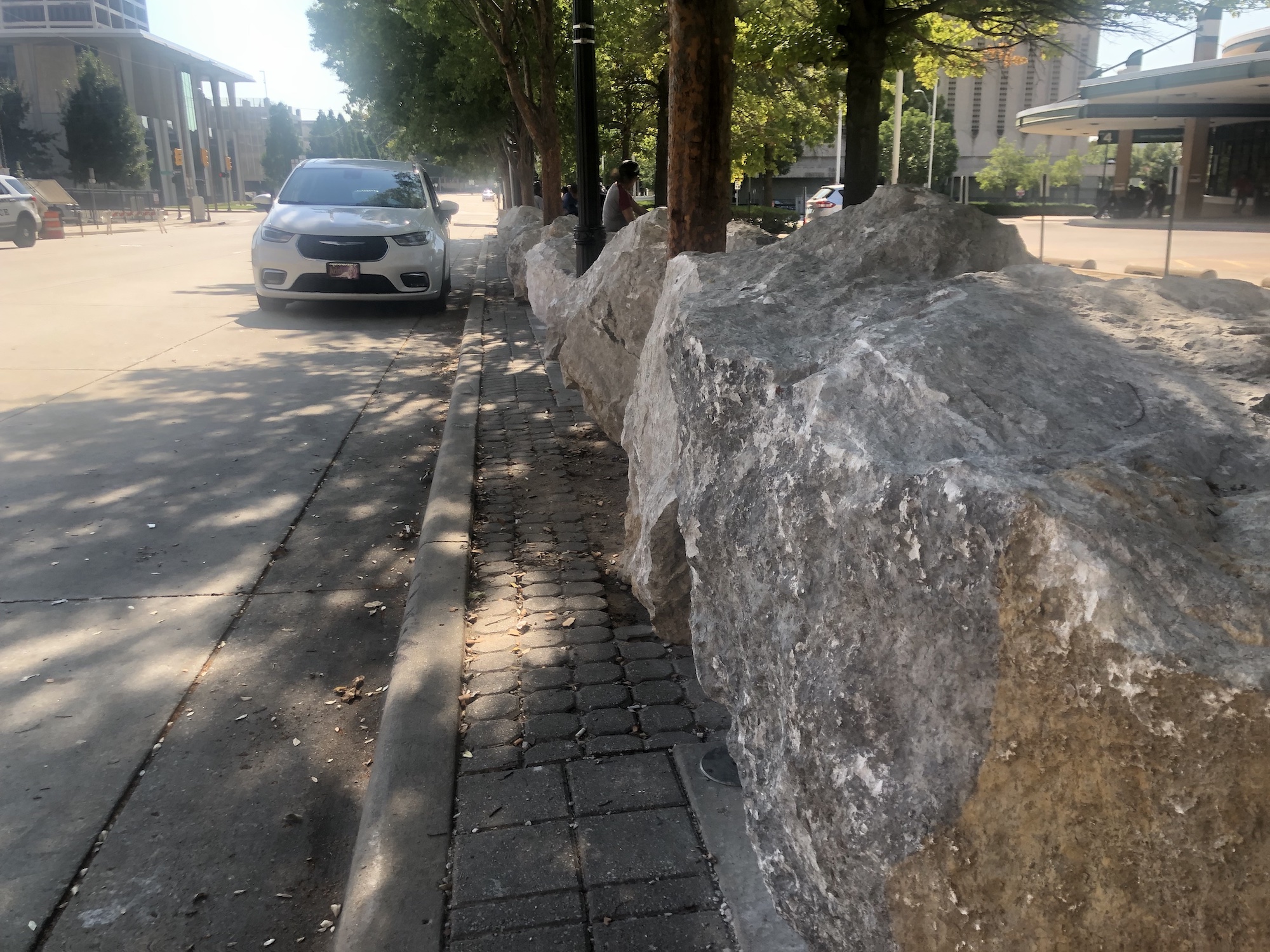
The City of Tulsa recently placed a large number of huge, jagged boulders along the sidewalk of the 4th and Denver Bus Station, one of the main hubs for Tulsa’s bus system. These boulders are linked, in the City’s statement, to the area’s homeless population, and the desire to give that population more robust services: the assumption being that, instead of hanging out on the sidewalks at this location, they could take the City’s free shuttle to BeHeard, which offers a daytime shelter, showers, and food. Additionally, and more bizarrely, the City has stated that the boulders are part of a “community art project.”
Community art project? Boulders on the sidewalk? You’re talking about these guys?

How funny. This is obviously an example—and quite an ugly one at that—of hostile architecture, which attempts to ward off homeless individuals through uncomfortable or impossible-to-enjoy benches, sidewalks, whatever—think of bird-deterrent spikes. It’s not even a veiled attempt by the City, whose statement directly links the boulders to the homeless population. Add it to the list of ways that the City is making life hard for the homeless.
But sure. Let’s take them at their word. These boulders (I type this with a heavy sigh) are art.
Whatever. “Art is anything you can get away with” is a quote that’s often attributed to Andy Warhol, but it was actually Marshall McLuhan (the “The Medium is the Massage” guy), who studied the ways media and art could be used to send, essentially, subliminal messages. And if this is art, it’s sending a hell of a message, which I think can be summarized as: Get the fuck away from the bus station.
But that’s too clunky, too mean, too obvious! The City needed something kinder with which to render their statement. Thus: Hey, pals, it’s art!
So, dear reader, I have decided that, for the sake of the City and the homeless population it seems to think that it is serving—even as it gives them a giant, sharp, cold middle finger—I will do the City a similar backhanded favor. For this art installation, for this embarrassment of stone and hostile architecture, I will write an Artist Statement for these stupid fucking boulders.
You’ve seen an Artist Statement before: those long, often rambling, jargon-filled paragraphs that artists include on works that are dense and impossible to understand without them. I think that this could be printed on a posterboard and plastered onto the Bus Station’s walls; it could also be spray-painted onto the sidewalk. (For legal purposes, I do not condone putting this Artist Statement on the site!)
Anyway. Here you go. Let’s start with some credits.
Title: The Big Boulders
Artist: City of Tulsa
Year: 2025
Materials: Stone, Presumptuousness
Size: 1 city block
“The Big Boulders” is an immersive, experiential work comprising a set of locally-sourced stone boulders, optimally placed for individual displacement. This work seeks to explore the “liminal space” of city sidewalks by obstructing them and making them ugly as hell. In this, the artist seeks to complicate the very notion of a “sidewalk,” asking: what is it that we call a sidewalk? If we fill it with rocks, is it still a sidewalk? If people we don’t like are hanging out on it, does that annoy people with six-figure incomes who walk around downtown? Can we solve homelessness by annoying homeless people out of areas we don’t want them in?
These are the questions this work considers, for about two minutes, before deciding that the questions are actually wayyyyyyy too hard to answer. Boulders are, as befits a modern public art installation, a sui generis solution, working beyond constraints like genre, art, material, or indeed common sense and decency. By denying the public the option to enjoy the “sidewalk,” this work attempts to subvert and subjugate every strata of human experience at once—homeless and homed—vis-a-vis the physical and proprioceptive concepts of discomfort, annoyance, powerlessness, insult, and confusion.
Many attempts have been made to understand this work through the lens of “hostile architecture.” The City, in the strongest possible terms, denounces this understanding of the wink. Er, sorry, the “work.” The work! Sorry, we meant to type work, not wink! Shoot! Anyway, since “The Big Boulders” is a piece of art, it can in no way be considered a piece of architecture. See how that works?
Art is something that you don’t get to understand, man; you have to feel it, man. For example, feel the gravelly surface of the boulders. Isn’t that nice? Aren’t you glad your tax money paid for someone to think this up?
One of the most important ideas in conceptual art is the relationship between the viewer and the art piece. “The Big Boulders’” situates the viewer as an a priori construct of place, time, and art, using those words in such a dense and impenetrable way as to obfuscate any real purpose that the piece could be conceived to have. Form is function, stones are sidewalks, and annoyance is art. If you have the power to get the big rocks, and the legal jurisdiction in place, you can do it!
Look forward to the artist’s next installation, likely cropping up wherever homeless people happen to congregate after this.


