Skip to Content
Culture

Erin Turner Wants To Have The Hard Conversation

The Tulsa-born artist discusses her new book about Ed Galloway’s Totem Pole Park and its complicated attempt to commemorate the Native American experience.

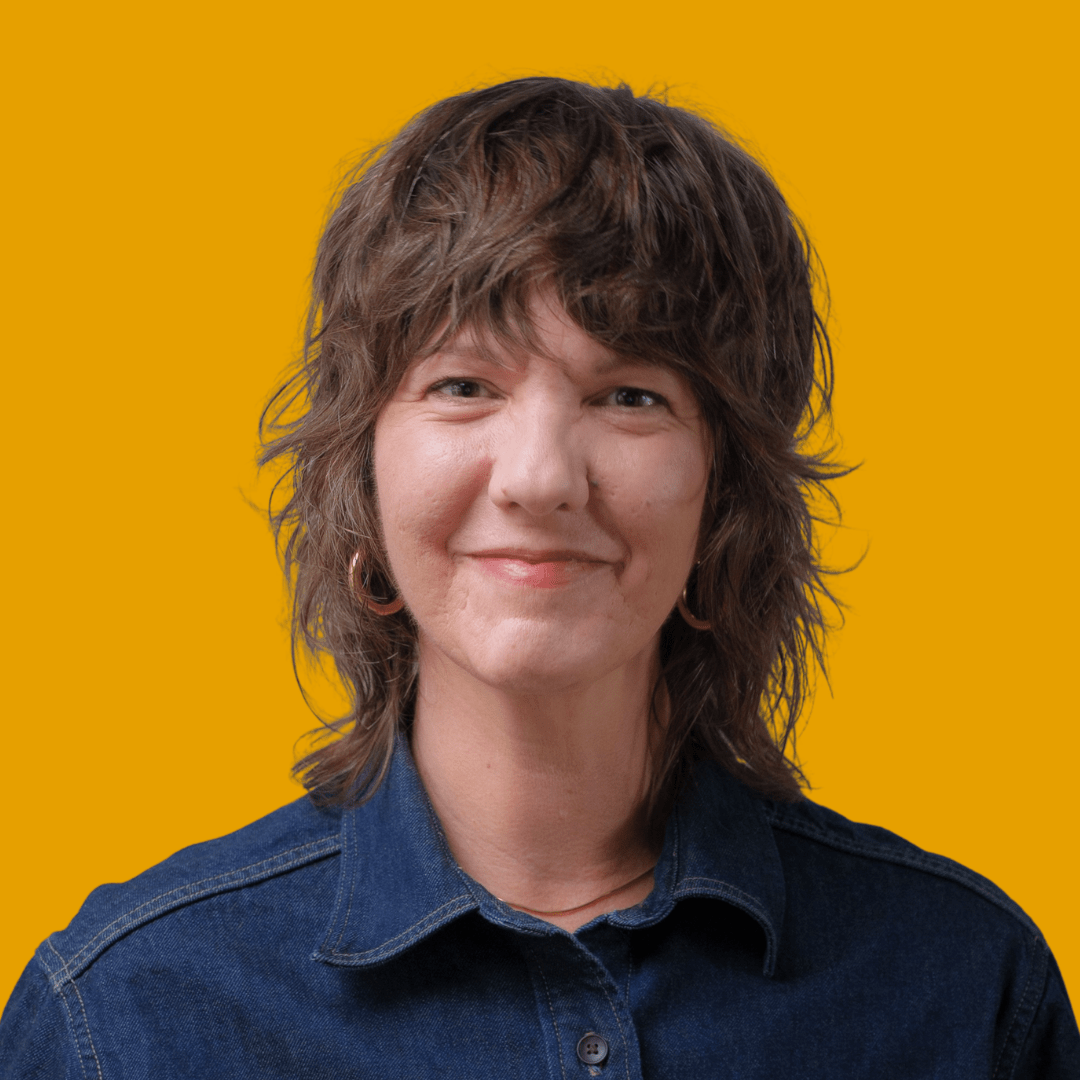
Erin Turner

|photo by Pickup staff

The Pickup's Culture coverage is brought to you by Tulsa Artists' Coalition Gallery, 40 Years of Empowering Tulsa Artists. Visit TAC Gallery to see American Highway Revisited by VC Torneden and Melinda Harvey Green, June 5 – 27, 2026.


Built between 1937 and 1948 and adjacent to Route 66, Ed Galloway’s Totem Pole Park shows up on nearly every list of out-of-the-way Oklahoma attractions. Its central feature is a 90-foot-tall structure designed as a tribute to the American Indian, covered in iconography that Galloway largely drew, it’s said, from photographs in National Geographic

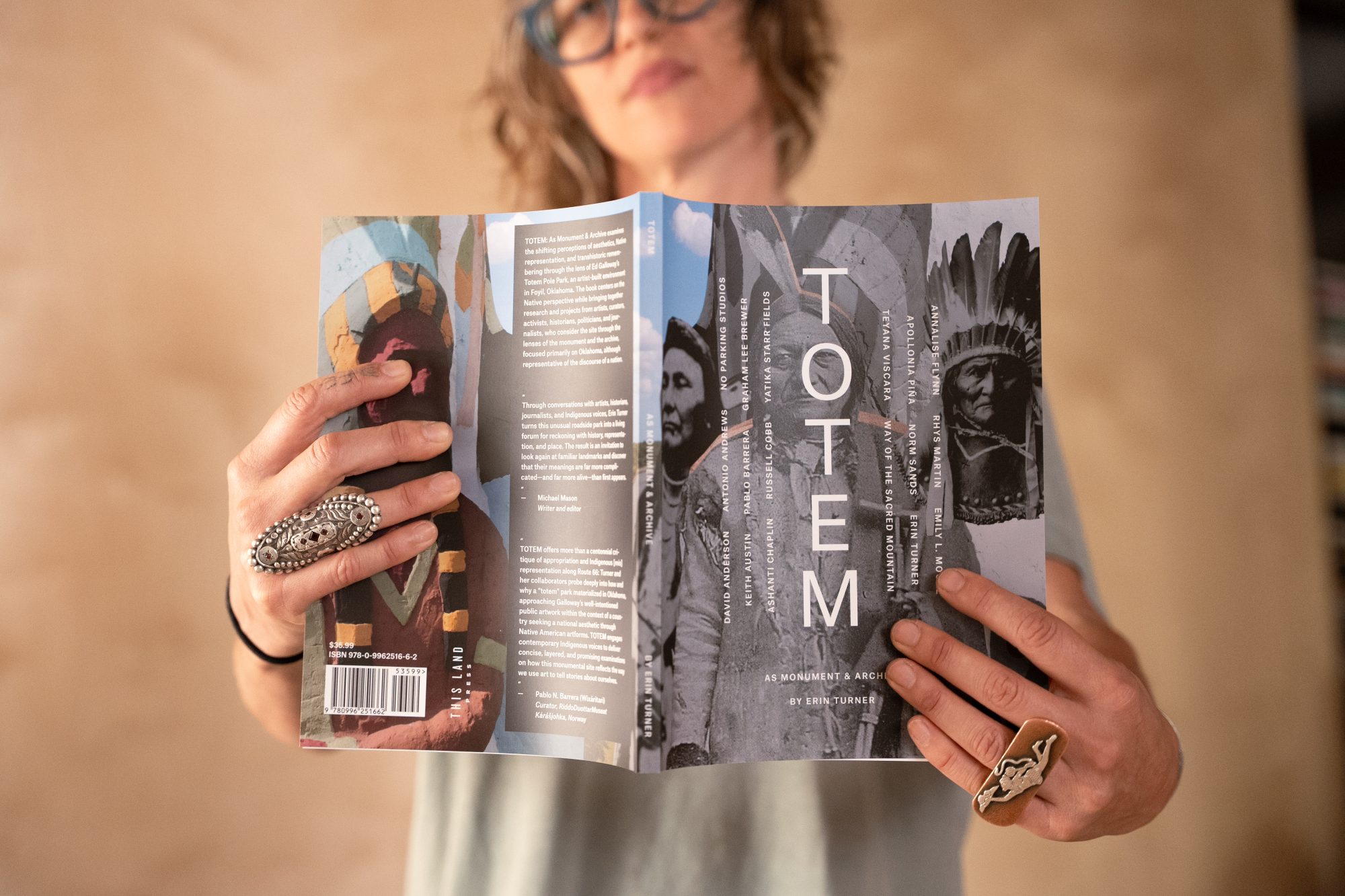
As usual in Oklahoma, there’s much more to the story. In her new book, TOTEM: As Monument and Archive, Tulsa-born, New York-based itinerant artist Erin Turner and an array of artists and historians dig into the history of Galloway’s totem pole—which Turner helped restore starting in 2015—as well as into larger questions about monuments as sites for storytelling, commemoration, and complicated histories. The art writer, critic, and activist Lucy Lippard has called the book “simultaneously sympathetic and analytical,” noting that “the collected texts address the contradictions between stereotyping and good intentions, entangled histories and local politics.” 

TOTEM marks a return to book publishing for This Land Press—which, full disclosure, also publishes The Pickup—and ahead of its launch event on May 30 at the Center for Public Secrets we sat down with Turner to talk about the book, her art practice, preservation and memory, and the many voices that are present in “monumental” spaces.


How did this book come about? 

Erin Turner: The public program that the book is based on was in 2023. Jeremy Charles, Apollonia Piña, and I sat down to talk about who would be the voices that should be involved in the conversation. The idea for a publication was always present, but after figuring out what that was going to look like, [the process involved] writing a framing essay, then having the transcribed lectures, and wanting it to be a very photographic-heavy piece. That then became a conversation with [designer] Ryan McGahan, who started framing that process. We already had so much beautiful research from all the slideshows that were compiled [for the lectures], so it was really just thinking about how to get the photo releases for the majority of that work. And then it just kind of snowballed—wanting to do it well and make it really beautiful.

You're coming at this topic from a lot of directions: academic, personal, as a Tulsan, as an artist. All of that is present in the book, so it’s fun to be reading along and encounter a paragraph that’s deeply cited and researched and critical-theoretical, and then jump to a paragraph about Antonio Andrews and Yatika Fields and hyperlocal art practices.

ET: I think that was part of the appeal of incorporating all these other Tulsa artists into a bigger conversation around something, realizing that there were so many voices that should have space to think and process. The lecture part is present in the book, but then there were these moments of actually being at the park and having conversations with people that were led by Antonio or Yatika [Fields]. It was super beautiful and really intimate and it felt like a very safe place to develop ideas and think about kind of touchy subjects and complicated ideas about place and identity.

That comes through in the book when you're writing about how Ed Galloway was trying to honor and commemorate the Native American experience, to the best of his ability—and how it's also important to say the ways in which it was not enough, it wasn't the whole story. To hold both of those perspectives at the same time is harder to do than simply coming down on one side or the other. 

ET: Especially with the public program, my intention was: let's publicly talk about ways of thinking about how to use a public space, what's needed there, what is missing. I think that was one of my biggest reasons for wanting to do a project [at the Totem Pole Park]. I had spent so much time there from the perspective of being an artist—I can easily go into the very technical, the DIY, the craft of it—which is why I think sitting in conversation with people who are stewards and conservators of artist-built environments and seeing that landscape within the United States is really interesting. In the last three or four years, there's a little bit more of a national conversation [around that], and I am a part of it; we meet every year in person for a conference and have dialogues about what these sites mean. The Totem Pole Park has just kind of sat on the edge of that conversation for a long time. For me, it's very clearly [an artist-built environment]. And I think for the community, it sits more like a roadside attraction.

Like the Blue Whale of Catoosa or something.

ET: I don't know if that's myopic or if it's actually just how the community wants it to function, but I do see it as a missed opportunity to not educate the public at this site more intentionally. The amount of tourism that comes through on Route 66 is insane, actually. When you see the guest book full of 10 different countries in one day, and all of these countries have really no notion of what “Native American” is, what they're looking at, where they are—that's just a major amount of people who are reading it thinking it's some authentic Native sculpture when it is so not. There's been a little bit done about signage at the park and educating about Ed’s craft and life, but there is a lot of room to grow here. I was personally thirsty for understanding, and there is no deep historical context on the site, really; there has not been any kind of critical discourse. 

It reminds me of what's happened around Route 66 and other complicated sites in our community and in Oklahoma in general. The centennial of Route 66 could have been a more complex conversation about what Route 66 means—are we really going to be satisfied with a celebration that centers a very particular mythology of America?

ET: I think that's also the topic of relationship. That's why I really love that Antonio is a part of the Totem project because what his neon signs did is so powerful—thinking about the Black body in relationship to the car, in relationship to Route 66, in the same vernacular as the signage along Route 66. For me personally, Route 66 is not the part of the conversation I'm most interested in. So giving space for the people who have really thought about what that means to them, to history—that experience is super beautiful to be present to.

You write in the book about treating public spaces as commodities vs. as hubs for community storytelling. How could we approach monuments in public spaces differently, or think differently about who is allowed to be part of the conversation around what these public spaces are for? 

ET: I am much more a proponent of intervention. And I think those interventions are really important because they make visible that there is not just one narrative in the same space. That is the thing that I wanted in this project: the goal is to actually complicate space, because space is super complicated. Histories are not linear either. How do you build that complication into your public space? 

There's this monument from this year, a sculptural intervention by Kara Walker, the Confederate statue monument. That, to me, is a perfect work because it does everything that you want it to. It takes the form, it reimagines it, and it really critiques what it is that that form has signified. 

I met this woman a couple weeks ago in Philadelphia who was a part of the community that was trying to dismantle the Robert E. Lee monument. She went out for two or three years and photographed it every single day, from before the protests, through the protests, to them taking it down. And the day that they took it down, her aging mother, who couldn’t leave the house, just cried. She was like, “I can't believe it, I had no idea that that would ever happen in my life.” It almost makes me cry. 

But it's one of those things where, for that community, there's so much memory there still. The monument not being there still holds presence because the absence holds presence. Whereas I think if somebody is walking through public space and all of a sudden maybe there's not that complicated conversation, or there's not that thing, then there's not that memory. It makes me more worried what happens when those monuments go underground. I have this image, super strong: all of these Confederate monuments hanging out together with all the Nazis, and they're conferring with each other in this alternate reality. That, I think, is not an alternate reality. It's still present reality. 

If we leave these things in public spaces and can actually talk about them in those public spaces or modify them—I don't know if it means for every space that a counter-monument is appropriate. But I do think that the role of the artist is really important in these conversations because they work in the visual realm. They're storytellers also. Having artistic interventions is powerful, in my opinion, [as well as] leaving the remnants of graffiti. Nicholas Galanin does a lot of really beautiful rethinking [of] what the monument is in terms of its absence, its shadow. Those things, I think, insinuate something that is really important. 

Before and after restoration | photo courtesy of Erin Turner

You could say Ed Galloway's totem also is insinuating an absence of authentic engagement with the kind of communities that were right next door to him as he was constructing this. It's a presence and an absence all at once.

ET: Right—where was he grabbing his information from? The story that everybody tells is he had some National Geographics. I did find a newspaper article that said he got a postcard from this kid in the early ‘40s from Alaska. And then a lot of the other things that I present as theory, which comes from just looking at the ephemera of the era, thinking about how Native identity was placed in the public sphere. You can also think about National Geographic and how that magazine functioned for people or how marginalized people in general were portrayed in a documentary style in that era. There is a mechanism around what that aesthetic looks like. 

I was reading an essay by Martha Rosler talking about documentary photography, as photography became something that anybody could use as a medium. You were taught to take photos of foreign communities so that they're not actively a part of the acknowledgement of the photo being taken.1 That was in itself also a trend, one of the ways that the mechanism of photography folded in to create specific aesthetics that then influenced how people see the world. 

I know Edward Curtis is the obvious one in this conversation, but there’s also C.S. Fly. He's the one who photographed Geronimo in the field, as he's having conversations with the cavalry. That photography from, like, 1872 is really interesting because it's actually this first attempt at photojournalism where he's not trying to modify the scene. He is literally trekking out to this conversation between the US Cavalry and the Bedonkohe Apache with his wet plate process, photographing the conversation that led to Geronimo's surrender. Those photographs are so insane to me, because it doesn't make the Native “native.” It is simply documenting this conversation.

But then it was published in the newspaper, and then reproduced and reproduced and reproduced. That mechanical reproduction makes photography a very particular art form. It also becomes an art form that is democratic in a way—accessible. What does that do to the human brain?

It also takes you further and further from the actual force of the image. It's crazy to think how unreproducible Ed Galloway’s monument is, how totally singular it is.

ET: And I know for a fact that he used photographs to make his representations to a certain degree. 

So he's coming all the way back around to hand-built craft through the world of photography.

ET: Yeah. And then he's also just a maker, making things. As I've thought about that monument over the years, it's like, yes, he has made a very stereotypical representation of a non-monolithic community. But he's also made this monument to the Oklahoma vernacular. And I find that aspect of it to be so beautiful. The colors are the colors of the houses in the country in the ‘30s, ‘40s and ‘50s, because all of the paint was just dropped off at his doorstep by neighbors. The metal that's tying in the cement is baling wire, barbed wire, telephone wire. There's some rebar for sure. But the actual stuff you see that's poking through the cement is just a neighbor's old farm metal. 

I was talking to the previous director at the park, who is from Chelsea, and he was a soil scientist in his career. He was like, yeah, there actually were no field stones on the other side of the road. So had [Galloway] had property on the other side of the road, he may not have had the wherewithal to make a monument. All of the stone and mortar and everything—the sand came from his creek bed. He was hand-mixing the cement. All of the fieldstone was collected from that side of the road. I think that's something that's so beautiful—this kind of chance that all of these elements were there.

How did you first encounter the monument?

ET: A really close friend of mine has his studio in Osage County. He's essentially my godfather. So going up there and working in the studio, [I’d see] he had these posters of the Totem Pole Park on the walls. And I never made the connection with Oklahoma. So there were years and years going out there, and I had never seen the totem pole. We were talking in his studio one day, and he was like, “Wait, you've never been there? We're going tomorrow.” So I actually first encountered the monument through archival photographs. 

What was your first impression when you went out there? 

ET: I was shocked that I didn't know about it. I was like, how is it this close? And I've never heard about this place before, even as somebody who has always liked poking around in the country. Some of my first education was steeped in artist-built environments or grassroots arts environments. I went to the Garden of Eden in high school. That's a five hour drive. There's also this thing that I've encountered in Oklahoma specifically, though I don't think that it's necessarily just a mentality that is in Oklahoma, but it's like “what's in your back yard is not important or interesting.” And so it just sits there until somebody is interested in poking at it.

And then you uncover this whole story.

ET: When the woman at the gift shop was like, oh, they've been trying to find somebody who would paint this thing for years, I was like, “What does it mean to paint a 90-foot conical structure in the middle of rural Oklahoma?” So I entered it from this place of “that’s a puzzle that I need to figure out,” like how do you technically do that and logistically do that and what are the ethics of approaching a restoration project? It is an art form that is chipping, that has a certain material reality to it. So it was like, how do we figure out the best methods and practices, which was a very fun thing to figure out as a young artist. That was like a dream project. It's technical, expressive, it's historical. It deals with really big boom lifts, which.… 

I know you love a boom lift. I've seen you on boom lifts for 20 years. 

ET: Yeah. Where's the boom? Without that it’s not complete. 

The boom in question during the restoration process | photo courtesy of Erin Turner

Did you have mentors and people to help answer your questions, or did you mostly just figure it out by yourself?

ET: There's this book called Backyard Visionaries that was produced by some professors from KU and they used Galloway's Totem Pole Park as their case study for putting restoration into place. So there was already a big restoration that we could look at and use all of their essential research, because they were the ones who were dealing with the first chipped paint, archival images, matching tones. That’s knowledge that is invaluable, and that was no longer present because they had already scraped and repainted. So I used that knowledge and then modified it just to make a better material choice. Standards for restoration shift, methods shift. Back when they were doing it, they were just using the same materials that Galloway used. We essentially just changed the type of paint so that it is made for concrete, so the concrete will breathe and not trap moisture and start to decay the actual structure itself, and not fade, and not do all these things. 

There's this woman, Jo Farb Hernández, who is a very vocal person within the vernacular art and architecture world. She was my first resource in how to think of going about the project. After really shooting in the dark and gathering information and figuring it out along the way, and now being a part of the Artist Built Environment Network—that is the story for all sorts of artist-built environments because there's no funding. It's essentially a labor of love. An art environment lands in your lap and then it's like, well, this place is worth saving or preserving, and then figuring it out. 

Now essentially what that network is doing is trying to make it easier to skillshare and resource share so that if there's an issue, you know the people to contact and it's easy, instead of everybody operating on their own, which has been the way it's been forever. The people who were pioneers and stewards of these places have done a lot of work, and Kohler is a huge organization that has done a lot of work, but there are so many art environments everywhere, and there's no way that one organization can save them all. It does end up being that very grassroots story. If you don't have institutional backing, it is so hard to make the money to make the project happen. 

How are you making it work? 

ET: I work in the photo industry and as a stylist on photo shoots, and that's where I'm able to make a living. It's all freelance and so it's a way for me to keep my own schedule so I can work on my own projects. I got my master's in Social Practice, so it was a little bit more about “Let's think about public spaces, let's think about politics as they relate to art. Let’s think outside of the white cube gallery experience because that is 1% of the art world and there's so many ways of engaging art and the arts in general.”

My personal career is much more about place and place-making, and I come from a conservation perspective as well. The conversation with preservation is important as it relates to the Totem Pole Park. But I think a lot about it in terms of public space on a much larger scale, like in the public park system and how we are using or modifying those spaces and how different people engage with different notions of what space and place look and feel like. Because of that, I kind of see this project as an extension of my own art career and interests. 

Do you think that growing up in Tulsa, a place that has particularly complex histories, has influenced the kind of artist that you’ve become?

ET: I was very fortunate to go to Booker T. I came from a really sheltered childhood. I went to Riverfield when it was literally a country day school. We were hiking in the forest every day, I fed the farm animals every week. It was amazing because it was so small that I could let my interest, which at the time was mathematics, just run wild. I think I always was an artist. But then, going to Booker T, once I was actually given the tools, I was like, holy shit, I'm an artist. Like, this is what I am. And that was really a beautiful moment.

But, you know, the conversation about the race massacre was a part of my education, whereas it wasn't for a lot of people. That history was always there, and that knowledge was talked about. And then Booker T. was the place for amazing creatives. All of my friends were musicians and artists. It was an easy place for who I was. Once I found paint, it was like, that's all I was doing. So, yes, Tulsa, or my trajectory of education in Tulsa, provided a really amazing foundation for the arts in my life. 

What's next for you after this book launch and exhibition? 

ET: I'm focusing on a body of more studio-based work that's about Arid America, thinking across borders of what that region is culturally as well as environmentally. Arid America, from the southwest all the way down through the middle of Mexico, is a region with a lot of mineral extraction. I have been pretty active in an anti-mining activist group for like 10 years. I would like to flesh out the idea of what that conversation looks like across Arid America, thinking about the intersections of opposing realities like industry and cultural tradition. I'm interested in this idea of invisible architecture, which I think is something, especially for an arid region, that is kind of embedded in its reality. And I am really interested in that idea of ephemera, like non-permanence, and how that situates in the landscape—and then how these major mining industries come in and modify the landscape to a place where you can't get it back.

The permanence of absence.

ET: Yeah. I've heard from multiple sources across the world that mineral loads are often considered the places where there is a balance in the world. That's something I'm also thinking about a lot: this idea of balance between one idea and the other and how that relates to the scale of a mountain. This series of work that I'm working on is titled “Imagine Mountains, the Geometry of Loss,” really thinking about what that looks like sculpturally. 

I think I hear a through line with the Totem project also, in terms of balance. Holding two influences at once, two forces at once, two conversations or more at once.

ET: Yeah. There's this piece that I've been making for the exhibition that won't be at the Center for Public Secrets, but it'll be at Jeremy Charles’ Pursuit Films studio, which is just thinking about extraction and the land and the history of the people who participate in that land. I'm interested in this idea of curating conversations that don't happen often. So, like, what happens when you put a historian and a geologist together to have a conversation about what the land means? I have a residency coming up at The Luminary in St. Louis to develop a methodology about walking in terms of publication and dialogue, partnering people together to walk the same place and perceive the landscape from different lenses. 

I think what started to initiate that was thinking about the oil history in Oklahoma, having spent so much time out in Osage County and never really knowing the scale of industry and how it's hit every single last square inch, down to the fence posts. When you see all of these things you’re like, all of that was for pumping oil. All of the cattle guards. It’s so obvious, but I'd never known to look for that.

I've been playing around a lot with copper, silver, and gold leaf—when you walk by, the light will just light it up with fire. I feel like that is essentially what happens when you're given a different set of glasses to look at place with. It's like all of a sudden these things just light up and you see something that was so normal now in a completely different light. That's what I want to do: make these vernaculars visible.


Footnotes

  1. "We needn't quibble over the status of such historical romances, for the degree of truth in them may (again) be more or less equivalent to that in any well-made ethnographic or travel photo or film. An early —1940s, perhaps—Kodak movie book tells North American travelers, such as the Rodman C. Pells of San Francisco, pictured in the act of photographing a Tahitian, how to film natives so that they seem unconscious of the camera. Making such photos heightened patriotic sentiments in the States but precluded any understanding of contemporary native peoples as experiencing subjects in impoverished or at least modern circumstances; it even assisted the collective projection of Caucasian guilt and its rationalizations onto the 'Indians' for having sunk so and having betrayed their own heritage. To be fair, some respect was surely also gained for these people who had formerly been allowed few images other than those of abject defeat; no imagination, no transcendence, no history, no morals, no social institutions, only vice. Yet, on balance, the sentimental pictorialism of Curtis seems repulsively contorted, like the cariogenic creations of Julia Margaret Cameron or the saccharine poems of Longfellow. Personally, I prefer the cooler, more 'anthropological' work of Adam Clark Vroman. We can, nevertheless, freely exempt all the photographers, all the filmmakers, as well as all the ethnographers, ancillas to imperialism, from charges of willful complicity with the dispossession of the American native peoples. We can even thank them, as many of the present-day descendants of the photographed people do, for considering their ancestors worthy of photographic attention and thus creating a historical record (the only visual one). We can thank them further for not picturing the destitution of the native peoples, for it is difficult to imagine what good it would have done. If this reminds you of Riis and Hine, who first pictured the North American immigrant and native-born poor, the connection is appropriate as far as it goes but diverges just where it is revealed that the romanticism of Curtis furthered the required sentimental mythification of the Indian peoples, by then physically absent from most of the towns and cities of white America. Tradition (traditional racism), which decreed that the Indian was the genius of the continent, had nothing of the kind to say about the immigrant poor, who were fodder for the Industrial Moloch and a hotbed of infection and corruption." —from "In, Around, and Afterthoughts" by Martha Rosler (1981), republished in The Contest of Meaning: Critical Histories of Photography, Richard Bolton, ed. Cambridge: MIT Press, 1990.Return to content at reference 1

If you liked this story, please share it! Your referrals help The Pickup reach new readers, and they'll be able to read a few articles for free before they encounter our paywall.

Stay in touch

Sign up for our free newsletter

More from The Pickup

Only The Dead See The End Of Craw

Come with us to Coweta, home of the unlikeliest great food fest in Oklahoma: Bayou Bash

May 28, 2026

Fiawna Forté Glows In The Dark

At Tyler Thrasher's Moonbeam Conservatory, a night of creative healing through music

What Do A Wasp’s Nest And A Nebula Have In Common?

Two shows in the Arts District walked me through stars, spores, and cathedral-like termite towers

Michael Wright Wants Tulsa To Play More 

Trust when we say: experimental theatre won't hurt you.

May 21, 2026

This Spangly, Sassy Shakespeare Is Shelter In The Storm

Tulsa Shakespeare Company’s “The Tempest” is a must-see

See all posts