



2021
On the 18th of December, 2021, a photo pops up on my screen, texted from an unknown number in the 405. In the photo is a baton of darkish red, against a background of wrinkled wax paper. At first glance, I mistake the thing for a Slim Jim.
The accompanying text reads, “And by the way this is your cousin. And that is our grandfather’s garlic cheese. Was submitting for your critique.”
It’s Steve Fielder, my father’s sister’s son. For years, we all spent Christmas Eve together, taking turns as host, either in Tulsa or in one of his dad Jerry Fielder’s various ministerial outposts: Bixby, Okmulgee, Oklahoma City, Moore, Okmulgee again. Even before that, before our grandparents moved into an apartment on the municipal golf course, the earliest Christmas celebrations we can remember were held at their house in Seminole. It was there where our taste for garlic cheese was cemented.
“We made five,” Steve texts. “I am curious to know how you do it.”
It’s the beginning of a text thread now four years in the unraveling.

“I use three cheeses,” I reply, “an aged Gouda and a Wensleydale cheddar1, then a white one for visual variety. I use fresh garlic—an almost sinister amount—then blend a bit of smoked paprika in with my chili.”
“Mom told me you made a gourmet version. And it sounds fantastic. I am a purist and make the effort to preserve his recipe but I do also make the effort to perfectly reproduce it.”
What is it, exactly? Garlic cheese is a tradition; it’s a family thing; it’s an experience. It’s cheese and garlic (duh), with nuts and chili powder. I ask him if he has the recipe or is winging it.
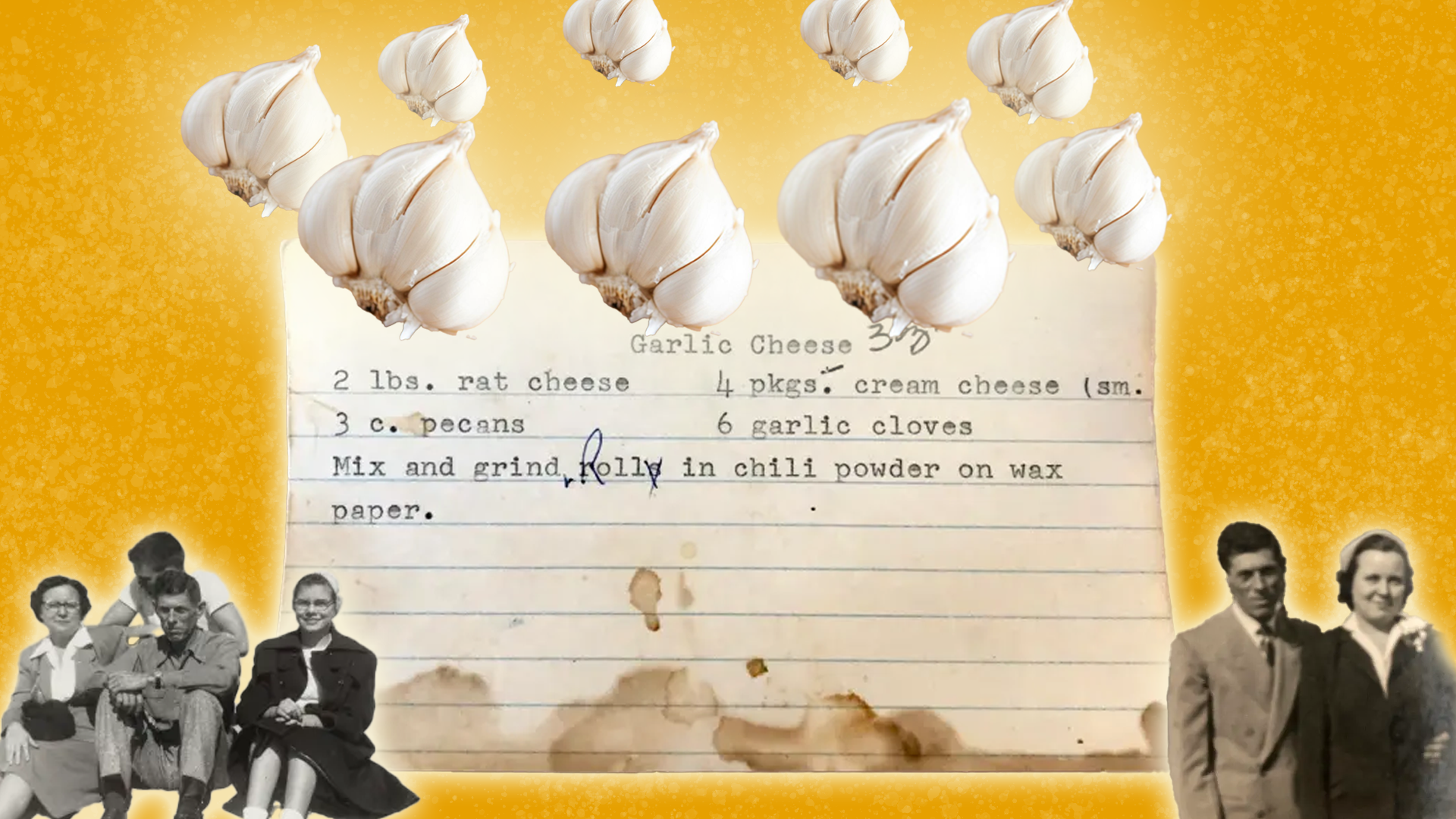
“Yes,” he says. “We have the original directly from his typewriter. He typed it for Mom.”
“The Magna Carta! Text me that bad boy.”
He does. From the hand of Lloyd K. Brown himself:

GARLIC CHEESE
2 lbs. rat cheese
3 c. pecans
4 pkgs. cream cheese (sm.2
6 garlic cloves
Mix and grind rolls in chili powder on wax paper.3
This was always the first of my Christmas presents. The rolls would be out on the counter and I had to reach up to cut one. The wax paper was already unwrapped.
The sensation that haunts to this day is one of intense chili powder—chili of powder-keg proportions. The rest of the kitchen was left to cooking less-spicy fare, with my grandmother dishing up the usual holiday medley, and my grandfather in his easy chair, smelling casually of Aramis.
“My latest theory is he rolled them in wax paper for the first time PRIOR to putting the powder on,” Steve texts. “Then rolled them in chili powder and transferred to clean parchment paper then rolled again.”
“Rolling the shape in wax is my method, but I would hardly call my shapes uniform.” A uniform shape is not essential but aesthetically pleasing. (Uniform coverage is paramount.) For size, I picture the barrel of a Wiffle bat and roll to that. This may not work for everyone.
Steve: “Yeah I think he had to shape it as he rolled. I do too. He had to have a method on the chili powder. I suffer from the exact OCD he did so I can anticipate him a little but can’t figure out how he got the perfection on the chili powder.”
We’ve spent years trying to figure out how he got the perfection on the chili powder.
2022
Steve and I’s kinship is a tightly woven matrix held in perpetual check by golf, Sooner football, old-time religion, and garlic cheese. Which of these institutions is the most sacred would make for a lively debate.
“Hello cousin,” he texts. “Steve Fielder here. Just letting you know that next week I begin the process of making original recipe garlic cheese. Made to the exact standards of our beloved grandfather Lloyd K. Brown. I may film it.”
“Do it. And resend recipe.”
“Protectionist” only begins to define my cousin’s near-maniacal approach to this slice of family lore. There’s a reason he calls it “original recipe garlic cheese.” When a week goes by without any pictures, I begin to question his dedication.
“Haven’t made them yet,” he finally texts. “Dad had a health issue that delayed things. Start early next week.”
“Made mine yesterday,” I respond. “Fudged on the recipe a tad: fortified the cheddars with a goodly amount of Stilton.”
Through the phone, through the distance, I feel him bristling at the alterations.
2023
Driving back from dropping our freshman off at college and already an emotional wreck, I get a phone call from my mother: Jerry Fielder, Steve’s dad, has died.
“Steve, Bonna phoned me about Jerry on my way back from Lawrence, and then I lost a day,” I text. “Give me a call whenever you have time. Hard to overestimate your dad’s influence. He was a force.”
“Mark. Forgot to call you. Been in a bit of a fog. Will try to call tomorrow.”
We don’t talk again until after the funeral.
“Man I’m so sorry I didn’t get to spend more time with you and Jason and Brent,” he says, referencing my brothers. “I love you guys. Please send along my regrets to Jason and B.”
“Yeah, on the drive back I got to thinking about all those Christmases.”
“Oh yeah.”
“I’m afraid you’re going to have to text me Lloyd’s recipe again.”
What did we used to do, call it out over the phone? Send it in a letter? Print it in one of those community cookbooks, Treasured Recipes From the American Reformed Church?

“Thought you would be interested in this,” Steve texts. “Lloyd K. used ‘rat cheese’ in his garlic cheese. I did some research to see what specifically that was. Rat cheese was originally a Colby BUT it doesn’t exist anymore. In the 1970s, Wisconsin changed the laws regarding what constituted Colby cheese (so it could be made quicker for increased production) and it is no longer made the same way. Cheese experts say the closest thing to it is cheddar. I am not happy about this.”
I once saw our grandfather nibble through the mold on a rat cheese. “That’s the good part,” he said. He was wrong, but his countenance was stronger than mind. There is good mold and there is bad mold, and I have consumed both, a habit I got from him. For example, the mold on a Roquefort is there by happy accident: edible and fine. The rot that bloomed on a Crottin de Chavignol after I put it on the ledge of our Paris hotel window—and ate with a demi of Champagne for a picnic on the Pont des Artes, in the rain—was not, and nearly killed me.
Steve’s lower-casing of cheddar (and mine elsewhere in our exchange) is noteworthy. Cheddar is the catchall in the lexicon, to cheese what Kleenex is to tissue. I tell him I found a Rutland Red, a Leicester cheese, just to see if I can get a rise out of him.
“It’s pricey though, too dear for a cheese log,” I say, pushing the idea that I may tinker—further—with his beloved recipe.
“I say cheddar,” he shoots back. “I like to think Paps would appreciate the obsessive effort to reproduce his work.”
2024
On May 1 my mother suffers a stroke; on August 8, his mother breaks her hip. It’s a long hot summer. Come late fall, we distract ourselves from the heat and bad news by discussing an act of blasphemy it’s hard to take the measure of: One of his nephews, it seems, is talking of eating garlic cheese on crackers.
“And truly I was irritated by it,” he says.
“As you should be. This is how we ended up with AI.”
“Exactly. We do not produce a cheese spread. I genuinely never saw Papaw or Mom or anyone else ever eat it with a cracker. Maybe I just missed it. There is a doctrine that governs the cheese and any deviation is error.”
I think he’s done. But I am wrong. He goes on:
“Seriously one of my real flaws is my fierce love for and protection of the family. When he told me he was having his wife’s sister make it I bristled. And when he told me they were eating it soft so that it would spread I really did take it as an insult to Paps, my Mom, me and the Browns. I really did. I truly wish I hadn’t given him the recipe.”
“They lose their true path,” I say, aching for us all.
“What kind of cheese did you use this year?”
“English coastal and Wisconsin extra sharp cheddars.”
“I am a purist,” he says, telling me what I already know. “I try to make it precisely as Lloyd did.”
“You are our Parsifal.”

On December 22, he texts: “Cheese is made. According to family orthodoxy.”
“It’s called garlic cheese,” I remind him.
The recipe calls for “6 garlic cloves.” A question now plagues the text thread: What does this actually mean?
“If I have one complaint on the recipe instructions it's hard to know what he meant by ‘clove,’” Steve says. “I use six as he specified but honestly I think his had more. I think it’s possible that what he meant by clove may have been what we call two. That is, both halves of the bloom.”
Then, a photo: “Here’s what I mean. The piece right above my thumb is actually two cloves but Papaw may have called that one. There were exactly 12 of those in the garlic I bought. Or exactly six if you call both sides ‘1’.”
Lloyd K’s had more garlic than mine; this I remember. More than Steve’s too, he says. It had a strong bite, as if the man was trying to ward off Vlad Dracul. We all agree: the garlic bite differs from maker to maker.
“Also. I believe Mexene may be the chili powder. It came to Mom today.”
From the website: “In 1906, John Walker of the Walker Chili Company developed Mexene Chili Powder in a small South Texas town.” The town was Austin. The jar is labeled Chili Powder Seasoning (emphasis mine). The ingredients are pod chili powder, cumin, oregano and garlic. Add another wrinkle of confusion to the wax paper fabric.
“How’s Bonna?” Steve asks after my mother.
“Not so hot.”
“Oh hate to hear it.”
2025
Over the Fourth of July weekend I get a text from Steve:
“I think Mom has decided to discontinue dialysis. She will not last long after doing so. Keep that under your hat for now please. I will let you know when it’s final.”
On July 18: “Mom died at 4:30 this morning.”
“Free at last,” I respond.
“Yep.”
I used to go through Okmulgee to see shows in Dallas: The The at the Bronco Bowl, 808 State at the Starplex Pavilion, James at Deep Ellum Live, Nick Heyward at Trees. The only time I go to Okmulgee is for Fielder funerals: Cousin Sherry in 2007 (age 43), cousin Greg in 2014 (53), Uncle Jerry in 2023 (87), and Aunt Myrna (85).
That leaves Steve.
“I am threatening as a personal tribute to not make the garlic cheese this Christmas,” Steve tells me. “We go dark this year to mourn my sweet Mom.”
“A season of fast.”
“Indeed.”
I let a season pass before I get the itch again:
“Man, I hate to make you do this again, but can you resend the pic of that card with Lloyd’s garlic-cheese recipe?”
“I am not convinced I have ever had the right amount of garlic,” he responds.
“Well, we have two things working against us: a very garlicky impression of yesteryear and an ambiguous recipe card. Six cloves of the usual Gilroy white would disappear in two pounds of rat and 12 ounces of Philly. But six HEADS seems excessive by any measure.”
“That is the issue,” he says. “I wish we knew the date he typed the recipe. I am going to check AI and see what it thinks the likely amount is.” A few minutes go by.
“Here is what AI says,” he texts. “If the recipe dates to the 50’s bulbs were smaller than they are today. They were of the California variety. Today bulbs come from China and are substantially larger than they once were. Given the cheese volume, AI thinks he almost certainly meant ‘bulbs,’ which at the time was a term often used interchangeably with cloves. AI used an average yield in tablespoons to compare to modern heads. It theorizes that he almost certainly meant bulbs but four modern bulbs would yield the same amount of garlic as six 1950s bulbs. It said that garlic didn’t become widely used in the U.S. until the late 80s.”
Testify! I learned this the hard way, trying to cook from a set of Time-Life books, Great Meals in Minutes. Fresh out of college, with a newfound penchant for cooking, I went looking in the grocery aisles for stuffs new to me—shallots and garlic, hazelnuts and basil leaves. The only garlic my Homeland stocked in those days was the granulated jar of McCormick. Garlic is granular, I had to learn and unlearn.
“You still plan on a hiatus in her honor?” I ask.
“No,” he says. “I may make some in her honor.”
“Now you’re talkin’.”
“I mean it’s what we do at Christmas.”
While not the most prominent ingredient in the recipe, chili powder is arguably the dominant—though the garlic may beg to differ. Steve and I both have a clear memory of this being a showcase for chili powder first and for cheese second. Curious then that no amount is specified, and that it’s not even in the list, only the instructions.
“I remember his chili powder distribution as more or less perfectly uniform,” Steve says.
“Takes a deft, if not heavy, touch,” I respond. “This is where you excel.”
He does. Steve spends the amount of time and attention on getting his chili powder spread just so. You would expect that kind of specificity from a man who reads Greek.
It might be days from now, it might be hours, but soon a text will wake up my phone indicating that my cousin has pulled the recipe card with the chili stains on it to begin again. He won’t need it for reference; he’ll do it out of compulsion, gathering the ingredients and following the steps to a T. In this year of loss and overall national tomfoolery, I may join him. I mean, I’m going to join him, just probably not with my usual expressions of upmanship. I will not seek out exotic Cheddars and smoked paprika. It will be a return to pastime. I can’t ward off greed and speculation, war and tragedy, fire and ICE, no matter how many cloves of garlic I use. But I can evoke a real and better allegiance with my cousin.
One thing I will do: leave it out at room temp. The garlic cheese does not do well with a chill. As with all things, it’s good to let it ripen.
Footnotes
- A gaffe on my part. Wensleydale is a Yorkshire cheese, produced some 250 miles from the Somerset village of Cheddar. When our family says cheddar, we only sometimes mean Cheddar.Return to content at reference 1↩
- Lloyd ran out of room typing, not even enough for a closing parenthesis. I have retained the omission in the interest of flavor.Return to content at reference 2↩
- This last sentence is lousy, especially for a man married to a public school teacher. What he meant to say was, “Mix and grind the first four ingredients, then roll in chili powder on wax paper.”Return to content at reference 3↩


