


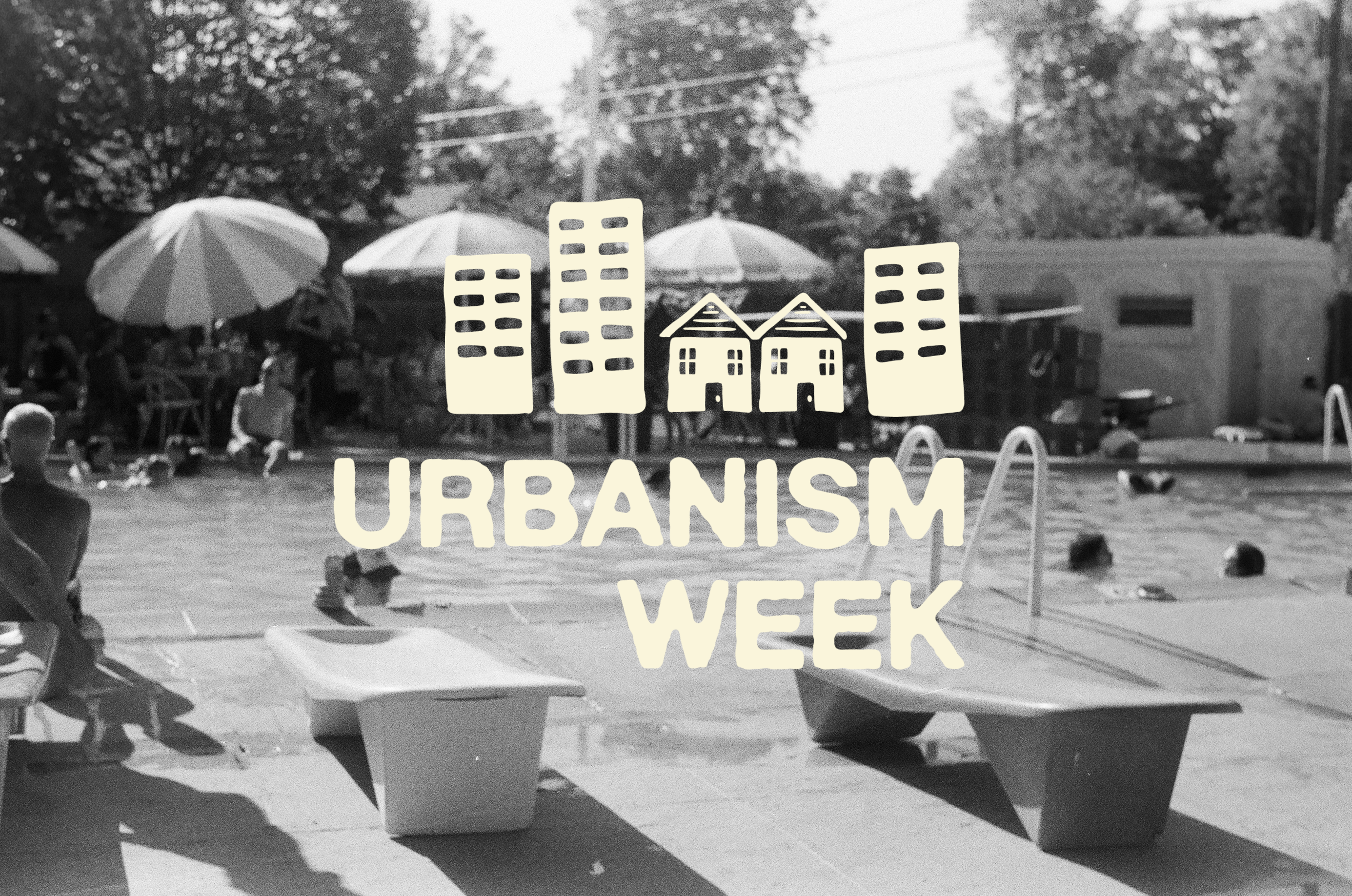
I was walking through Henthorne Park recently when I noticed a strange structure above a circular patch of grass, surrounded by concrete. It was too large and shaded to be a garden, but from a distance I couldn’t quite tell what it was. As I approached, I realized that I was looking at a filled-in pool. A quick search later confirmed that Henthorne Park’s pool closed in 2002. In retrospect, that empty space held more than I thought.
In 1998, my family moved to the Park Plaza neighborhood specifically because it had a neighborhood pool. This mattered as much to my parents when choosing a home as safe, strollable sidewalks. They understood the social value of a neighborhood pool: that it would serve as a reliable place to spend our summers, to meet neighbors and make friends without the hassle or cost of owning a pool ourselves. Luckily, Sun n' Fun, the wholly volunteer-run pool in Park Plaza, became the perfect third space for our family to escape the heat.
My dad served as the pool president at Sun n’ Fun for years. I remember listening to the radio in our garage while he repaired webbed lawn furniture he’d often rescue from the side of the road. He would mow grass on the pool property, manage the chemicals, and stock concessions. Once, he threw me in the pool filter to collect all the frogs that accumulated there over the off-season. My mom occasionally worked as a lifeguard and would offer swim lessons to kids in the neighborhood. When I turned 14, my first job was lifeguarding.
Some of my favorite childhood memories are from the pool. My younger sister and I, both Leos, celebrated our birthdays there year after year. We had a barbecue on Memorial Day and Labor Day to celebrate the unofficial open and close of the summer. The Fourth of July was a blur of swim races, picnic games, and a potluck. My favorite event was the money dive: board members would take cash from concessions and drop it in the pool for kids to grab, and we promptly returned our winnings to the stand for chocolate drumsticks.
We devoted many summer days to playing mermaids and marco polo. Some nights, if we were lucky, another family would bring their projector to play a movie. As we got older, we would compete for the deepest tan and use the pool as a backdrop for our MySpace pictures. I still stay in touch with many of the friends I met there in the early aughts. I assumed most people had grown up with a place like Sun n’ Fun—until I started to look for a house myself.
The pool at LaFortune Park has been closed since 2020 due to social distancing, with no sign of reopening. Harvard Club pool allegedly burned down in the ‘90s. Newblock Park and Braden Park pools have vanished. The city pools at Maple Park and Florence Park have been replaced with a splash pad, as have many others.
My search for a home near a neighborhood pool had turned out to be much more frustrating than it had for my parents. Where did Tulsa’s neighborhood pools go?
Who Gets To Swim?
Pools have always been a setting for our national culture wars. Access to pools can be an interesting way to track America’s castes: who gets beneficial amenities and who gets left out, who’s entitled to welcome and who has to fight for it. Political, racial, and socioeconomic realities are all present between the lifeguard chair and the concession stand.
Before the 1890s, indoor private bathing was considered a luxury in America. Those who couldn’t afford to scrub their toes in seclusion did so in the nearest creek or river. As America industrialized, public bathing pools gained popularity, eventually giving way to the modern public pool as we know it: a space for socializing, exercise, and relaxation.
Municipal pools boomed beginning in the 1920s. Progressive-Era reformers reasoned that building pools in working-class areas would cut down on social problems in American cities. Who was and wasn’t allowed to use the pool was an open question for much of this time, both before and after the 1964 Civil Rights Act outlawed segregation in public spaces in the United States.
Robert Moses notably used New Deal money in the 1940s to build pools in poor and wealthy neighborhoods alike across New York City, though historians still debate whether or not some of Moses’ choices exacerbated racial segregation. In Robert Caro’s Pulitzer-winning biography of Moses, The Power Broker, Moses tells a city official that lowering pool temperatures would deter Black and Hispanic residents from using them. Moses contested that particular detail in Caro’s book.
Faced with the prospect of allowing Black Americans to swim, some pools chose to close entirely. In other cases “white swimmers imposed and enforced racial segregation through violence,” according to Jeff Wiltse, a history professor at the University of Montana who wrote the book Contested Waters: A Social History of Swimming Pools in America.
Fred Rogers made history in 1969 with an iconic scene filmed for his public access show Mister Rogers’ Neighborhood. In the scene, Rogers fills a children’s wading pool and invites Officer Clemmons, a Black police officer, to take a rest and place his feet in the pool. Initially, Clemmons resists, as he doesn’t have a towel with him. Rogers insists, and he offers Clemmons his same towel to dry off with. Clemmons later described the moment as “a definite call to action on Fred’s part.”
Lortondale: Tulsa’s First Community Pool
In Tulsa, city and neighborhood pools were once plentiful. A front-page Tulsa World story from May 30, 1954 trumpets “the official opening of the new $250,000 modernistic swimming pool at McClure park” that held capacity for 850.1
Exactly two years later, a new Tulsa pool opened a few miles to the south and west, in the Lortondale neighborhood. More than 200 people took a plunge on its first day of operation. It was the first community pool to be built in Tulsa in a housing division by a developer, according to a Tulsa Tribune story at the time. Thousands of Lortondale home listings printed in both the Tribune and the Tulsa World at the time frequently mention the pool as a selling point alongside such other amenities as central air conditioning, wall-to-wall carpeting and proximity to a bus line.
Lortondale developed a bohemian reputation befitting its midcentury architecture, and the pool was a big part of that culture. Alexander Hogue, Margaret Tomshany Kelley, Don Kelley, and Brad Place were known to have pop-up art shows at Lortondale, featuring the work of their students at the University of Tulsa. Mrs. Sonny (Suzan) Gray, a vocalist with her husband’s jazz orchestra, would pose for a photo with a Richard Neal painting.
According to Don Wheeler, a former Lortondale Club pool president, the pool began to struggle financially in 1982. Membership diminished as the neighborhood’s original homeowners no longer had children at home who wanted to use it. Cash for repairs and upkeep became scarce. The Lortondale board was forced to partition the land the pool sat on for quick profit.
The ‘90s were even worse. Misfortune struck in 1990 as the Lortondale pool shell “floated” above its original placement, likely due to negligence. Board members scrambled to fix it ahead of opening day. A dump truck was brought in, the pool was repiped, and fresh concrete was poured in a hurry. Thirty-six years later, correcting the uneven concrete and PVC piping is going to be a monumental undertaking.
Today, Lortondale’s pool has bounced back after a rough couple of decades.2 Membership is at capacity, the amenities are festive, and summers are bright again. Nobody is more responsible for Lortondale Club’s revitalization than Sean Everett, who organized countless concerts and parties, in addition to maintaining a high standard of safety and cleanliness. Everett even carefully sourced vintage furniture over time, routing his family vacations around Facebook Marketplace pickups in order to maintain the pool’s distinctive midcentury look.
I doubt Lortondale would be as popular today without the work he and countless other volunteers have done to get it there. That work has restored not just the pool itself, but the pool’s status as a desirable third space of the kind that’s becoming endangered as our economy grows more K-shaped.
Financial Ebbs & Flows
Unfortunately, the last two decades haven’t been as kind to Tulsa’s municipal and neighborhood pools as they’ve been to Lortondale.
In 2002, former mayor Bill LaFortune cut the city’s pool budget by $300,000, forcing the closure of 13 pools in a single summer. Private donors couldn’t close the funding gap, as the city received only $60,000 in contributions. It took 16 more years, but in 2018 Tulsa Parks began pool upgrades at Lacy, Whiteside, McClure, and Reed Parks, all of which are now back in action; a new public pool opened at Chamberlain Park in 2025, funded through Improve Our Tulsa.
In the intervening years, neighborhood pools have filled an important social need in a relatively affordable and accessible way, and they’ll continue to do so as municipal budgets shift. Pools like the one I knew growing up are what I consider a “neighborhood pool.” These are typically organized and managed by an elected board of volunteers who rely on reasonably priced memberships and donations to operate. 5300 Club, Forest Creek, Lortondale Club, Park Plaza South, Sungate, Sun n’ Fun, and Valley Glen pools are all neighborhood pools. Some only allow members to attend, while others may also offer a day rate to the public.
By contrast, YMCAs are great for swimming for sport, but often lack the familiarity and socialization desired in community spaces. And country clubs require steep upfront costs and monthly fees that leave a lot of Tulsans unable to join, by design. Big Tech has even gotten in on the action. Airbnb-type companies like Swimply let its users rent pools from private pool owners for a limited time, divorcing social cohesion from the poolgoing experience.
The Pool As Social Infrastructure
But neighborhood pools create an environment unlike any other: a place where neighbors gather and unwind, sustained through the shared investment of time and resources that make recreation accessible and community-centered. Rather than serving as isolated destinations that require a drive across town, their walkable locations foster a sense of familiarity and encourage spontaneous interactions that are increasingly rare in Oklahoma. In doing so, they function as small but mighty pieces of social infrastructure, strengthening relationships and cultivating a shared sense of ownership within the community.
The pool requires me to unplug. I remove my watch and leave my phone in my bag. I lose track of time and choose leisure in a way that few other built environments afford. Pools and electronics famously don’t mix, limiting one’s ability to work remotely. And kids are off their devices, abandoning their parents for the other kids at the pool with glee.
Seeking summers that felt like my childhood, my husband and I found a home in Lortondale. We loved that this neighborhood has two pools, a park, a library and an elementary school. I followed in my father’s footsteps and quickly joined the board at Lortondale Club pool. This introduced me to like-minded neighbors, who wanted to protect the pool as a third space the same way my family did for Sun n’ Fun. What I didn’t realize at the time was just how popular Lortondale Club was to so many families outside of the neighborhood, in large part because so few neighborhood or municipal pools exist within midtown.
Shane Darwent is an artist and a Lortondale member. He spent last summer in Omaha, Nebraska with his son and his wife, Elspeth Schulze, also an artist, who was doing a residency at the Bemis Center. “Maybe we were a bit naive to expect it to feel a bit cooler than Tulsa, but Omaha was just as hot,” Shane said.
They asked around for natural bodies of water to enjoy, but locals only suggested pools. It turns out that fertilizer runoff from nearby farmland had led to the city of Omaha developing, as Shane put it, “a strong culture centered around pools.”
“People would gather at these pools the way someone might meet up at the Gathering Place or Philbrook Museum,” Darwent said. “Their pools were built into the fabric of the city itself. Halfway through the summer, we realized Omaha had something we hadn't known we were missing in Tulsa.”

Building and maintaining pools is a long-term investment whose payoff is a more resilient community. Cities around the world are now evaluating how to activate urban waterways in the face of a heating climate. But others have long known about the social cohesion that pools create.
In Iceland, for instance, public pools are more than a municipal investment; they are a key factor in social well-being and are even considered a civil right. Some of this enthusiasm for outdoor swimming was born out of necessity: in 1887, a newspaper reported that over 100 Icelanders drowned that winter. Something had to change. The country’s national energy authority began offering no-risk loans to villages across Iceland to drill for geothermal energy, helping modernize homes and aid the construction of public pools. As pools became common in communities throughout the country, swimming education was made mandatory in all Icelandic schools in 1943. With few other third spaces available, and despite the frigid above-water temperatures, the pool became the place to meet your neighbor, face your rival, or greet a newcomer.
It’s impossible to avoid interaction with one’s fellow citizens in these waters. Icelandic pools require all guests to strip completely nude and vigorously scrub their bodies before entering. The pool becomes an equalizer where all bodies are welcome; there is nothing to feel ashamed of in your own skin. I’m not suggesting that the City of Tulsa or neighborhood pools should introduce similar requirements, but it’s worth noting the seriousness with which one of the world’s healthiest, happiest countries takes its pools.
Tulsa’s own pools are inching back as much-needed and viable gathering places, even though access to such spaces is still a stretch for many due to growing costs and lack of walkability. Neighbors worked together to restore and reopen Valley Glen pool in east Tulsa after an unexpected $9,000 maintenance bill in 2023. Community members are donating money to help cover admission for children who want to swim at Lacy Park but may not otherwise be able to afford the $3 cost. Volunteers continue to show up, year after year, to keep their community spaces updated and safe.
It can be thankless work to some, but invaluable to others. Public pools demonstrate that recreation and social infrastructure are not separate investments. Their value extends far beyond luxurious leisure. Their greatest contribution is providing a place where community is practiced every day.
Footnotes
- One does wonder how many of those 850 Tulsa poolgoers weren’t white.Return to content at reference 1↩
- Full disclosure: I’m currently the president of the Lortondale Club, so I’m a little biased here.Return to content at reference 2↩