


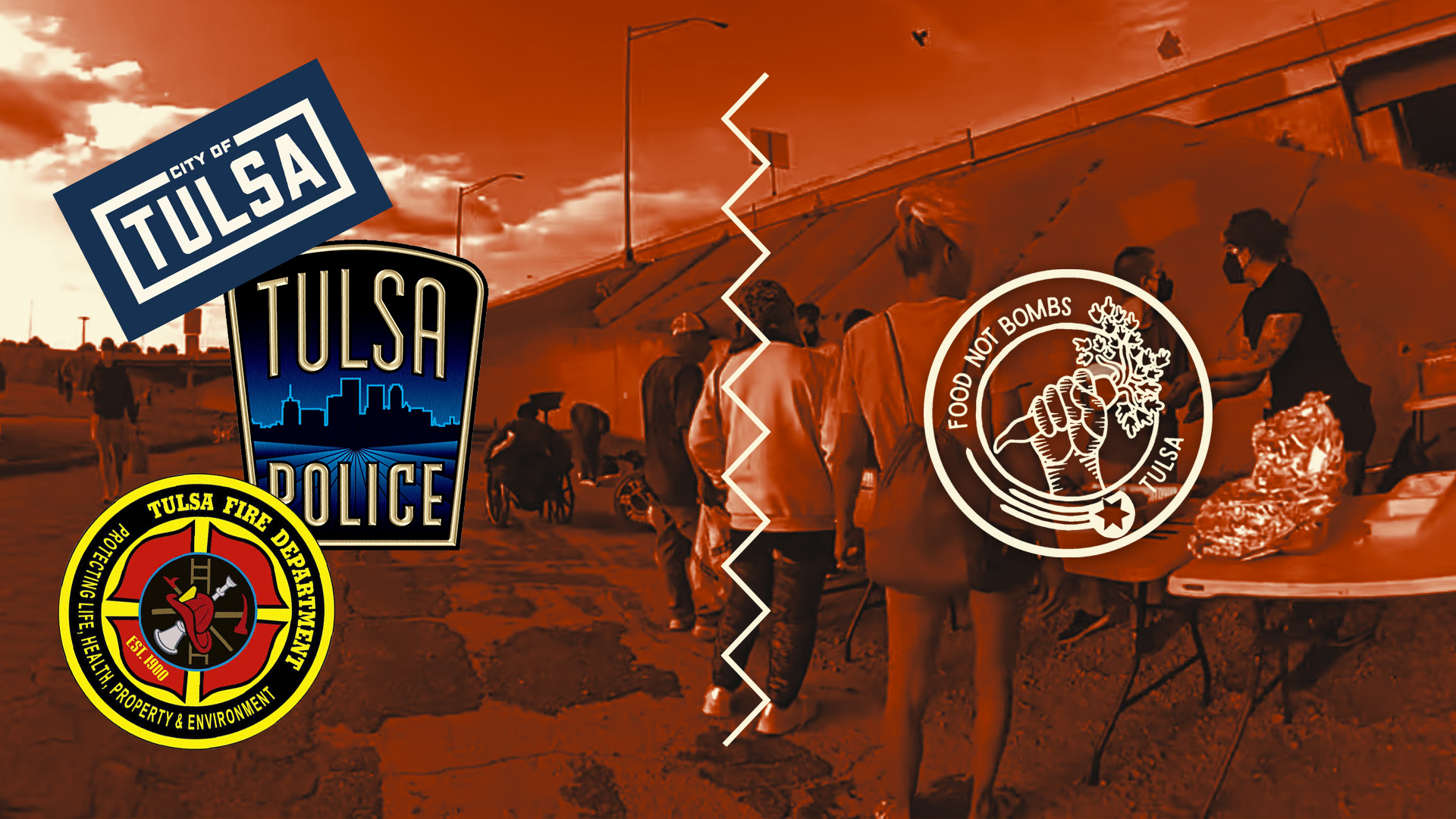
What began as a routine weekly food distribution in downtown Tulsa last month ended with multiple volunteers getting arrested.
By the end of the night on Wednesday, May 6, several people affiliated with Tulsa Food Not Bombs had been handcuffed while others left under police order. What unfolded raised questions not only about what happened on the street that evening, but also about how a longstanding mutual aid operation became the focus of escalating police surveillance and city intervention in the first place.
Tulsa Food Not Bombs (hereafter abbreviated as TFNB), has operated since July 2020, distributing food every Wednesday evening to any and everybody who shows up, no strings attached. For years, the organization operated publicly and consistently in downtown Tulsa without significant interference, but that changed near the end of April 2025 when volunteers say they were approached by the fire marshal while distributing food in Legacy Park, located near the corner of Main and Archer in the Arts District.
According to TFNB volunteers—who spoke on the condition of anonymity—the fire marshal told them he was acting under orders from the mayor’s office and instructed the group to leave or face citations. Volunteers relocated shortly after, characterizing the decision as an act of compliance, made in good faith. The group moved their distribution site away from local businesses in an effort to avoid further conflict.
Shortly after that interaction, TFNB volunteers said they attended a meeting with Mayor Monroe Nichols and other city officials. During the meeting, TFNB raised what they described as the central question underlying the conflict: why had the city intervened now, after years of allowing food distributions to occur in the same location without issue?
According to volunteers, the city’s answer centered on permitting. Officials insisted TFNB obtain a special events permit in order to continue distributing food each Wednesday evening. Volunteers pushed back, arguing that the distributions constituted a form of public protest protected by the First Amendment. Notably, there is a precedent for this argument with a 2018 court case decided by the 11th U.S. Circuit of Appeals, which characterized the distribution of food to the unhoused as “expressive conduct,” and ruled in favor of a local Florida Food Not Bombs chapter, declaring Fort Lauderdale’s permit requirement unconstitutional.1
In response to these arguments, city officials have repeatedly returned to concerns about business traffic and downtown activity as justification for requiring a permit. “A primary word that they used a lot was traffic,” one volunteer recalled. “Whenever we asked them to kind of explain more what they meant by traffic, it wasn't so much vehicle traffic, as much as it was business traffic for that area.”
In the months that followed, TFNB says only a handful of emails were exchanged and that their final correspondence with the city occurred in July 2025. “It had been fully nine plus months since we had last heard from them,” a TFNB volunteer said. “And then all of a sudden they're showing up, there's 20 sheriffs and cop cars there, and they're arresting us.”
In a statement following the arrests, the city of Tulsa continued to frame the issue as one of public order and permit enforcement, while insisting that it supports organizations serving unhoused residents so long as they comply with city ordinances and permitting processes. Copies of the emailed correspondence between the city and TFNB obtained by NonDoc corroborate interviewees’ experiences with the city, as well as the city’s lack of communication since July 2025.
What Happened On May 6?
TFNB volunteers said they arrived for their regular distribution around 6pm on Wednesday, May 6. About ten minutes later, they said, multiple police vehicles showed up and monitored the distribution for more than 40 minutes. Officers then approached the group at approximately 6:51pm, according to the timestamps on Tulsa Police Department body camera footage obtained by Channel 2 News.
The footage shows an officer, identified as Lieutenant Jonathan Oxford in TPD arrest records, informing volunteers that they are required to possess a permit to distribute food. “We’re gonna shut everything down, you guys have to have a special permit to be out here,” he says at about 6:52pm. Lieutenant Oxford then dismisses a volunteer’s claim that the group’s activity is protected by the First Amendment before saying that citations would now be issued.
The lieutenant then moves closer to the tables where volunteers were already packing materials away, appearing to comply with earlier instructions to shut the distribution down. Lieutenant Oxford calls for backup shortly after approaching the volunteers.
The encounter then briefly escalates. As one volunteer steps forward to help clear materials from the area, two officers, including Lieutenant Oxford, physically restrain her and force her backward toward the group before placing her in handcuffs. Three other volunteers are arrested during the confrontation and the moments immediately following it, along with a man filming the altercation between police and volunteers. In the footage, Lieutenant Oxford informs them that they’re being arrested for obstructing an investigation.
“The mayor’s office warned you guys,” Lieutenant Oxford says to a volunteer at about 6:54pm, according to the time stamp on body camera footage.
After a few minutes of arguing, the confrontation calms down and police sirens can be heard in the background. At 7:01pm, officers confer about who to arrest and why. At one point, a volunteer can be heard counting 12 police vehicles on scene. From that point on the footage mostly shows officers standing around. As one volunteer put it, “there was truly nothing for them to do.”
“I started detaining them and they fuckin’ surrounded us. There were only three of us,” one officer says at about 7:05pm.
According to a call service sheet obtained from TPD by Deon Osborne, the call related to the May 6 incident was received at 6:50pm, with officers arriving on scene at the same time. The record does not indicate any calls from nearby businesses or residents, suggesting the dispatch may have been internally initiated by law enforcement.

What Did We Learn Here?
For TFNB volunteers, the timing and rhetoric surrounding Operation SAFE raised broader political questions about the city’s posture toward homelessness and mutual aid. One volunteer I interviewed suggested that pressure from the state may have created an incentive for the mayor to take action on the issue of homelessness.
“I think it also coincides with Governor Stitt's ordinance with Operation SAFE,” the volunteer said. “So whenever he did that, he really cracked down on Monroe and kind of like held his feet to the fire.” In that framing, TFNB becomes an accessible target: a highly visible organization operating in public, serving unhoused residents downtown without formal city authorization.
With the launch of Operation SAFE last year, state officials signaled that clearing homeless encampments had become a political issue, one they framed as a matter of order and safety. Never mind the fact that Tulsa housing service providers met afterward to discuss the ways that Operation SAFE set them back from their goals of increasing housing security in our city.
In the state’s framing, mutual aid groups like TFNB exist in direct conflict with the city and state’s priorities. Rather than distribute aid discreetly, they meet people in public and create consistent meeting spaces for unhoused Tulsans, challenging the idea that poverty can be swept out of sight by law enforcement.
This contradiction is especially striking given the rhetoric around Tulsa’s approach to homelessness under Mayor Monroe Nichols, who campaigned heavily on the issue. Publicly, city leadership has emphasized compassion, collaboration, and humane responses to unhoused communities. Yet the May 6 arrests and insistence on red tape suggest a parallel approach of regulation and containment.
Taken together, the events of May 6 amount to much more than a single confrontation between police and activists. They show a city that’s more concerned with regulating visible homelessness rather than addressing the material realities faced by our unhoused neighbors in need of food, clothing and shelter.
Footnotes
- Moreover, in January 2024 a local Texas chapter of Food Not Bombs filed a federal lawsuit against the city of Houston for citing volunteers, and only a month later in February, federal courts granted a preliminary injunction on the issuing of citations. As of June 2024, U.S. District Judge Andrew Hanen denied the city of Houston’s request to dismiss the case. Return to content at reference 1↩


