Skip to Content
Music

Gen Z Is Finding Their Way To Woody Guthrie

From Solid Sound to WoodyFest to Tulsa, our correspondent tracks Guthrie's legacy beyond nostalgia and into the future.

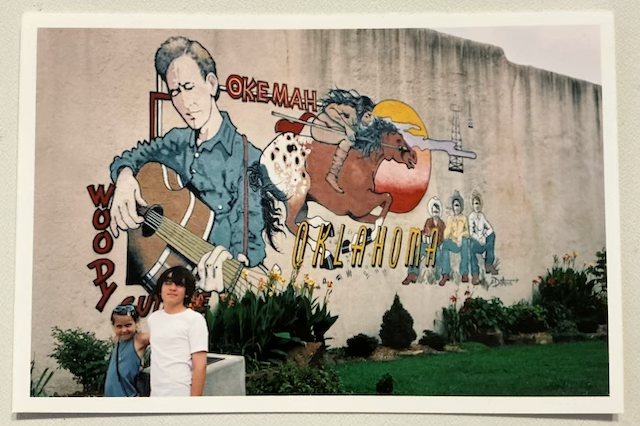
Musicians Louise and Sam Sullivan visiting Okemah, Oklahoma, during a family road trip around 2003

|photo courtesy of Louise Sullivan

Every other year since 2011, Chicago-based band Wilco has hosted and curated the Solid Sound Festival at the Massachusetts Museum of Contemporary Art (better known as MASS MoCA) in North Adams, Massachusetts, a tiny hamlet tucked into the Berkshire Mountains. Over three days in late June, around 8,000 people gather for music, art, food, and experiences like breaking the world record for the most people yo-yo-ing at the same time. 

On June 26, the night before the yo-yo-ing, listeners packed Joe's Field, the museum's outdoor amphitheater, to witness the first-ever full concert with Wilco and Billy Bragg playing a set of songs from the music that had thrown me and many other Gen X-ers in the alt country pipeline onto Woody's trail so many years ago: Mermaid Avenue, a 28-year-old, three-album collection of Woody Guthrie lyrics with music composed by Bragg and members of Wilco. 

With the 2026 Solid Sound set, a vinyl re-issue, and a recently released book about the making of Mermaid Avenue, these songs are back in the Americana music zeitgeist. With them come Guthrie’s own questions and answers for a generation that’s facing struggles not so different from the ones his own fellow Americans faced. 

It's not ideal that his ideas are still necessary more than 80 years after his career began. But the surge of his songs—those from Mermaid Avenue and others about labor organizing, deportation, and racial injustice—back into the cultural bloodstream suggests that there’s more to his legacy than nostalgia. 

Back in 2012, while finding solace in the Mermaid Avenue albums during an early midlife crisis, I hit the road, hobo-style, in search of Woody Guthrie. My travels took me across the country, following the trail of commemorative events during his centennial year, including the first of over 20 trips to Tulsa and four weeks of research in the Woody Guthrie Archives. 

It took 14 years, but all my Woody-chasing turned into a book-length memoir. As I started sending query letters to literary agents earlier this year, the Solid Sound Festival lineup was announced, and I knew it would have to be included. And so I’d have to get there. Woody has been key to my own discovery: personal, musical, and political. This summer, thanks to him, I hit the road again, from North Adams to Okemah, with an ear to how he’s traveling into the future. 

Reconciliation And Resistance At Solid Sound

The Woody I know best is the protest musician who influenced Wilco, Bruce Springsteen, Joe Strummer, and the alt country stalwarts of my 1990s early adulthood. In 2026, with so much to protest, that influence is only growing louder. 

Guthrie's song "Deportee" has recently been reimagined by Springsteen, Margo Price, and John Fulbright in light of the ICE actions around the U.S. It’s the subject of an upcoming documentary based on the books of Tim Z. Hernandez. It was the theme of Woody Guthrie Poets this year. Woody’s "This machine kills fascists" scrawl is a regular sight on protest signs and memes, and the Woody Guthrie Center reported a staggering increase in revenue from its anti-fascist merch last year.

At Solid Sound, protest messages were surrounded by friendly feeling. The festival grounds teemed with popup performances in the museum and packed shows in outdoor courtyards, including a set by Billy Bragg where drenching rain poured through bright sunshine. Food truck vendors slung broccoli-based vegan creations next to bratwursts and Asian dumplings. Concessionaires sold out of beer and water before the night ended. A record-breaking crowd of all ages—from elderly folkies to infants strapped to their parents' chests—cheered, laughed, cried, and sang throughout the show. 

A team of mermaids welcomed Solid Sound Festival attendees in landlocked North Adams, Massachusetts, on June 26, 2026 | photo by Robin Wheeler

At the festival entrance, I found former Woody Guthrie Center Executive Director and Tulsan Deana McCloud visiting with her son-in-law, who’d come to the festival from Norman with 20 of his friends. We talked a few days later about the intergenerational crowd. 

"The Mermaid Avenue albums have always had a broad appeal, from serious songs, playful ones, tunes that were a little risqué, spiritual songs, and everything in between,” McCloud noted. “The variety of songs that Jeff Tweedy and Billy Bragg selected from the archives reflect Woody as a whole person, and folks of all ages are drawn to those songs because they are able to show Woody's personality through his personal narratives, which are the songs that touch our hearts the most."

If Solid Sound is Wilco Summer Camp, then the Mermaid Avenue set was a joyous 30-year camp reunion of old friends and foes who’d buried the hatchet in the intervening years. Jokes, hugs, and smiles abounded on stage and in an exuberant audience, yet the performance was smooth and tight, like no time had passed—much less 28 years—since these artists had shared a stage. 

After Bragg led the crowd in a ferocious, fist-pumping “All You Fascists,“ the night ended with the most recognized Mermaid Avenue track, “California Stars,“ and a singalong rendition of “This Land Is Your Land.” The stage was packed with musicians from elders to children, along with several generations of Guthrie progeny. For a moment, everyone seemed unabashed and unashamed to sing of the United States—the good and the bad.

The stage backdrop for Wilco and Billy Bragg's "Mermaid Avenue" set at the Solid Sound Festival on June 26, 2026 featured art and writing by Woody Guthrie that's housed in the archives of the Woody Guthrie Center | photo by Robin Wheeler

It’s Actually Cool To Care About Something

Bragg often speaks about the need to eradicate cynicism, a worldview that permeated Gen X and has trickled into a Gen Z facing rising food costs, housing and job insecurity, and other real-life signs of a crumbling America. The Mermaid Avenue set spoke to that, too, settling disagreements or setting them aside, as Bragg and Tweedy have done, in the name of something bigger: joy, expression, care. 

Before the festival, Gen X Long Island-based writer Mike Conklin wrote about Sam and Louise Sullivan, the family band that opened this year’s Solid Sound. He told me afterwards that he tried to see the festival through that duo’s younger eyes and noticed similarities between young listeners and middle-aged ones. 

"I do think there are some parallels between [Gen Z] and Gen X where a sense of ironic detachment has really taken hold in how they engage with the world around them," Conklin said. "Even just for myself, going from listening to bands like Pavement or even early Weezer in high school, to discovering Uncle Tupelo and the rest of the alt country movement—which, it could be argued, reached its peak with Mermaid Avenue—there was something so appealing about feeling encouraged to care about stuff. And I think something similar is happening with Gen Z right now. I've been really trying to stay on top of new music lately, and it's been really interesting to see how frequently alt country comes up as an influence."

Louise Sullivan, who traveled with her brother from Philadelphia to perform their indie pop, folk-tinged music at Solid Sound, said that Mermaid Avenue alt country connection played a large part in how they make music. They even have childhood home video of them singing Guthrie's "Roll On Columbia" on the banks of the Columbia River as children in Portland, Oregon. 

"We grew up singing a lot of Woody Guthrie songs, and around Wilco albums, listening to Mermaid Avenue particularly,” Sullivan told me. “My dad and mom are big Wilco and Billy Bragg fans. We took a bunch of road trips when we were kids. Our parents brought us to Okemah." 

"Woody Guthrie wrote songs about everything he'd seen, thinking about the people, the land, housing rights, landlords, workers, and it feels like his life is in song,” she continued. “That's something we feel influenced by as musicians, that life is worth singing about."

Musicians Louise and Sam Sullivan visiting Okemah, Oklahoma, during a family road trip around 2003 | photo courtesy of Louise Sullivan

Poet and current Woody Guthrie Center employee Quinn Carver Johnson considers themself lucky to experience this at work daily. A Gen Zer raised in Kansas on Guthrie's music, Johnson called it "[a] privilege to work with thousands of school students who visit the center every year and I get to watch as they find their own connections to Woody. This is the true Gen Z, raised in an increasingly hyper-accelerated, mega-modern world." 

Johnson said media like the 2024 Bob Dylan biopic A Complete Unknown "allows socially-conscious young folks a foothold to explore Woody's message." Young Oklahomans will get a full immersion in that message when they come in for tours this fall: the current special exhibit at the Woody Guthrie Center is called “A Dozen Loops: The Radical Voice of Woody Guthrie.”

Like Johnson, Sullivan sees the current relevance of Guthrie's music. "It was really exciting to hear these [Mermaid Avenue] songs again as adults and to hear how interesting they are lyrically,” she said. “They're unusual, dense and weird in this cool way. Those lyrics are really powerful. I think sometimes in the folk tradition things can be made to feel simple. Those songs are beautifully challenging and yet still so amazing and comforting to listen to. They feel so good to sing. Music is really about sharing something, about connection."  

Seeds Of The Future At WoodyFest

If Solid Sound is a summer camp reunion, WoodyFest is more like a family reunion. It’s been taking over the small town of Okemah for three days every July for 28 years, bringing an influx of folkies from around the world. While both festivals platform emerging and classic artists, the Oklahoma festival thrives on repeat performances from favorites like James McMurtry, The Red Dirt Rangers, and smaller folk acts, including plenty of regional artists. Judging from the positive response to folk and protest music firecracker Carsie Blanton's headlining set this year, giving even more space to up-and-coming artists would probably be welcomed too. 

There are some questions about how WoodyFest will continue as its leadership retires, attendees age, and finances grow tight. The festival was free until 2015, but now ticket prices for the main venues are on par with Solid Sound's three-day passes. Faraway fans can access live streams of the sets for a fee. Some of the fanbase struggles with the technological advances WoodyFest has adopted to keep up with the times, like online ticket sales. 

You won't find any yo-yo-ing world records being broken at WoodyFest, and no one’s riding on a mechanical Grillo's Pickle as at Solid Sound. Ticket prices might be rising, but this is definitely a folk festival without a corporate presence. There's a strong focus on activities for kids, including a stage for performers under 20 years old, harmonica lessons, and a mainstage showcase for kids who participated in the festival's songwriting and recording workshop. Both festivals include broader educational components, too: Solid Sound uses MASS MoCA's art resources for album cover design and screenprinting workshops, while WoodyFest brings in expert panels and poetry. 

Prof. Aimee Zoeller—who was also at the Solid Sound Mermaid Avenue set, which she said “overwhelmed me in the best possible way“—led one of those panels at this year’s WoodyFest, a discussion about folk revival protest musician Phil Ochs, whose archives are also in Tulsa. Zoeller teaches a college course called “Music and Social Change in the United States“ through the sociology department at Indiana University Columbus, which gives her a front row seat to what music is influencing young adult listeners. She's also part of the Teaching Woody Guthrie Collective, a group of scholars who help educators include Guthrie in their curriculum. 

Aimee Zoeller, presenting with the Teaching Woody Guthrie Collective, at the Woody Guthrie Center on May 6, 2023 | photo by Robin Wheeler

In Zoeller's course, she locates Guthrie in every movement—labor, civil rights, anti-fascism—with an emphasis on how someone born in Okfuskee County in 1912 could transform into an anti-racist, a theme that remains evergreen on the individual and collective scale. On her campus, 45 minutes south of Indianapolis, many students are from rural areas not too different from Okemah. “It's not equivalent to Woody's background, but it is parallel in ways,” she said. “[These students] can relate to rural issues like industrialization, labor issues with a lot of available jobs being low-pay. It's pretty easy for them to see what Woody wrote and say, 'Oh yeah, I get that because I can apply it to my own life.'"

Zoeller doesn't aim to make her students experts on Guthrie. Instead, she draws connections between his music and artists who came before and after him. “The objective is to use past and contemporary music to illuminate social problems and their potential solutions. The music is just a way to get there,” she said. 

As listeners of all ages keep connecting—through modernizations of his words, celebrations at festivals, reimaginings of his words and ideas, digging into his history beyond the whitewashed version, and a love of the personal and universal ideas he expressed—Woody Guthrie keeps speaking to us. As long as our world is the way it is, he probably always will.

If you liked this story, please share it! Your referrals help The Pickup reach new readers, and they'll be able to read a few articles for free before they encounter our paywall.

Stay in touch

Sign up for our free newsletter

More Stories

The Best Tulsa Events: July 22-28

"Oklahoma!", Benson Boone, Tulsa Fringe Festival, and more!

July 21, 2026

Let’s Take A Trip To Imaginary Oklahoma

Heat crazed? Get into the spirit with selections from This Land Press' flash fiction series, in which 46 of America's most important writers spun their own takes on the 46th state—from cryptid fables to surreal situations.

July 20, 2026