

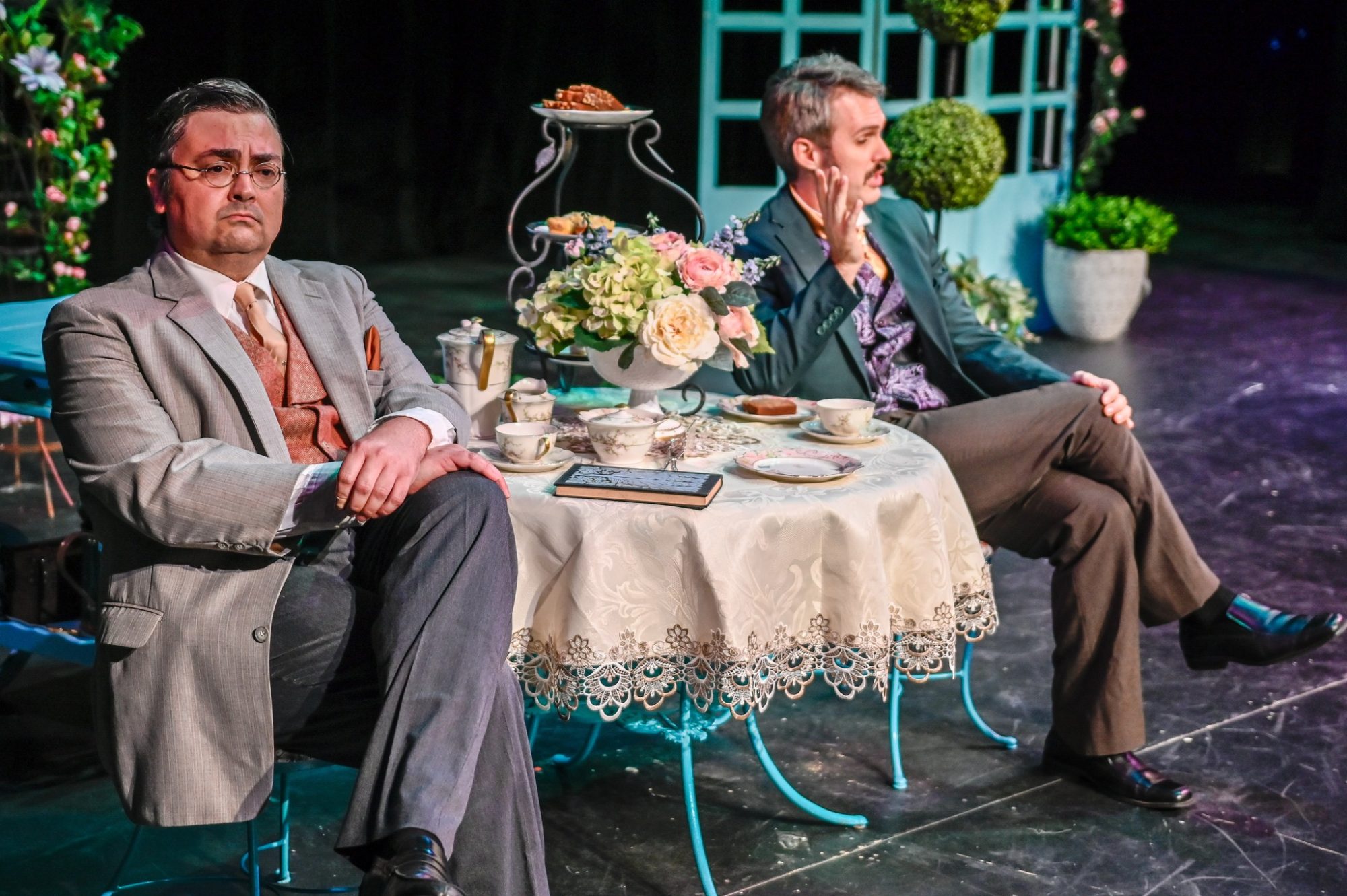
The Tulsa theatre season is in full swing. Between the established companies, new companies and a wave of independently produced productions, shows are opening almost every weekend this fall. As an avid theatre-goer, I use these first few weeks of the season to see what’s in store artistically for the rest of the year. This past weekend, World Stage Theatre Company kicked off its eighth season—promising a year of “Timeless and Relevant Stories”—with Oscar Wilde’s The Importance of Being Earnest, which continues through September 28.
The play, which premiered on Valentine’s Day 1895, follows two friends, Jack Worthing and Algernon Moncrieff, as they create false identities to skirt social responsibilities. The satire serves as a commentary on Victorian social norms and the institution of marriage, which makes sense coming from Wilde, who was known to have relations with men (and was criminally convicted for it in the same year the play premiered).

I felt a distinct shift as I walked from the 2nd Street lobby into the Liddy Doenges Theatre. As the bubbling Friday night chatter faded away, I found myself in an elegant drawing room: very still, very curated, complete with faint classical music in the background. When you see a show in this space, you enter the theater just feet away from the stage; I genuinely felt like I had just walked into someone’s home for a moment.
Forgoing platforms, backdrops, and levels in lieu of a set consisting of just furniture can be a risky move in the Liddy, which can feel empty if not adorned appropriately. Jason Sirois, who served as both director and set designer, did a remarkable job curating a collection of complimentary furniture, rugs, partitions and props that created a believable, aesthetically pleasing backdrop with height and depth. The play takes us to two additional locations—a garden and a second drawing room filled with plants—arranged with equal intention and precision. I wish I had this level of interior decorating knowledge available at my own house.
Stay in touch
Sign up for our free newsletter, The Talegate
This decadence extends to other areas of the production, like Pax Zeller’s uppercrust Victorian costumes. I’d never thought to pair dark periwinkle and mint green for an outfit, but I couldn’t look away from it. It was easy to see how the costumes reflected each character’s inner journey. For example, when in the city, and pretending to be another man, Damien Hartzell (in the role of Jack Worthing) is dressed almost entirely in black. But, when the play shifts locations to the country, where Jack does not lie about his identity, his clothes become more colorful. These costumes’ visual boldness emboldens the performances. The choice to play classical covers of pop music before the show and during both intermissions feels pointed, too. While some may roll their eyes at songs like these, I think a string quartet cover of “Uptown Funk” and “Bad Romance” is exactly Wilde’s brand of camp.

Sirois deftly directs a well-balanced cast, creating chemistry in duos. Jarrod Kopp and Jennifer Ann White are hilariously in sync as Reverend Chasuble and Miss Prism. Hartzell and Jasper Hammer (who plays Jack’s friend Algernon Moncrieff) are delightful foils. While Hartzell is rather restrained in the first act, the humor of his character leaks through his bold facial expressions. He opens up as the play proceeds, becoming more physically ridiculous like his friend.
Hammer flaunts into every scene with the chaotic yet endearing energy of a seven year old. While at times I struggled to follow what he was saying, he kept me engaged through his physical choices and natural chemistry with his scene partners, especially the effervescent Samara Cain-Burrow, who plays Algernon’s love interest Cecily Cardew. Margaret Stall is elegant as Jack’s love interest, Gwendolyn Fairfax, but she’s also not afraid to put a spotlight on the character’s absurdity with delightful diction and pinpoint physicality. Her scenes with Cain-Burrow were some of my favorites.

I was a little worried when I realized, within the first few lines, that every actor was speaking in a British royal accent, but Sirous helped everyone find the musicality of the dialect within the script. For Lori Bryant, who played the domineering Lady Bracknell, it made the character’s disdain palpable. I found myself enjoying the show because of this choice, rather than despite it, and I think without it, the jokes would not have landed as well.
While I found the cast charming and chuckled along with the rest of the crowd, I kept feeling like something was missing—a joke, a larger message, something to make the play seem like it was more than what I saw on the surface. Was I just tired after a long day? Was I not trying hard enough to get the message?
Then I thought of the moments where I felt the most engaged—like a moment in act two when Jack announces that his fake (unbeknownst to the group) brother has died, or later on when Gwendolyn and Cecily stomp off, upset with Jack and Algernon. These were moments when the actors paired dramatic vocal variety with sharp, precise, energetic movement. This synthesis heightened the stakes of the performance and thus the satire of the piece. Incorporating more of this decisive movement throughout the play would’ve helped keep the energy up and match the other already-elevated and precise aspects of the play. Basically, I needed more camp!

World Stage’s The Importance of Being Earnest makes for a charming evening of theatre. Whether or not you’re familiar with the play, this performance offers a great chance to step into Wilde’s world and see his humor brought to life. There’s a prop that returns throughout the show —a bird in a cage—which speaks to the play’s fit in World Stage’s theme of relevancy. It made me think of the confines we place ourselves in when we contort to fit expectations. In Wilde’s world, those expectations would be societal and class norms. Today, I think of the push toward traditionalism, or the status symbols we flaunt (expensive jewelry, plastic surgery, high-dollar, picture-worthy experiences), specifically on social media. Perhaps the answer is in Wilde’s title itself: it’s worth the risk to be a little more earnest.


