


Looking out from the gleaming Williams Crossing pedestrian bridge suspended over the Arkansas River, Tulsa’s urban history is manifest. To the east the meticulously landscaped trails of the Gathering Place wind around engines roaring through the Riverside tunnel; to the west the iconic brick facade of Public Service Company of Oklahoma anchors industrial plants and smoke stacks powering the city; to the south the relentless march of suburban sprawl, strip malls and rooftops as far as the eye can see; and to the north the skyline: the antenna of the University Club Tower, the distinctive copper and terracotta roofs of the Mid-Continent and Philtower buildings, and the Art Deco spires of Boston Avenue Methodist Church.
But physical history is written by the victors, and what one can’t see from our current vantage tells a story of its own. Zink Lake, the reservoir between Williams Crossing and downtown created by the impoundment dam directly below the bridge, appears unassuming (and green-ish in color, during a certain time of day).
But underneath the placid surface lies the forgotten history of the Channels, a manmade island of walkable urban density and verdant public space, a marvel of early 2000s civic architecture and sustainable geoengineering rising from the alluvial bends of the Arkansas River, our city’s most ambitious and controversial urban development project that never came to fruition.
It started with a bruised civic ego. Vision 2025, the revitalization plan championed by mayor Bill Lafortune that eventually led to the construction of the BOK Center, was explicitly pitched as a way for Tulsa to remain competitive with places like Wichita and Little Rock.
“That hit people funny,” said Tom Cooper, President of The William K. Warren Foundation, who wasn’t the only Tulsan surprised to learn the city, once known as the oil capital of the world, was struggling to keep up with regional upstarts.
Cooper became one of six prominent Tulsa citizens—they were also, by Cooper’s account, friends—who formed Tulsa Stakeholders Inc.1 Rather than beginning with a grand urbanist blueprint or city plan, they started work on the Channels with civic-minded goals: to improve community strength, bolster the tax base, and, most importantly, attract and retain jobs and talented workers in a decade when net migration of bachelor’s degree holders was hovering around zero.
Early in the planning process, the Channels’ team took a thermometer out to the Arkansas. Tulsa’s heat had proven an unavoidable obstacle to the development; a stubborn fact of local life worsened by our post-war car culture and its attendant lack of density and walkability. Standing on the old pedestrian bridge, they found a way around the problem: the water temperature in the middle of the river was significantly cooler than on either bank. What if instead of building along the river, they built in the river?
By the time Tulsa Stakeholders Inc. made their Tulsa Channels proposal to the public, they had spent years planning behind the scenes. Premier global engineering and design firms—Bing Thom Architects from Vancouver and Arup Group from London—were enlisted to draw up an urban infrastructure project bold enough to make Ezra Klein blush.
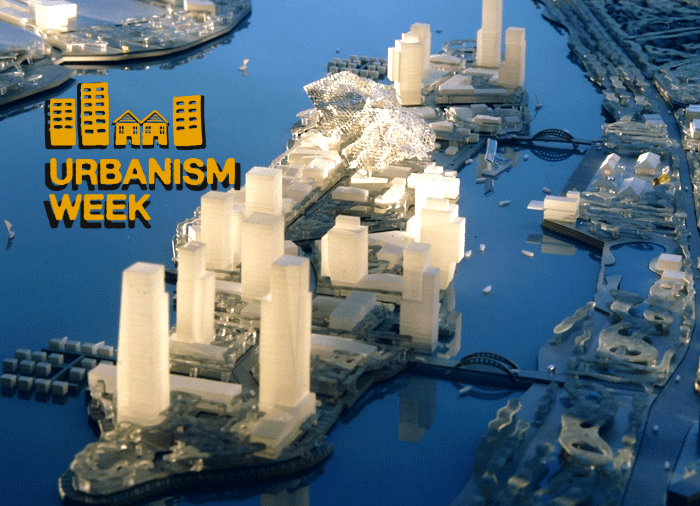
The specs: an impoundment dam at 23rd Street would create a 12-mile lake stretching to Sand Springs, the foundation for three linked islands, housing for up to 3,000 residents in high- and low-rise buildings connected by navigable canal to the central island featuring a plaza for pubs and cafes accessible by underground parking structures, solar panel-covered walkways complete with cooling misters, a verdant public park with a floating performance stage, and more. All of it powered by sustainable energy to be sold back to the city.
Such ambition would not come cheap. “The goal was never initially to ask the public for money,” Cooper told me. The stakeholders planned to fund it privately by convincing Tulsa’s many philanthropists to pitch in for a gift to the city. But as with most large construction projects, the costs ballooned.
Between due diligence and post-Katrina flood precautions from the Army Corps of Engineers,2 the $150 million price tag the stakeholders originally envisioned rose to nearly $800 million. They considered scrapping the idea, knowing they’d never raise that much privately. But so much work had already been sunk into the project that they opted to change fundraising tactics. Namely, by taking their idea directly to the public, hoping that enthusiastic Tulsans would foot the bill.
Stay in touch
Sign up for our free newsletter, The Talegate
In September 2006, Cooper found himself in front of an overflow crowd at the downtown Doubletree. The ask: $100 million from private donors, $600 million from the city. “It is time to awaken the sleeping giant,” said fellow stakeholder John-Kelly Warren during his portion of the presentation. In a way, they already had.
For those of us who grew up driving past the oft-dry Arkansas—where the closest thing to islands were mounds of wet silt covered in trash and the only public art was graffiti in the storm drains—the project’s vision appears fantastical. But its proponents leaned into the grand narrative. Shortly after the public unveiling, Thom told the Tulsa World the Channels would be no less than “a poetic interpretation of a new kind of community.” Cooper told me the goal from the start was to “change the trajectory of Tulsa.”
In the early 2000s media environment, manufacturing buzz for a midsize city in the center of the country was no small feat. Several architecture and urbanism blogs picked up the Channels story; one headline read “River Visions of a Midwestern Manhattan.” Cooper spoke of a “global battle of cities” (the “Research” section of the Tulsa Channels website archive features a New York Times article titled “Cities Compete in Hipness Battle to Attract Young”; Tulsa is not mentioned). Warren closed the proposal with a simple pitch: “Support the Channels and help Tulsa get its swagger back.”
Did The Channels Walk So Gathering Place Could Run?
Rather than rally civic pride, the stakeholders’ decision to go public invited a chorus of objections. (You can’t get public money, after all, without inviting public opinion.) In retrospect, this was the beginning of the end for the stakeholders’ grand vision for a floating urbanist paradise in the Arkansas.
The primary concern was the cost, which many assumed would come with a tax increase despite the stakeholders’ insistence otherwise. Some commenters accused the stakeholders of financially benefitting from the publicly funded development, a rumor Cooper vehemently denied. “This was always a nonprofit, volunteer effort, and as a matter of fact we all had forsworn any pecuniary involvement,” he said.
There were other roadblocks. Within days of the proposal, the Muscogee (Creek) Nation asserted ownership of the riverbed based on an 1852 treaty. Later treaties indicate the Cherokee and Chickasaw Nations control portions of the Arkansas in Tulsa County, though these claims were disputed by the stakeholders’ lawyers. Environmentalists expressed concern over the effect on wildlife and the river’s natural ecology. As one airboat operator told Urban Tulsa Weekly, “we’re trying to beat nature on this river, and we’re going to lose.”
After years of further planning, public meetings, and pushback, Tulsa County voted against a tax increase to fund a much watered-down version of the Channels, albeit by a slim margin. Conventional wisdom could blame the rejection on suburban voters who balked at raising taxes for urban revitalization. But the public backlash perhaps spoke to a deeper skepticism of the necessarily opaque and questionably democratic nature of the public-private partnership, a recurring and checkered feature of Tulsa’s urban history.
The failure of the river tax ended any hope of salvaging the Channels. “I don’t think a lot of people that we encountered felt strongly about any kind of ‘why,’ or even that it would succeed,” said Cooper. “Many were happy with Tulsa just the way it was.” By the end of 2008 the official Channels website had disappeared, according to the Wayback Machine, its domain replaced by spam and classifieds.
If the point of the Channels was, as Cooper said, civic revitalization, then Tulsa is still figuring out what that demands. “This is your future,” Cooper told me. “People your age, that’s who we were doing this for. We wanted this to be a place that you would want to come back and raise your families and build your businesses here.” In his mind, the Channels represented something larger, a question about what Tulsa should be, or at least, aim for.
Of course, Zink Lake isn’t the only waterfront development that subsumed public memory of the Channels. Turn your gaze east from the Williams Crossing and you’ll find the Gathering Place, with its internationally renowned architecture and design, walkable urban greens and water features, promises to attract talent and jobs, rebuild community, and revive Tulsa’s cultural cachet. It’s hard not to see the Channels as a precursor, especially considering the Gathering Place’s own unique approach to the public-private partnership, as documented in Russell Cobb’s canonical 2016 reported essay for This Land.
Even the name of the park shows up in the discourse around the Channels. In that fated public proposal, stakeholder Chris Lambert described the Channels as a “magnificent public gathering place.” The same phrase is credited to Bing Thom on the original Channels website.

Why did the Gathering Place garner public approval when the Channels could not? Perhaps it was a matter of different timing, different city leadership, different philanthropic backers. Or put more directly: it had to do with money.
In exit polls from the 2007 river tax vote, many wondered why vocal, wealthy supporters of the referendum3 couldn’t cover the whole cost themselves. Perhaps Tulsa’s elite learned their lesson. The Channels asked for public funds with the promise that private investment would follow. Gathering Place, on the other hand, was pitched as a $465 million up-front gift from Kaiser and others, lending credibility (or perhaps conditionality) to the 2016 river vote that ultimately did pass, allocating $48 million for the Zink Dam and the new pedestrian bridge.
Speaking of which, on midsummer days, one can stand in the middle of Williams Crossing and enjoy the temperature relief that Cooper and the rest of the stakeholders noticed more than two decades ago. It’s as good a place as any to recall the urban dreams of Tulsa that could have been, were it not for the vicissitudes of money, power, and the cruel, majestic whims of the Arkansas River.
Footnotes
- Cooper’s compatriots in this endeavor were John-Kelly and Margie Warren of the Warren Foundation, Travertine Elevator owners Chris and Scott Lambert, and Rusty Patton, an attorney.Return to content at reference 1↩
- Also consulted for the project, the Corps would become a necessary partner for any structural changes to the river.Return to content at reference 2↩
- Although the Channels and the 2007 river tax campaign were tied together in the public imagination (exit polls found one-third of referendum voters thought they were voting on the Channels), the two plans were distinct. Compared with the original residential and commercial development plan for the Channels, the river tax would have funded a far less ambitious series of infrastructure improvements. In an ironic twist, however, George Kaiser, would become the public face of the 2007 river tax vote despite having little to no involvement in the development of the Channels.Return to content at reference 3↩