

Editor's note: If you lived in Tulsa in the 2010s, Gathering Place was perhaps the major point of discussion. The 66.5-acre park snarled traffic for years and cost $465 million to build, a cost footed mostly by a visionary billionaire. It remains the largest gift to a public park in U.S. history.
First published in the Winter 2016 issue of This Land, this deeply reported feature from Russell Cobb captures Tulsa at a critical moment and raises urgent questions about the politics at the heart of public investment.
It’s one of those steam baths of a late August night. Cicadas are revving up their engines in the post oaks and sycamores. Stealthy mosquitoes are feasting on my ankles. The corner of 33rd Street and Riverside Drive is officially closed to traffic, but there’s a desire line through the front yard of a house on the corner. The cicadas are the only sound on this once-bustling section of the scenic boulevard that winds its way alongside the Arkansas River through Tulsa. The river smells like dead fish.
I walk north and come to a high cyclone fence that used to bear a sign reading “Manhattan Construction.” The sign hasn’t been replaced since the George Kaiser Family Foundation (GKFF) abruptly dismissed Manhattan a week earlier. I guess they haven’t replaced security either, because a gate in the fence is wide open.
Ambling on through, I’m humming that verse of “This Land Is Your Land.” You know, the one about how the other side of the “No Trespassing” sign was made for you and me? Right now the other side of the fence is an unholy mess of dirt, weeds, and steel pipes. It’s the heart of what will be A Gathering Place for Tulsa, one of the most stunning and expensive parks to ever be built in America. I guess I’m trespassing, but this is supposed to be a public park. Or is it?
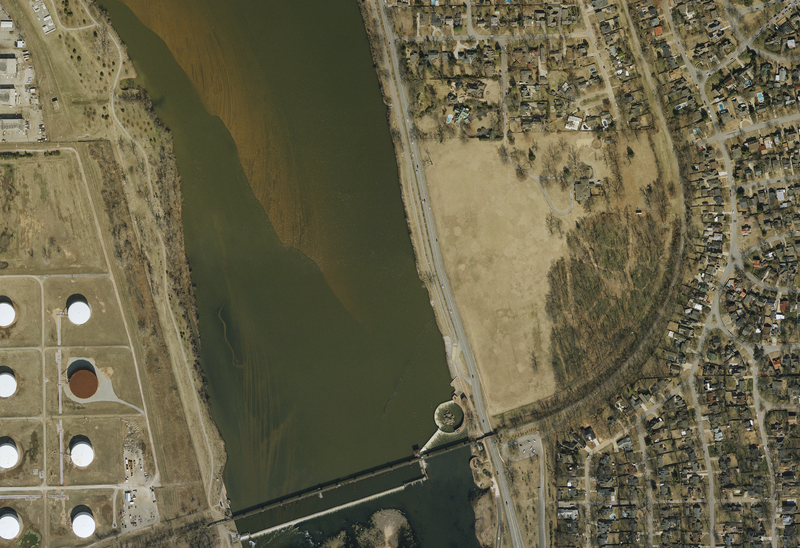
Economists acknowledge that America is the midst of a New Gilded Age. A few mega-wealthy individuals, such as Mark Zuckerberg, Bill Gates, and Warren Buffett, are giving billions of dollars to causes that used to be the sole domain of government institutions—public education, public health. This has given rise to a phenomenon called “philanthrocapitalism.” It’s a mouthful, but it gets to the heart of a new economic model in which the rich avoid a tax bill by giving away their billions for specific purposes, either directly to charities or through their own foundations or donor-directed funds, like community foundations. Oklahoma’s own mega-wealthy individual, George Kaiser, has turned his efforts into the revitalization of public space. A Gathering Place will be the crowning achievement of this effort—Kaiser hopes it will shift the center of gravity of the city away from sprawl and back toward the river.
I ask Jeff Stava, COO of the George Kaiser Family Foundation and the public face of A Gathering Place, who, exactly, owns the park. It’s a complicated arrangement, he explains. Kaiser’s foundation created the GKFF Parks Conservancy LLC, which gifted the park to the River Parks Authority for 100 years. The LLC remains in charge of the maintenance and programming of the park. It gets trickier because the River Parks Authority, for its part, is not technically part of the city or county government, but rather another public-private partnership created in 1974, during Tulsa’s last monumental attempt to transform the nature of the prairie river that ambles along its western shoulder, the Arkansas River. A Gathering Place then is a public-private partnership whose public partner is a public-private partner whose public partner is Tulsa and whose private side is a subsidiary of a foundation known for its public-private partnerships. Stava has, on occasion, referred to the park as “my project.” You tell me who owns it.
The massive scale of the project—$350 million over the next five years—has put some people in the quiet, affluent neighborhood of Maple Ridge on edge. Residents around the park regularly engage in skirmishes with GKFF and its partners in the project about road closures, sidewalk access, and construction noise. NIMBY stuff, basically. Some residents are the staunch libertarians who fought the city 20 years ago to make Riverside Drive inaccessible to public transit. Still, Stava has pounded the pavement, reassuring neighbors that the unwashed hordes will not be pouring into their leafy midtown enclave and parking on their lawns. According to the neighbors I spoke to, the Foundation has been unexpectedly responsive to their concerns.
There are some cranks in the neighborhood, for sure, but the big question about the park is not whether it will lead to prolonged road closures and construction noise, but what it will mean for the future of the city. Will A Gathering Place be the city’s central square, where all races, classes, and age groups finally come together? Or will it become “One Percent Park,” the yuppie playground of one of Tulsa’s most exclusive neighborhoods? Either way, where do voters fit in?