


Collidoscope: De La Torre Brothers Retro-Perspective
Through April 28
Philbrook Museum of Art
Remember lenticular? It’s that style of art with a glossy, shifting surface, where the image changes depending on your vantage point. In popular children’s images, an eye winks or a lion’s mouth opens. In Philbrook’s new show, “Collidoscope: de la Torre Brothers Retro-Perspective,” the images are a little weirder.
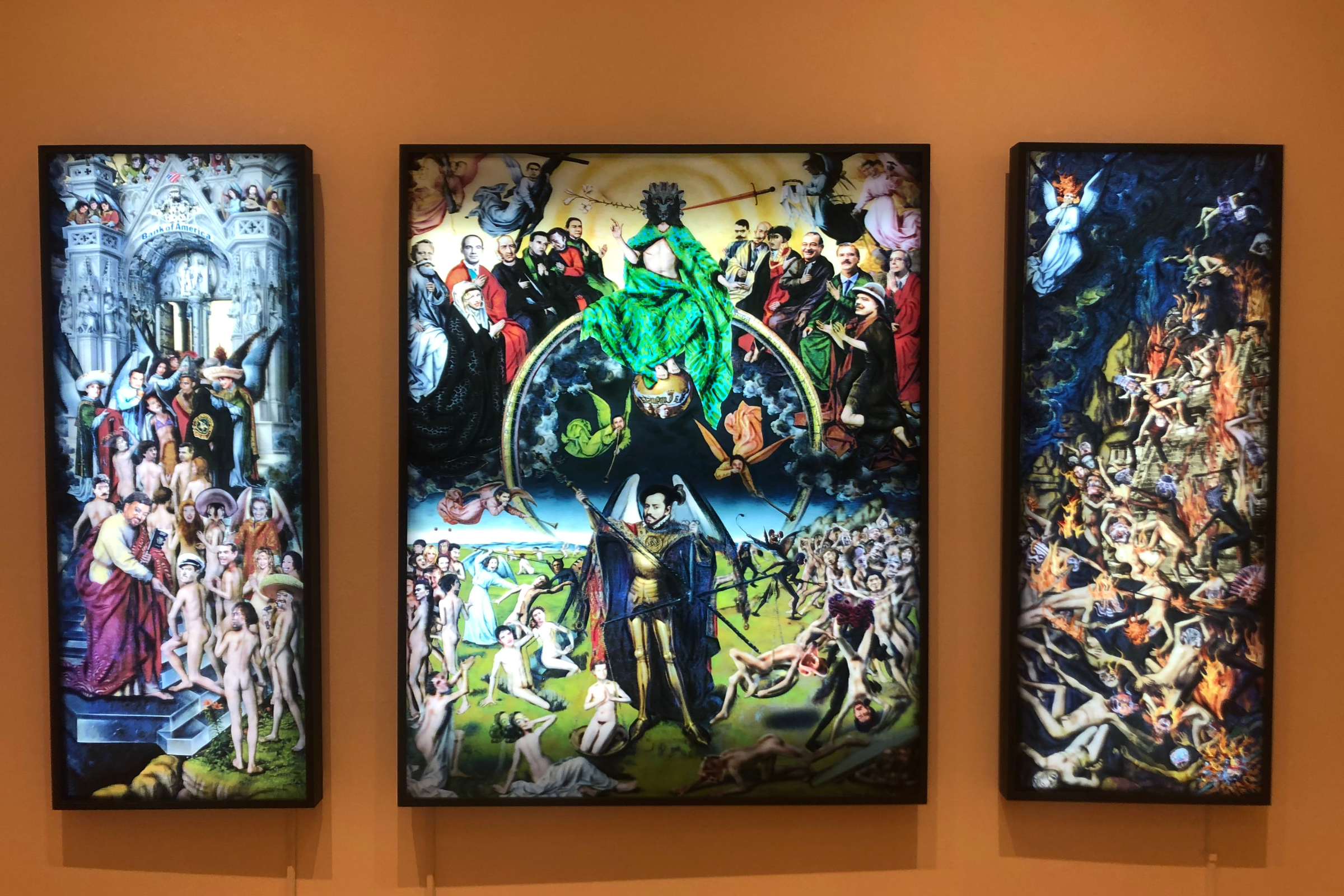
So much of the work in the exhibit is about that in-between space: the border, the shifting identities (Mexican? American? Sure, the show says), the confluence between old and new. Perhaps the most striking is La Reconquista (inspired and fashioned after Dutch painter Hans Memling’s The Last Judgment of 1473), in which figures like Barack Obama and Hillary Clinton, along with many celebrities and those generally considered “white,” share the entranceway to Heaven—complete with Bank of America logo. In the middle, Hernán Cortés, the conquistador who ravaged the Aztec civilization, presides over the judgment, while the indigenous people of Mesoamerica (in their traditional masks) are shown on the right, cast into hell.
This show brings together many of the collected works of Einar and Jamex de la Torre, two brothers born in Guadalajara into a family of artists that brought them up on both sides of the San Diego/Tijuana border. The brothers work primarily in glass and lenticular: odd mediums for odd images. To be annoyingly dualistic, the iconography stems from both Christian/white/“American” sources and Mesoamerican/Aztec/contemporary Mexican sources.
The brothers’ glass work is no less surreal and striking, invoking awe as well as a certain disgust. There’s something uncanny and horrifying about an anatomically-accurate heart with lips, tongue, and teeth, or a baby covered in tattoos wearing a Dia de los Muertos mask, sitting atop a tiny four-poster bed. The most intimidating piece greets the visitor at the entrance. Oxymodern (Aztec Calendar) is a massive circular panel with a plurality of images: demons playing dominos, Tecate, cigarettes made of rebar, more anatomic hearts, semen entering the piece from four sides.