



Having moved away from Tulsa I have become accustomed to getting questions when I disclose where I was born and grew up. Sometimes I’ll mess with people and talk about riding a horse to school, but my unremarkable physical frame and lack of any twang in my speech usually make the ruse hard to sustain for long. And thus I quickly clarify that my life in Tulsa was mostly indistinguishable from the lives of many of my peers in the professional-managerial class. “I mean, we shopped at Target,” is a comment I often deploy to exorcise any lingering mental images of cowboys and tumbleweeds. And I always follow up with a simple statement, whose truth no demographer ever had to convince me of: “I mean, Tulsa is a city.”
As an adult I have called a series of bona fide Big Cities home: Berlin, DC, Chicago, New York, and now San Francisco, and measured against such places Tulsa will never rank the highest, whether in terms of density or public transit. And growing up I was always aware of where we stood in the pecking order. My freshman year of high school in 1991 saw the debut of Urban Tulsa Weekly, which my cohort of intellectual friends and I eagerly consumed for worldly content in the pre-Internet era, even as we scoffed with sarcasm at the aspiration of the publication’s title. And every time we were dropped off or picked up at the Java Dave’s Coffee at 15th and Peoria (the epitome of Gen X sophistication), or later drove ourselves to and from the late night diner Village Inn for coffee and pie, we were reminded of the fundamentally suburban character of our lives. But none of this shakes my fundamental belief, however, that Tulsa is a city.
And yet it’s only three decades since I last lived in Tulsa that I’ve come to understand the origins of this certainty and appreciate the type of urbanism that my hometown instilled in me. This awareness stems in part from a work of architectural theory published in 1972, three years before my parents moved to Oklahoma and five years before I was born. Learning From Las Vegas was prophetic in offering a framework for reflection on the built environment of Tulsa as it has existed during my lifetime. Originating in a workshop at Yale, the book was a provocative intervention in architecture and urban design, calling for scholars and critics to take seemingly unplanned spaces such as the Las Vegas Strip more seriously, or at least just accept them at face value. As critic Christopher Hawthorne summarized in a retrospective piece for the book’s 50th anniversary, the authors argued for “understanding cities as they are rather than how planners wish they might be.”
This idea of approaching a city on its own terms has inspired me to reflect on the kind of urbanism Tulsa instilled in me. And what I have realized is that beyond any architectural analysis, Tulsa has always been a city for me because of the people and spaces it gave me access to: a piano teacher who built a haven of modernism in an unassuming Broken Arrow home, a symphony orchestra and performing arts center that hosted an early and awkward attempt at gay dating, and a long-defunct bookstore where as a newly out-of-the-closet man I taught myself how you go about meeting a cute stranger. Through these and other experiences Tulsa taught me the value and values of city living.
***
About as often as I am asked about growing up in Tulsa I am asked how I got into classical music. I always give credit first to my parents, both of them gifted musicians in various capacities and who prioritized providing their children piano lessons with our family’s teacher, Beryl Nash, who died in 2018. When I was her student and even for many years after I was never aware of the backstory of “Ms. B,” whose biography now strikes me today as nothing short of inspirational, with the particulars of her life reaffirming Tulsa’s status as a city.
Stay in touch
Sign up for our free newsletter, The Talegate
Ms. B was born in Lubbock in 1943 and graduated from high school in Pampa, an hour’s drive northeast of Amarillo.1 She went on to study at the University of Oklahoma and earned a Master’s degree in piano and organ performance, and from 1980 until her retirement was the music director at the Church of St. Benedict in Broken Arrow. Along with this position she made a living by teaching piano at a studio she maintained in her home, called the Music Institute of Tulsa. She never married or had children.
I remember it being a big deal—that is, discussed multiple times at the dinner table—when we learned that Ms. B had decided to relocate from her home near Eliot Elementary School to Broken Arrow, where she would have a larger space for her studio and a shorter commute to St. Benedict’s. From our house the drive would now be three times as long, and even longer with rush hour backups. Ultimately, Ms. B. sealed the deal by promising my mother first dibs on choosing a day and time for lessons. Thus my three siblings and I—and even my dad for a brief stint—would study with Ms. B through the end of our high school years from 1987 to 2005.
Ms. B’s new studio felt different. It was located in a separate space, with double doors separating it from the rest of the house. It was sparsely furnished, with her six-foot Kawai grand piano the main feature—she liked the instrument’s brightness and deemed Steinway pianos overhyped and overpriced—and a loveseat and chairs distributed along the perimeter. It had a modern, stripped-down aesthetic, with a lot of black and white and other muted colors, softened by a proliferation of house plants including several large indoor trees. Along one wall was a high-fidelity stereo system and large collection of CDs, most of them classical. The space had a vaulted ceiling with large windows on the east and west sides, with a loft accessed via a metal spiral staircase.2 And there were also the cats, always at least three in residence at any given time, who had free rein of the studio and her personal space.
One reason our family stayed the course with Ms. B was her approach to teaching and taste in repertoire. While some piano teachers attracted families interested in what outfit their children would wear for the spring recital, Ms. Beryl offered a more grounded experience. Her sensibility manifested most noticeably in the music she steered us toward, especially after our introductory repertoire. The canon of Mozart and Beethoven was well-represented along with Chopin and Rachmaninoff, and she wasn’t a snob about letting us tackle what she affectionately called “flashy trashy” pieces such as Paderewski’s Waltz or Bartok’s “Bear Dance.” And as we advanced into other repertoire in high school, she would spend almost an entire lesson at the beginning of the year playing through music that we could select from, sightreading work by obscure composers like Alberto Ginastera and Kent Kennan. During periodic group lessons where we would meet in groups of five or six to sit and listen to music, she introduced me to Gustav Holst’s Planets and the exotic dissonance of the Kronos Quartet’s Black Angels album.
At the time I was somewhat aware that the musical education I was receiving from Ms. B was not exactly conventional. The most dramatic evidence of this is the treasured family story of the time my mother burst in on my brother in a fit of pique, thinking he was just “banging around” on the piano instead of practicing his new piece. “Mom, this is my new piece,” he famously deadpanned in response.
What was always a charming anecdote in fact stands as a testament to the entrepreneurial ingenuity of Ms. B, who as a single woman born in the Texas panhandle made her way to Tulsa and built a comfortable life for herself as a full-time musician and teacher, and in the process made somewhat deranged modernist music a routine presence in our home. She certainly paid her dues over the years teaching hundreds of children variations on “Twinkle Twinkle Little Star.” But she also managed to carve out space that attracted like-minded people for the art that she truly cared about. I now regard her as an under-the-radar artistic and feminist hero, not that she would have necessarily identified as such. She was just living her life on her terms, you know, the way people do in a city.
***
At the core of my pitch defending Tulsa’s status as a city, I often catalog its cultural amenities, having grown up with them before Gathering Place was even a glimmer in George Kaiser’s eye: Gilcrease, Philbrook, and Tulsa’s trio of performing arts organizations, the ballet, opera, and symphony. Then as now, these served as almost ipso facto proof of Tulsa’s civic stature.
During my junior year of high school one of these institutions, the Tulsa Philharmonic—as the city’s symphonic orchestra was then called—provided the backdrop for a notable chapter of my young adulthood, when I began to take ownership of the city’s urban amenities for myself and in retrospect took a few tentative steps out of the closet. While some details of this experience are lost to time, the basic contours are confirmed, in part corroborated by a surviving ticket stub (Figure 1).
The short version is that during the 1993-94 season of the Tulsa Phil I was the organization’s youngest season subscriber—a claim I will stake until someone proves me wrong—and I leveraged this foray into arts patronage as a means to rekindle a friendship, and perhaps something more, with my friend Karl Jones, who also left Tulsa for several decades of Big City living before returning home as part of the Tulsa Artist Fellowship.
The longer version, however, is a tale of incipient adolescent urbanism: During my two years at Monte Cassino Middle School, Karl had been one of my closest friends, and in fact had been my official host l when I visited as a prospective student. As Karl and I have often recounted, my half-day visit coincided with a special science class activity involving the removal of mouse bones from an owl pellet in order to reassemble them into a skeleton. Karl was too grossed out to participate in the activity, and expressed his unease a little overdramatically to me and the other students in his group. Unbothered and unafraid, I eagerly picked up his slack, and thus the stage was set for us to become friends when I enrolled in the fall. For the next two years we were somewhat joined at the hip, bonding over shared interests including the music of Janet Jackson and Paula Abdul—yes, I know, who did we think we were kidding—and enjoying frequent sleepovers.
At some point during the summer before our junior year, I hatched a plan, occasioned by my burgeoning passion for classical music, for the two of us to attend the Tulsa Phil together. With enough money to buy the tickets—at least for the cheap seats in the balcony—and the ability to drive ourselves downtown, parental approval of the plan did not prove to be an obstacle, especially for such a respectable and even educational activity. I am sure I was a little nervous when I called Karl to ask him if he was into the idea, but he didn’t hesitate to say yes, even though classical music was my thing and not really his.
And thus a half-dozen times during our junior year of high school, Karl and I met downtown at the Tulsa PAC for our special concert excursions. I remember getting dressed up for each occasion, perhaps repurposing some of my old middle school khakis and Oxford shirts, finished off with the double-breasted sport coat purchased for eighth-grade graduation. I’m sure the music at each concert was fine, although I don’t have any distinct memories of any of the programs.
What was important was that we were doing this activity on our own, something adult and worldly, entering the glamorous 1970s interior of the PAC unaccompanied by our parents. Karl remembers the thrill of being in line for concessions being sold by two older students, but neither of us can really remember what we even talked about on these evenings. As fun as it would be to spin this story into a heart-rending high school romance a la Heartstopper or Love, Simon, at no point during these encounters were there any clear overtures for emotional, much less physical, intimacy even though we were clearly on what any sane person would characterize as a series of dates.
I do remember Karl falling asleep a little during several of the concerts, which made me realize that he was mostly doing this to be nice and spend time with me. The following year I let our subscription lapse, the demands of senior year and preparation for college taking precedence. Karl and I mostly lost touch for the rest of high school, wrapped up in our different social spheres and activities. I started dating a girl at my high school and we all eventually went off to different colleges.
Unlike the details of our concert-going, I remember distinctly the moment I began to reinterpret the terms of our friendship, over Christmas break during sophomore year of college. I had come out during my first year at the University of Virginia, and word eventually got back to Karl, who had been on his own journey of self-realization at Hendrix College. I remember arriving home and my mother informed me that “Karl Jones called while you were out and he wants to know if you are free to get together.” On the outside I played it cool even as I had internally already instantly connected a dozen dots upon receiving the news, telling myself “Oh, of course, Karl is going to tell me he’s gay too.” My hunch was confirmed when he disclosed the news to me over lunch a few days later at Cardigan’s, in a strip mall on South Lewis Avenue just north of 61st. Over the rest of the break we hung out a few more times, including one brief and awkward attempt at physical intimacy in the car outside his parents’ home.
Looking back it’s hard to tell what fundamentally prompted me to pursue these experiences with Karl, to discern what desire was driving what. If I wanted to romanticize, I’d say my subconscious yearning for a new and authentic identity prompted me to pursue unrealized intimacy with a special friend, with my precocious musical taste providing a respectable cover story. But to be honest, burnishing my sense of cultural sophistication could just have easily been the driving force, with a potential deeper connection with Karl an added bonus. The truth is somewhere in the middle, and likely I thought I was doing both of us a favor by helping us learn the ropes of high cultural urban sophistication, and testing the waters about what it felt like to do so with another man.
Perhaps I implicitly sensed what lay in our futures after college, that is, that we’d both end up in Washington DC and later New York, engaging in all manner of Big City activities, which for me would include a lot of time at orchestra concerts for both work and leisure. In any case, just like my piano lessons in Broken Arrow, it’s the sort of confounding adolescent adventure that neither of us would have been able to undertake had we not lived in a city.
***
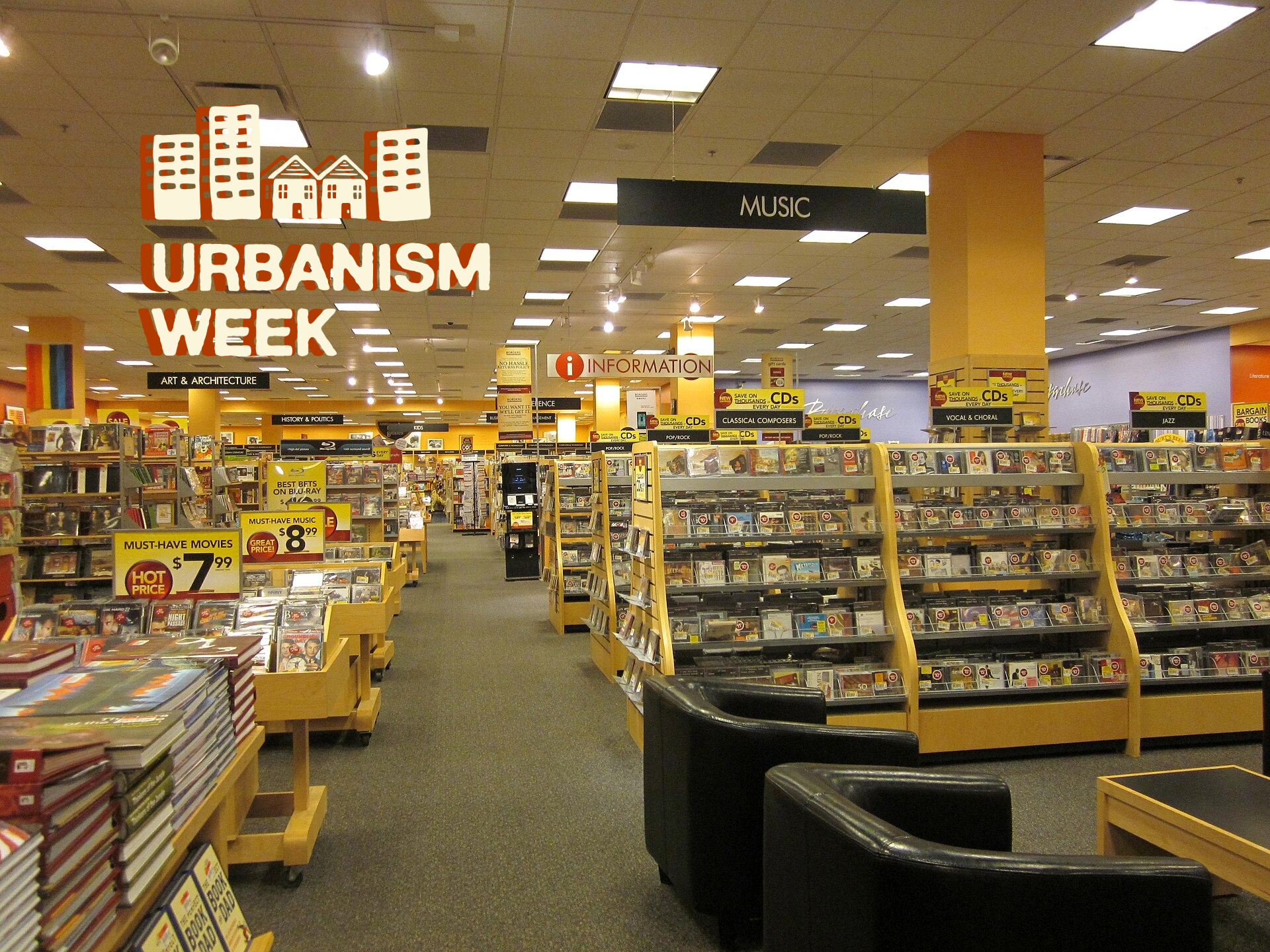
“If you take the signs away, there is no place,” the authors of Learning From Las Vegas note about the importance of roadside signage to identify buildings along major corridors. The inverse is also true, and I understood this implicitly when the sign went up in the late 1990s for the new Borders Books and Music on 21st Street between Harvard and Lewis. This truth was once again revealed when the chain announced the closure of all its Tulsa locations in 2011, and I witnessed the once tall and proud red lettered sign languish unlit for many years after.
For an overly intellectual college student beginning to make his way out of the closet, the arrival of this big box store was like gaining symbolic access to the Strand, Tower Records and Central Perk all at once. While Barnes and Noble had conquered Tulsa during my high school years, the arrival of Borders represented a distinct leveling up, literally so. Unlike the B&N locations on 41st and 71st, which sprawled out in a single-story shopping experience that felt a little too much like Kmart, Borders stores boasted two levels, with a cafe and magazines on the main floor and CDs and additional books located upstairs and accessed via an open central staircase.
I had already experienced Borders when visiting my aunt and uncle in the DC suburbs, where I had obtained the Rent soundtrack as well as made the extravagant purchase of my first ever hardback book, a collection of essays provocatively named Naked by an up-and-coming author named David Sedaris. I could not imagine my good fortune knowing that Tulsa would have its own location. There had always been books and music available in town but Borders felt new and modern by comparison.
What I have only come to appreciate now is that this addition to my cultural world was located in a space only conceivable in a highway-oriented city such as Tulsa. I was forced to scrutinize Google Maps in order to make sense of its exact borders—no apologies for the pun!—even though I have passed by it a thousand times. It’s an awkward oval patch, almost a rhombus, south of 21st and bounded on the east by the Broken Arrow Expressway and on the west by an on-ramp, today housing a Starbucks and Extra Space Storage. All of this is to say that it would be hard to conceive of a more anti-urbanist choice of location, at least in terms of pedestrian access or walkability, for what I always regarded as a valuable urban amenity. This oasis of culture was located in the shadow of a highway and separated by busy streets on every side from the surrounding neighborhoods. Like most activities in Tulsa it goes without saying, but bears mentioning in this context, that I never visited this store by any means other than a personal automobile.
I spent an untold number of hours browsing at Borders or sitting in the cafe with various high school friends, but during the summer after my second year of college the store was the setting for what I realize now was a screenplay-worthy meet-cute. I had first spotted him while browsing in the classical section, where he had been restocking CDs in another area nearby. He was on the shorter side with wire frame glasses, with a shaved head and smooth and slightly muscled arms that told me he cared enough about his body to eat well and do some push-ups every other day but not at the expense of more important things in life like reading and art. But his look wasn’t professorial, with an untucked short sleeve button down shirt that revealed the upper quadrants of smooth pecs. Sturdy boots completed the look, along with the fact that he worked at Borders, which for this nerdy college kid home for the summer was the sexiest quality of all. I could also tell that he was a little older than me, which added an element of intrigue.
I eventually summoned the courage to talk to him, albeit in his professional capacity, making up a question about where I might find a book on philosophy or theology or something comparably pretentious—can’t remember precisely but as it was the late ‘90s probably Foucault—and he smiled and pointed me in the right direction. I then made the calculated move to plant myself in front of the store’s small section of gay and lesbian books for an unnecessarily long amount of time. I took my time scrutinizing each title, until, of course, he inevitably stumbled upon me and we both smiled broadly to signal a certain degree of mutual recognition.

I didn’t ask for his number that evening, and even if he had wanted to it was probably against the rules for him to ask for mine. Thankfully a high school friend also worked at the store, and the next day I called her during my lunch break working in the mailroom at a local construction materials conglomerate to ask if she knew the guy who had been working upstairs in the music section the other night. I offered a brief description, and asked if she knew whether he was dating. She readily identified him and said she was pretty sure he was single but couldn’t say for sure, and I asked if she might pass along my phone number to him. He eventually got in touch and thus began an actual summer fling, which of course lingered as an awkward long-distance relationship for part of my third year of college.
We had our share of romantic times, but almost more thrilling for me was to get a glimpse into how one might live in Tulsa with a different set of rhythms. His existence seemed to take place only north of 31st Street, centered on his apartment—not a house!—on 14th Street just east of Denver, located in one of several small brick buildings spared demolition during construction of the Inner Dispersal Loop. The space was modest but had old doors and windows and high ceilings and crown molding and was filled with art and plants, and always smelled of American Spirit cigarettes and the sandalwood cologne he favored. It was thousands of miles away from Haight-Ashbury, much less the Castro or Folsom Street. But there’s no way you could convince me, then or now, that it wasn’t in a city.
Footnotes
- These and other details are drawn from her obituary.Return to content at reference 1↩
- You can get a sense of the layout of the building from the photo at the top of this 2023 Fox 23 article about its conversion into a storage facility.Return to content at reference 2↩


