



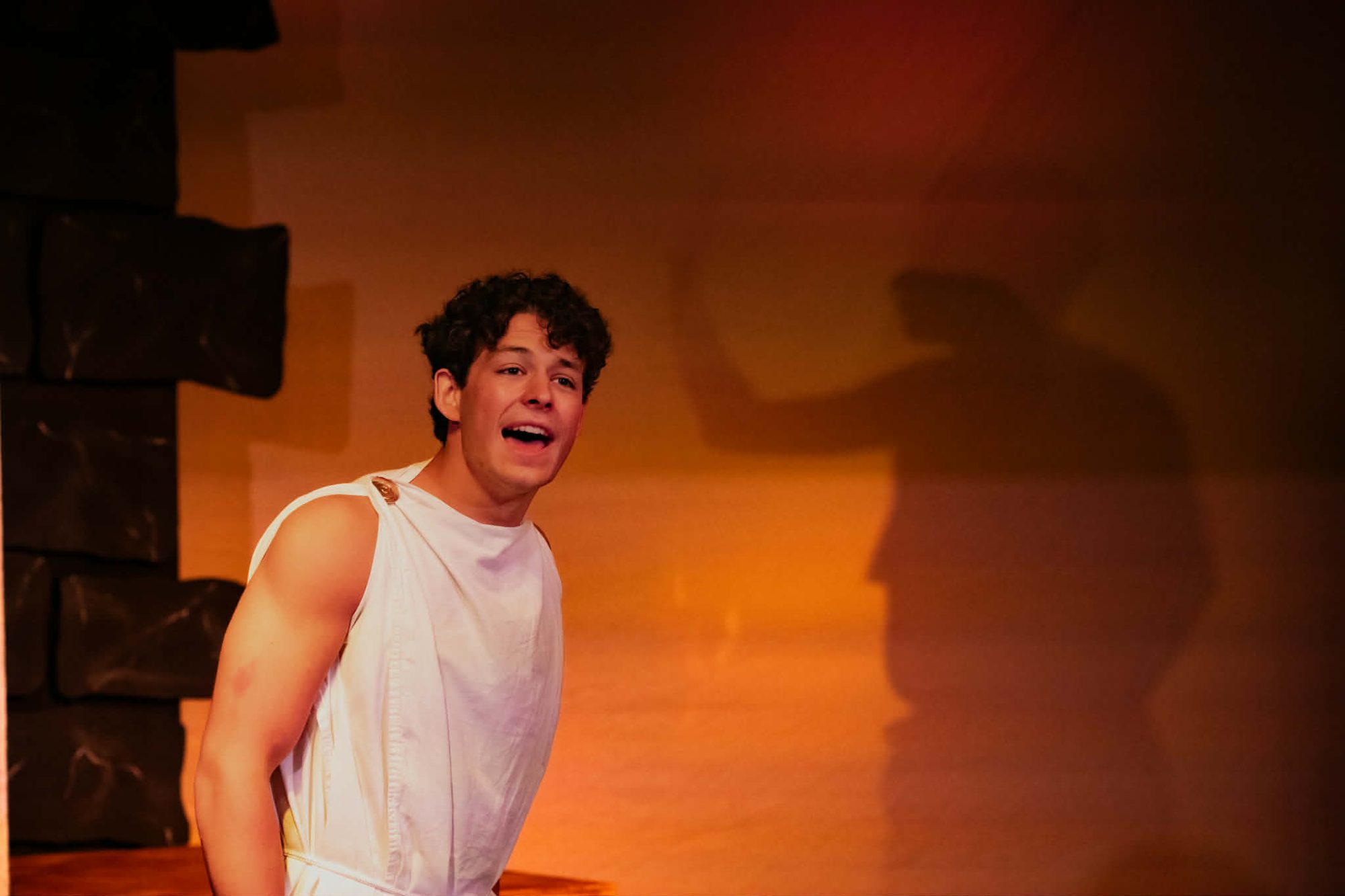
Little Shop of Productions: "Feathered, the Musical"
Theatre Tulsa Studios
June 25, 2026
This past weekend, Little Shop of Productions closed out its ambitious first season, as well as the larger Tulsa community theatre season, with an even more ambitious endeavor: staging their first musical. Written and composed by recent TCC graduate Judah Brown, Feathered is a creative retelling of the Greek myth of Icarus, the boy who attempts to escape imprisonment with homemade wings, but flies too close to the sun and meets his tragic demise. With Brown’s indulgent score, dramatic technical elements, and actors who brought big emotion to Theatre Tulsa’s tiny black box, this production met quite a different fate.
Brown’s retelling deviates from the original myth in a few ways. The main plot follows Icarus and his father Daedalus, trapped in a tower at the hands of King Minos. Here, however, Daedalus is the driving force behind their continued imprisonment. Wary of the world after the death of his wife Naiara, he builds up the tower more and more, even closing up the windows in an attempt to protect himself and his son. That doesn’t stop Icarus from dreaming, though, and with a little encouragement from the god Apollo, he becomes determined to fly.
Icarus’ plans face an interruption when the three aurae, the show’s narrators, descend upon the tower with warnings. These warnings are presented as flashbacks, story lines that intertwine with the main plot throughout the musical. Klymene tells the story of her son, Phaethon, whose desire to touch the sky ended in his early death. Similarly, Nephele tells the story of her daughter, Helle, who met a similar fate when she was forced to flee her homeland by flying over an ocean. The third aura is Naiara, who we learn died during an early attempt to escape the tower.
These warnings give Icarus some pause, but ultimately do not dissuade him. They do serve to bring up a central question that feels on brand among Greek myths: Would you do something even if you knew you would fail? And what drives humans to try, despite this knowledge?
The two-and-half-hour-long story is entirely backed by impressive original music, composed and performed live by Brown on solely a piano. Each song felt tonally consistent while allowing for fun flairs that highlighted different characters’ personalities. The opening number, led by the aurae, felt eerie and flowy. A duet about the budding love between confident Phrixia (Dara Hand) and the anxious Helle (the delightful Kamryn Clagg) had moments that musically captured each woman’s emotions. The following number, when the citizens start to chase Helle out of town, was full of high energy and intensity. I didn’t understand why they were chasing after her, but it was a great moment nonetheless.