

The Pickup's Arts & Culture coverage is sponsored by Brut Hotel.

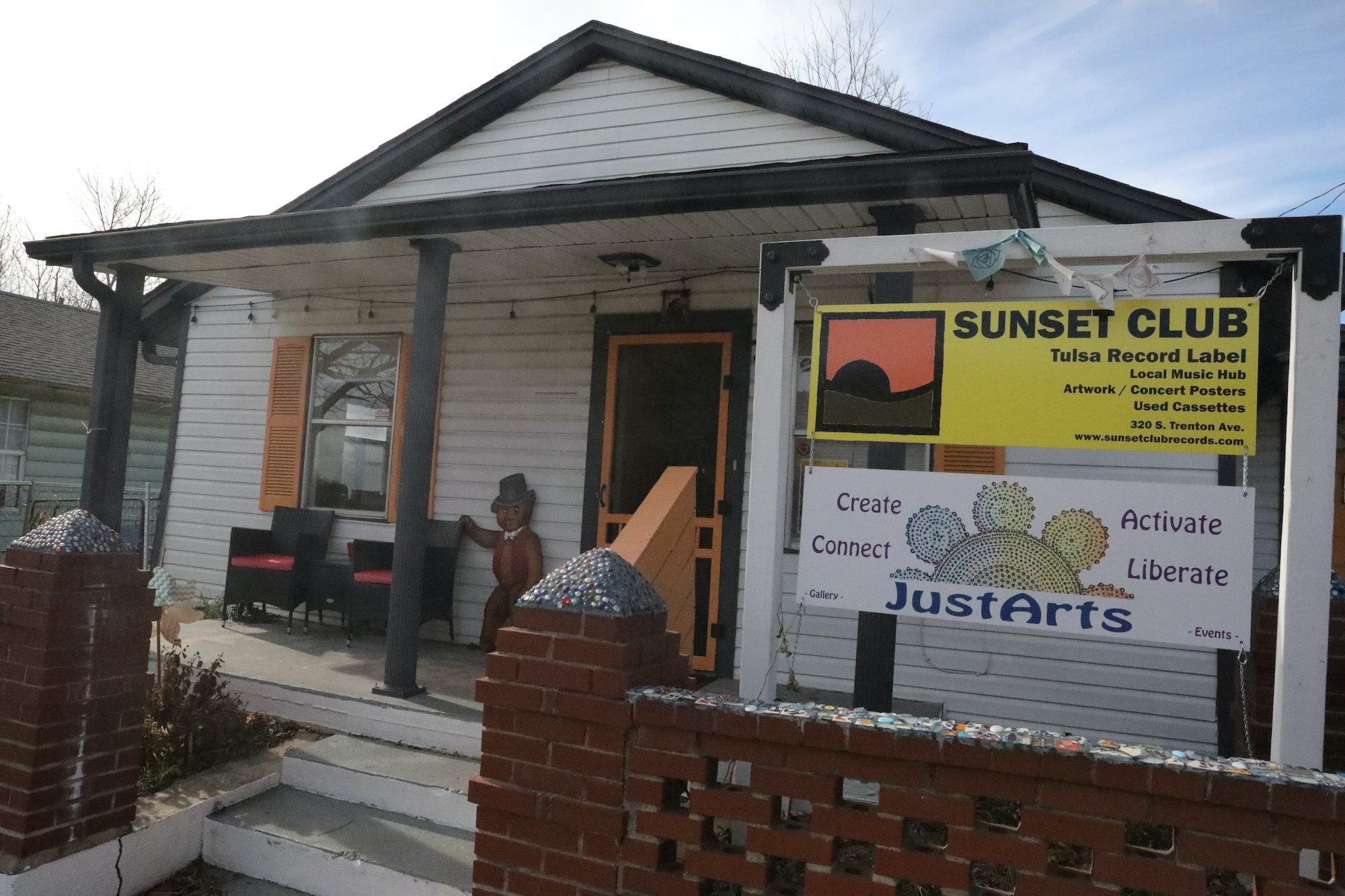
Down the street from The Church Studio, there’s a small art gallery that’s unlike most in town. The pieces in here are drawn or painted by someone who is currently or recently incarcerated.
That’s a big step forward, says Wendy Jason. Jason is the Founding Director of JustArts Gallery, a not-for-profit art space whose sole purpose is to display the work of these incarcerated artists. “It’s really easy, when we’re talking about the art world, to forget about this massive population,” she says. Jason’s quest with this gallery is to extend the art world’s accessibility to these prisoners, who, she finds, are enthusiastic, talented, kind, and excited to contribute.
Its current exhibition, “Drawing Parallels,” is a collaborative show between artists on the outside and those currently incarcerated. Take, for example, Tulsan Jamie Pierson, who creates urban art under the name Scraps Designs, and Sean White, an incarcerated artist who makes figurative and modern work.

“[Sean] White’s work focuses a lot on the physical form, on the human form,” says Pierson. “Mine focuses on the urban environment. But we both take similar approaches to mid century modernism, like very simplified lines and basic shapes.” Pierson and White’s collaborative piece blends White’s drawing of a humanoid or mannequin form, torn into four separate sheets of paper, overlaid onto a wood board over which Pierson creates an abstract.

Greg Streater, one of the artists in the show, happens to stop by while I’m there. Streater was incarcerated when he met William “Trey” Livingston III—Wendy Jason’s partner, a formerly incarcerated artist, and the proprietor of Sunset Club, a record label and music store that adjoins the gallery—who introduced him to painting.
“When you get [to prison], they strip your character from you, and you become a number,” Streater says. “Your head [gets] shaved. You can no longer have the color that you once [had] in the world. You don’t realize how much simple stuff, like the clothes you wear or the music you listen to, it gets stripped from you.”
When Streater started painting, he says, he felt alive again: “We got to get away from the yard and just chill and laugh and make music and paint.” Now, when he poses next to his artwork (a collaborative piece with Livingston) for a photo, he smiles. His hair is growing back.

At Circle Cinema, Wendy Jason and JustArts have launched yet another show, this one showcasing 60 pieces by almost 30 artists, all incarcerated somewhere in the United States. The exhibition represents dozens of mailed packages, Jason says, all acquired through the logistically complicated communication systems of the various Departments of Corrections for each state. For some of the artists, that means tablets via which they can text, but not send images, and for some, that means paper letters.
I talk to Marla Smith, who’s here to view the exhibition. I can hear the emotion in her voice when she refers to one of the longer incarceration periods of one of the artists: “He’s barely known any other life.”
Smith is especially drawn to the work of Cuong (Mike) Tran, a first-generation Vietnamese-American artist and substance abuse counselor currently incarcerated in California. Tran’s acrylic piece, “Behind Closed Doors,” depicts a man covering his face with his hands. In his artist bio for a recent auction, Tran said, “I hope my art helps to change the negative perceptions and stigmas associated with incarcerated people. No one is born a thief or murderer.”

Oklahoma has the fourth-highest incarceration rate in the United States. For a time, it held the dubious distinction of having the highest incarceration rate for women in the country. For Greg Streater, the previously incarcerated artist, these incarceration systems threaten to grind a person down into a shell of themselves.
“I had given up on everything,” he says. “I was done. I didn’t want to make music anymore; I was so embarrassed by my circumstances.” But having a place where he could work on something, create something, he says, allowed him to become a person again. “It allows you to keep in contact with that part of yourself.”
“He’s an amazing musician,” Wendy Jason adds. Streater performed on guitar—under his musical pseudonym, Neon Squid—at the opening for “Drawing Parallels.”
“That felt good,” Streater says. “It felt good to do that.”
For Jason, the reward is in that good feeling: “I get to know these incredible people who are totally relentless in their pursuit of this; nothing gets in their way," she says. "Despite having such limited access to supplies and communication and people and feedback, they work and grow. And they just want to be seen.”

For now, Jason juggles a lot of communication and responsibilities for the gallery. At any given time, she says, she could have 30 unread messages on six different communication apps. She stores all of the art in the gallery; she coordinates the mailing of the art; she runs the social media. She won't say how many hours she works.
But for her, it’s all worth it. She remembers one of her first experiences with incarcerated artists, facilitating a creative writing group in an Albuquerque county jail in 2009. The guys would come in a couple times a week, and they’d sit and write and talk for an hour and a half.
“My time with the guys in that group was so powerful, so transformative for me, for all of us, the community that was built in that little room that we shared together,” she says. “It was a way for them to shed all of the armor and the masks that they had had to wear in the main area of the prison; they got to share what really mattered to them.”
She smiles. “Any single one of them I could see walking out into the world, into a full life.”

There’s always more to do. She’s got a deal with Chimera, the Arts District coffee shop, where she’s been hanging these artists’ work since October. She’s looking for a storage space with flat files for all of the art that she’s currently storing herself. She’s working with a local art school to pair students with an incarcerated artist to create channels of communication and artistic feedback.
But right now, in the gallery on Studio Row, it's quiet. Sun is flooding the space and casting light over the wood floors. Across the walls, works of art—made by people spending a life behind bars—are getting to see more light of day than their creators do. And for some, like Greg Streater, freedom isn’t some distant dream: it’s here, in this gallery.


