


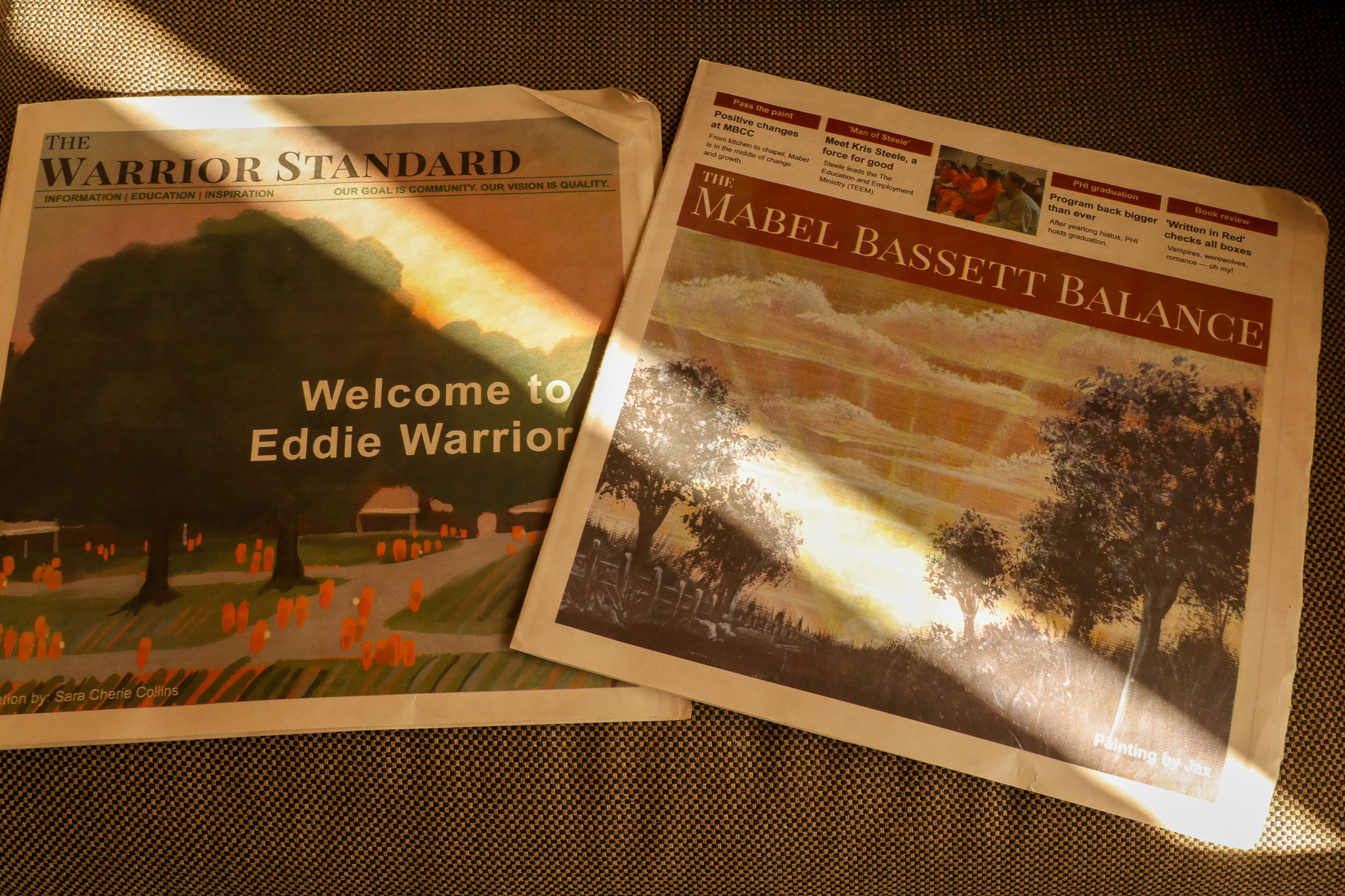
Deborah “Jax” Franks is usually up late. As one of the lead editors for Mabel Bassett Correctional Center’s new prison newspaper, The Mabel Bassett Balance, she has a lot on her mind—and a lot of time to think.
There is a sweet spot between midnight and 3 a.m., after lockdown when most people are asleep but before the kitchen workers wake up. “Funny that the same time that haunts me is also the most productive block of hours I have been able to find for my writing and editorial duties,” she told me via Securus, an online portal that Oklahoma prisoners use to communicate with the outside.
Her prison-issued tablet1 is bright enough to see her notes and rough drafts. Turning on the prison overhead light would be rude, and Jax tries to be a considerate insomniac. She sits in her bed, a pillow under her spine, fingerless gloves on her hands, and a roll-up keyboard steadied on her chessboard case.
It's from this makeshift desk that she helps lead Oklahoma's most subversive2 new print publication: A collaboration between Tulsa’s Poetic Justice and the national Prison Journalism Project that trains women who are incarcerated to be journalists. Ellen Stackable, a longtime advocate for women who are incarcerated, has led the charge at Poetic Justice for a decade. As Executive Director of Poetic Justice, her mission is to empower women to express themselves, whether through poetry or creative nonfiction. Stackable said the new journalism initiative would not be possible without the current Oklahoma Department of Corrections’ administrative support.
Two publications—The Mabel Bassett Balance and The Warrior Standard—launched last year with enough copies for all prisoners3 and staff, plus extras for nonprofits and politicians. The papers reflect their distinct communities. At Eddie Warrior, a minimum-security facility in Taft, Oklahoma, where most residents are preparing for release, the paper emphasizes reentry resources and transition planning. The Mabel Bassett edition, which serves many women with longer sentences in McLoud, focuses more on how to make the best of life on the inside. Printing costs work out to about 40 cents per issue, made possible through nonprofit and private donor support.
***
The Mabel Bassett newsroom would feel familiar to any journalist: Deadlines. Post-it notes. Chaos. The women lay out mock-up pages with cartoons, illustrations, and puzzles. Headlines and captions are discussed. A writer defends her particular word choice to the group; others argue about which photos deserve color. Most of the paper is printed in black and white, but the centerfold is printed in color.