
Editor's note: Incarcerated women are much more than an ID number or statistic to the facilitators of Poetic Justice, a nonprofit dedicated to bringing creative writing workshops to incarcerated women. This story is a firsthand account from Beth Niestemski, one such facilitator who shares with us the full experience of these women: their grief, humor, joy and sorrow.
This article was originally published in This Land: Spring 2016.
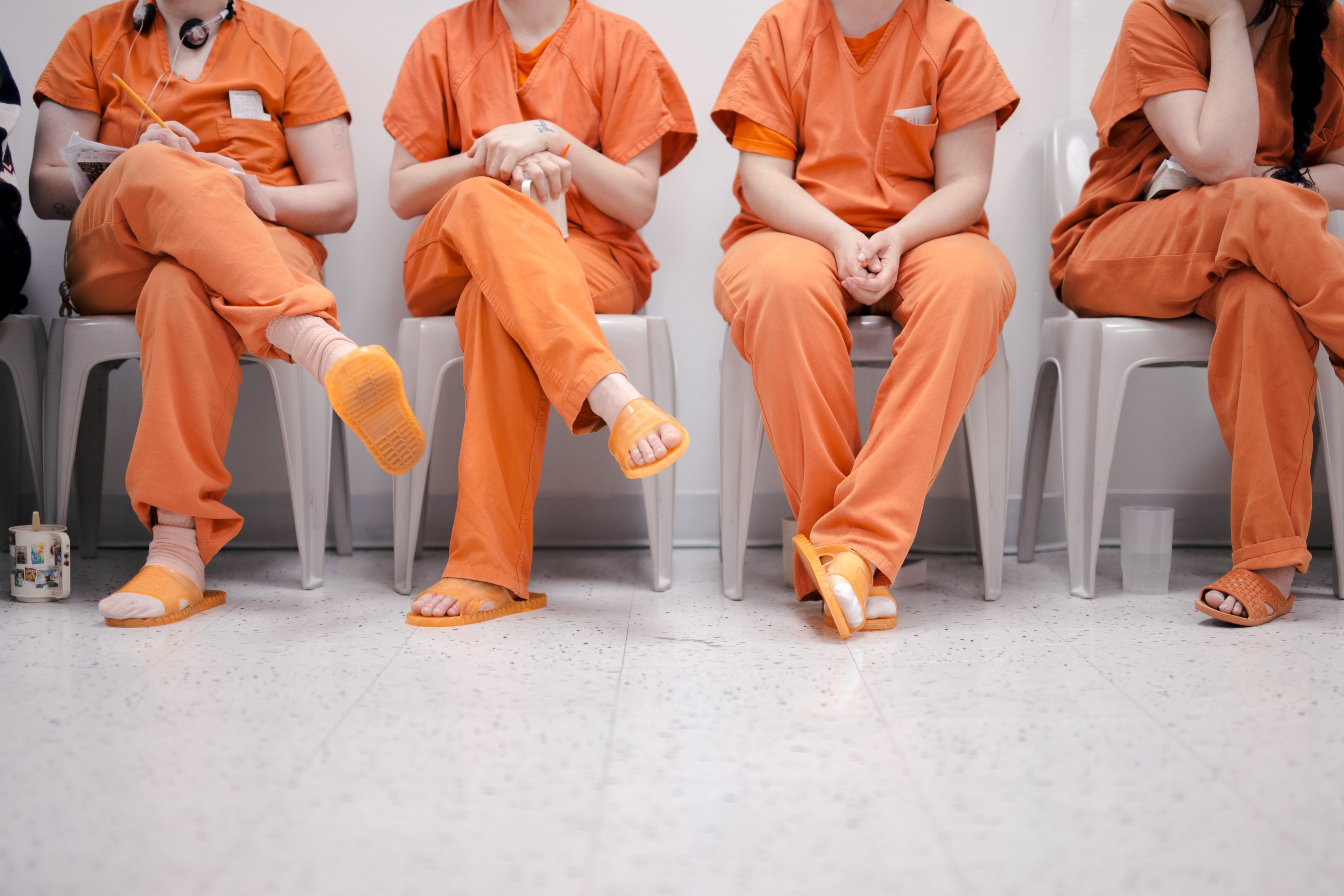
I come to David L. Moss every week to teach poetry to incarcerated women. It’s become so routine that all of the preparations, the drive to the jail, and the check-in process are robotic. But the autopilot always turns off the moment when the scent of my own freedom wears off and I acquiesce to the monochrome: white walls, white floors, white chairs, white tables, and beams of orange flashing up from the white backdrop.
There are three female “pods” that we teach, and each one looks relatively the same: a small classroom with a white board, a main dining area in the center, a concrete-laden outdoor space, and two floors of cells around the perimeter. We meet in the classroom, armed with a clear plastic backpack filled with countless sheets of loose-leaf paper, sharpened pencils, and essential oils. About five facilitators teach each day, none of us with defined roles. We find that lacking a hierarchical structure makes the women feel most comfortable. The women carry plastic chairs with them as they pile in, greet us, and get settled. Most of them I’ve seen before and know by name, but inevitably there is always a new face: someone who has either never been to class or has never been to jail. Generally, I take a seat next to someone new and introduce myself.
As class begins, the room transforms to a sacred space. It feels like church. Essential oils veil each woman in scents of lavender and peppermint as we invite them to close their eyes. The room feels thick with unspoken hurts as we walk through a meditation. “Think of someone you love. Listen for their voice,” we say. “Can you hear it? If you were in a dark room filled with a thousand people, could you point it out?” They silently answer through their tears and we use this moment to remind them of the power of their voices, that each of them has a story to tell, and a way to tell it that is their own.
We don’t discuss what twists of fate landed them here. Mostly, we talk about their children: the little voices they long to hear and the birthdays that are coming up. They’re not a DOC number or a sad story or a punchline of some right-wing joke now. They’re human.
A fellow facilitator once instructed the women to interview each other and write a poem about their partners. I didn’t know what to expect when they shared their work with the class, but I was sure there were some complicated dynamics at play. Would there be cattiness, pettiness, or passive aggressive lines woven throughout their poems? Instead I heard:
If I was with paint and brush
as I am with pad and pen,
I would paint you
in the most hopeful hues.
One mistake
does not a woman make.
Tears clung to the cheeks of every person in the room who felt defined by the mistakes they’ve made. I realized then that these women are each other’s greatest cheerleaders. There’s no sense of racial or generational divisions like those depicted in shows like Orange Is the New Black. It feels more like an episode of Golden Girls. They remind each other that any emotion is acceptable now, no one will cry alone or laugh alone, and certainly, no one will be laughed at.
Justice is different when your only sources of freedom are lined paper and pencils—a freedom in need of your own creation. And what is it that I (a middle-class white woman) feel safest here with them, with my sisters all in orange? And I don’t know what they need forgiveness for, but I suspect we all need it, and that, as Bryan Stevenson wrote, “each of us is more than the worst thing we’ve ever done.”
As we move into the lesson, we talk about the things they would never take back. Sara volunteers, “I would never undo giving up my children to a good family,” and relishes in how well they’re doing. “They don’t have the addictions that will end them up here like me.” She’s met with tears, empathy, and accolades for her bravery, and I’m reminded that, aside from being an inmate or a number or a crackhead, she’s a mother. I marvel at her strength.
All Casey talks about is her son. She had just a few days with him in October, right before she was incarcerated. He was born prematurely and needs to undergo a number of procedures, but she receives information slowly. She’s always waiting: waiting for her sister to come with news, waiting for her lawyer, waiting to be released. The jail is just a few miles from the hospital, but she can’t see her baby grow, feed him, or hold him when he cries.
Renée is incarcerated for theft. She stole a few things from a department store, immediately felt remorse, and returned them. It was too late, and she was arrested. Like Casey, she too left her infant behind. He’s three months old and she should be breastfeeding him. The pain she feels over their separation is both physical and emotional, but she doesn’t have the money it takes to call home.
They all agree that regret smells like burnt cigars and feels dark and dismal, that as much as it offers a learning experience, it also feels like a waste. The term “forgiveness’” renders brighter imagery: a prism, cold water, the taste of bittersweet chocolate. Together, we create a palette of words to draw from as we each write our own letters. Some write to forgive themselves; some write to forgive others. It’s more than completing an assignment—they’re curating an environment.
We end our time together with a version of the Serenity Prayer, reminding each other that the only person we are capable of changing is ourselves, and we leave, aware that we’re different from the way we came, and so is this bustling jail in the middle of Oklahoma, the state with the highest female incarceration rate, in the country with the most prisoners in the entire world.
My hands are bound too, but not by cuffs. My hands are bound by political strategies and policies and red tape and private companies that are trying to make a buck by caging people up like cattle. I wish my bound hands could deconstruct each prison brick-by-brick and spill vibrant colors all over these white walls. I wish I could tell each woman that she is worthy, that her screw-ups in no way invalidate her humanity, that cages do not make her an animal, that for every person betting on her failure, there are a dozen rooting for her success. I wish I could tell the ones with power in their hands to do something, to use that power to fight like hell for humanity, to reevaluate their definition of justice, to undo the systems of oppression that contribute to mass incarceration.
Instead, I take a deep breath, wave goodbye, and let the big, steel door compel my exit. This is what I know to do. This is all I know to do: show up each week and place myself in their orbit. Grieve and celebrate and cry and laugh and get angry with them. Offer lined paper to absorb all of the heartache, angst, frustration, and hope they feel. Remind them that even when they are stripped of all other freedoms they still have the power of their voice.
Poems by Tulsa Inmates (Courtesy of Poetic Justice, Inc):
THE STRUGGLE OF LIFE
For every struggle I’m transformed.
Kindness is a language the dumb can speak
And the deaf can hear. You are granted one measure of love
For every tear you brush from a cheek; I promise kindness
Will follow, will flow. Wherever you walk, under
Rainbows or stars over struggle, or down lonely hollows
I grant you one heart full of love and hope
For every smile you place on a face
I wish you two stars from above
The gift you earned from the lessons you learned
There is nothing the body may suffer that the soul cannot accept.
In order to be a realist you must believe in miracles.
I am who I am when no words seem appropriate.
-K.H.
WHAT IT’S LIKE TO BE MARRIED TO A BAD COP
Most see black and white, me however, I see black and blue
More often than not—I spot a new shiner
With scars so deep—not just in my back—but on my heart
It looks as if I fought with Edward Scissorhands and sadly lost.
No DNA required—I know it’s only my blood that is
Stained throughout the house.
I hear the siren and know what it must mean—sadly
Nothing more than a punchline to a bad joke
He knows they will not help me and laughs
I slowly peel away that badge—like it was a scab
From a bike wreck that never really healed
Revealing a monster that was never under my bed—but lying next to me.
In it.
“Freeze! Put your hands up!”
Never relaxing, you keep them up always, blocking punches.
“911, what’s your emergency?”
That was never an option for me.
Only the neighbor who found me crumpled on the bathroom floor
After taking a steel-toed boot to my entire body, while hearing,
“Look at you. You’re nothing. No one will ever love you.”
But surviving to say he was so wrong.
-L.S.