

The Pickup's Arts & Culture coverage is supported by Brut Hotel, featuring a rooftop VIP after party for Tulsa Irish Fest on March 14.
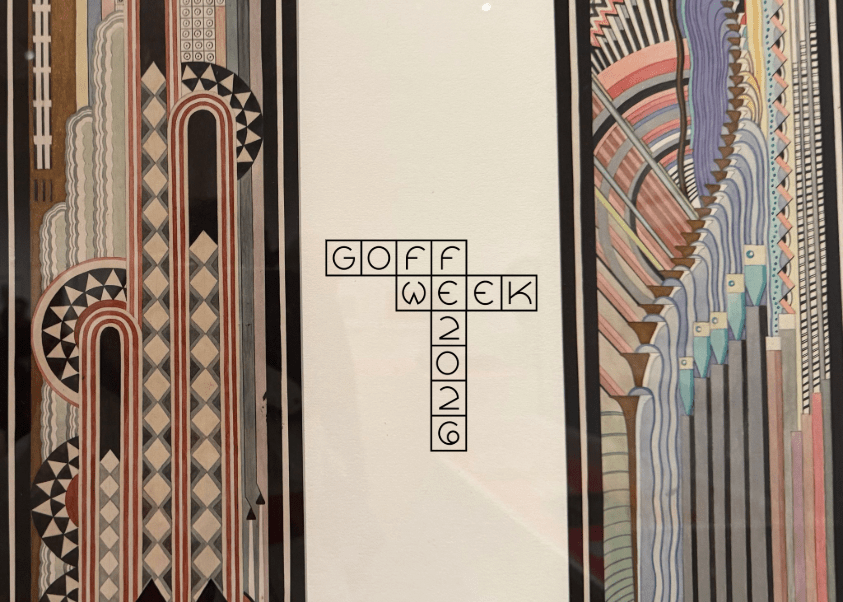
Bruce Goff’s work, be it music, buildings, or sketches, was influenced, it seems, by every place and thing he encountered: Japan, indigenous America, jazz, baroque art, absurdism, household objects, abstract maximalism; concepts and materials alike. In “Bruce Goff: Material Worlds,” a retrospective at The Art Institute of Chicago, this abundance of inspiration is made clear through an unpredictable and delightful presentation of his work.
As The Pickup’s man in Chicago who has made it to Tulsa a few times, I took on the mission to review the show before it closes on March 29.
Bruce Goff was born in 1904, in the tiny farm town of Alton, Kansas. His childhood is described as “nomadic,” but a great deal of his personal and professional development occurred in Tulsa. At 12, his aptitude for drawing landed him an apprenticeship with the Tulsa architectural firm Rush, Endacott and Rush. At 22, he helped design the iconic Boston Avenue Methodist Church in Tulsa, solidifying his influence on the growing city.
The Great Depression, and the end of his marriage, forced his move to Chicago, where his career continued to expand to new mediums with wilder influences. Throughout his career, he collected an impressive roster of peer-admirers from within the world of architecture; names like Mies van der Rohe and Frank Lloyd Wright, who eventually became a mentor for him. He continued to thrive, moving to the University of Oklahoma, working and teaching architecture, until he resigned as the result of a smear campaign against him for being a gay man.
From Goff’s life, a body of work that is precisely individual emerges. This collection of architectural drawings, models, and paintings reflects a worldview, a politic, a person with pinpoint potency, and solidifies Goff’s work as sprawling, idiosyncratic, playful, weird, bold, intimate, and physical.
Architectural historian Charles Jencks dubbed him the “Michelangelo of kitsch.” It’s a label that the Art Institute’s exhibit essentially displays as a thesis statement. Apparently Goff himself was slightly irritated by the label. I think it fits.
There’s both a knowing irony and a sentimental enthusiasm for domestic stuff at play in Goff’s work. His work has the same gauche, corny charm of a quirky, midwestern grandma, but is also sophisticated in craft, technical skill, and influence. Unmistakably cosmopolitan, yet covered in butter.
The aesthetics of the exhibit itself are sleek and bold: prioritizing showcasing the work over emulating it. It’s a minimalist room for maximalist art. The choice to mimic Goff’s artist’s signature in fonts, along with the hot pink accents, style the displays and the space, without trying to outshine the work itself. The wall-text is pithy and helps orient the patrons into the narrative and context of Goff's life and work.
At the center of the exhibit, a player piano, clambered an abstract melody of Goff’s own composition, affecting a cinematic aura. The mood was stimulating: piano keys hammering down in patternless bliss, bright bold colors illuminating displays of house keys and shirts, shag rug samples, hand drawn building renderings, and intricate models of strange buildings.
I quibble with the decision to have a projector flipping through photographic slides of Goff’s single family homes. I understand the practical, space-saving concession, but this one digital ghost disrupted an otherwise extremely tactile experience. Ultimately, the projector makes this feel more like an art exhibit sprinkling in some architecture, not an architecture exhibit.
His single-family homes are, of course, wondrous. Is there any synecdoche for America’s commodification culture more pervasive than the single-family home? Culturally, they reflect the American family living the American dream. As commodities, they use cheap materials and identical designs to scale production, and risk-averse aesthetics to scale the potential market of buyers. A quick glance at r/SuburbanHell, or a wrong turn from Route 66 onto one of countless, lifeless subdivisions that abut it, and you’ll encounter the context that makes Goff’s work unique.
Of the millions of houses built between Chicago and Tulsa in the mid-twenty first century, I’d venture to guess that very few are thoughtfully kitsch the way Goff’s are. In this exhibit, I found myself grateful for a space to consider a home for the way it welcomes light, for the storytelling of its procession, for the ideology of its shape, and for the life of its materials. Those aspects are rare and worthy of more than the attention the exhibition pays them.
There’s a chaotic and childlike curiosity to Goff’s work: deeply vulnerable and unpredictably delightful. I wish I could have stayed in his world a bit longer.