


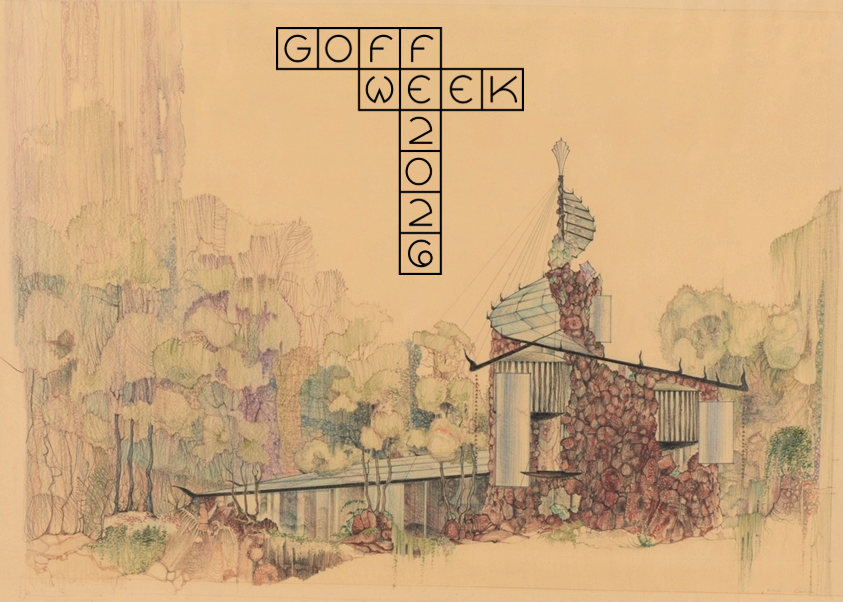
This story originally appeared in the November 15, 2011 edition of This Land.
“Not much is not enough.” —Bruce Goff
Long before I found myself down the Bruce Goff rabbit hole, I lived in a house built by one of his many students. The name of the architect is lost to history, since the house, like many mid-century modern gems, was bulldozed sometime in the 1980s to make way for a bloated and generic showcase luxury home. We rented the house, and the owner had made its destruction seem inevitable. According to the owner, the house was built on sand and it was slowly sliding down a hill, lacking a proper foundation to keep it anchored to the earth.
It had been dubbed the “Airplane House” at some point, even though its wings were rather modest grilles of iron that protruded from the roof. The house had to be the only one in Ranch Acres featuring painted cinder block walls, which angled out from the center like wings, accentuating the whole airplane motif. My bedroom was a loft and the living area had massive planes of glass on the east and west sides, almost like a modernist cathedral.
Next to its down-the-street neighbor, Frank Lloyd Wright’s Tulsa masterpiece Westhope, the Airplane House looked like a study in futurism on the cheap. Still, for all its defects, it stood out like a beacon against South Tulsa conformity, angling itself up against all those pseudo-colonials with fake plantation shutters, announcing a future that never quite arrived.
It could be the case that the airplane house did indeed have an early expiration date, and it was simply a matter of time before it slid off its concrete slab into the ravine. Or it could have been the case that the eccentric dwelling would never get along with its boring neighbors and the shaky foundation was a developer’s pretext to scrape a piece of avant-garde architecture.
Knowing what I now know about the madness and greed of men attached to such structures, I cannot rule out the wildest of conspiracies. In any case, living there as a 12-year-old was the first time I can remember hearing the name Bruce Goff. If our house was an amateurish Goff imitation, what must the real thing be like? To me, the Goff buildings around Tulsa looked like they had been teleported from another universe. The Boston Avenue United Methodist Church, an early Goff building, didn’t so much seem like a church as it did a module for communication with alien life forms.