

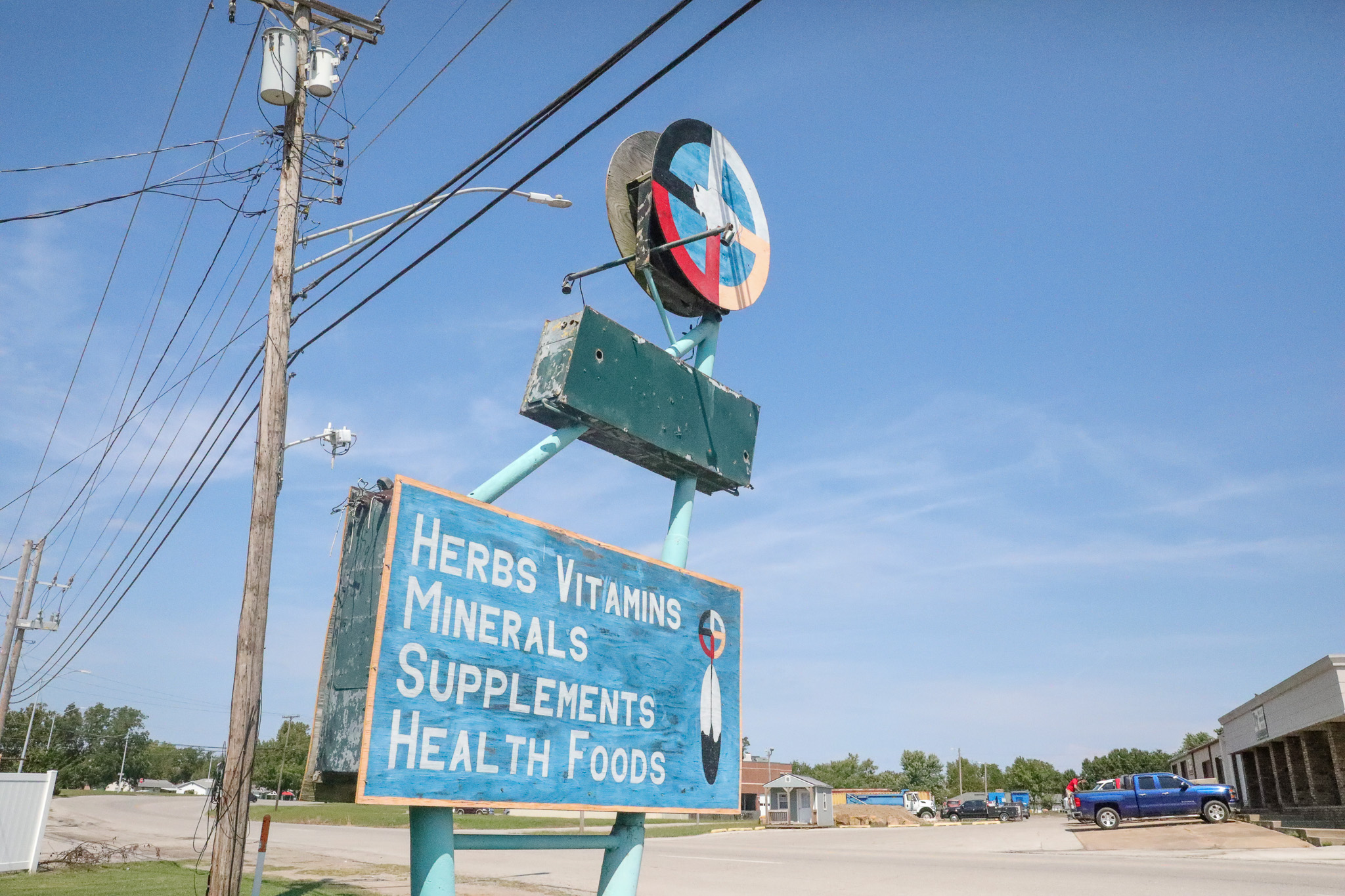
Rock Creek Herb Shop sits on a dusty gravel lot out on Highway 75, just south of Sapulpa, and has for decades. The walls are lined with dried herbs, vitamins and minerals, mortar and pestles, and naturopathic supplements. Visits are free, but they’ll cost you an afternoon. There are no appointments, and there is always a line. The shop sees hundreds of healing hopefuls come through its doors each week, and an online Facebook group called “Fans of Rock Creek Herb & Vitamin Co.” boasts 2,700 fans swapping insights gleaned from Phyllis.
Phyllis Van Deusen is what's known as an iridologist. The woman who reads your eyes, I’ve heard her called. One poster in the Facebook group calls her “an angel of God.”

Iridology is best understood as the study of the iris, with the goal of connecting discernible patterns to underlying health concerns. Iridologists claim that these patterns can suggest internal ailments a person is currently facing or likely to be susceptible to, even if those issues haven’t yet presented physically. Not so dissimilar to the divination of a tarot reading, it’s a way of discerning past, present, and future, with a focus on the body.
The first recorded mention of iridology dates back to the 1600s in Philippus Meyeus’ Chromatic Medica, but the modern practice is only about a century old. In the 1950s, a chiropractor named Bernard Jensen began offering classes based on his own method, bringing it into view in the U.S.
To date, iridology’s efficacy hasn’t been supported by scientific evaluations, and critics in the medical field have warned against using iridology as a diagnostic. A study published in the Archives of Ophthalmology concluded that “Iridology has shown to be of little benefit to anyone. Patients and therapists should be discouraged from utilizing iridology since it has the potential to cause personal and financial harm.”
After an unbearably uncomfortable year, personal and financial harm is the last thing I’m seeking. Yet, here I am. Truth be told, I’m not entirely sure what I’m doing here, or how I will communicate to Phyllis what exactly has been bothering me. But the other patrons assure me that she will know—even without me telling her—what’s brought me in: that I’ve been sitting with chronic internal pain, emotional chaos, and plain old worry for months.
I’ve never “had my eyes done,” but as I settle into the waiting area of the Rock Creek shop, I feel excitement and trepidation realizing that today will be the day I do. I start to wonder if eyes are something to be maintained like toes or fingernails—a sort of pedicure for our insides, a little tune-up with the power to change the way we live and project ourselves in the world.
***
There aren’t many places to sit in the shop, not because there isn’t furniture, but because it’s all occupied by people waiting to see Phyllis, or The Eye Oracle, as I’ve seen her called. One woman has already been waiting an hour and a half when I arrive around noon. I settle in for the long haul.
I make conversation with the others in the room while waiting, take in the vintage Native American and cowpoke art on the walls, and browse the free reading materials provided to pass the time. Liberal Fascism isn’t on my summer reading list, but then again, neither was a visit to an iridologist.
One woman tells me about how Phyllis diagnosed her shoulder pain and prescribed a concoction of supplements that stopped the aching in days. Another recalls how 15 years ago, Phyllis “read” a man on the verge of a heart attack and immediately sent him to the hospital.
“And he survived,” she assures me, with what can only be described as a believer’s smile spread across her face. If the number of patrons around me are any indication, Phyllis must be something of a messiah.
As for those patrons, they’re almost all women in their late 50s. They gossip, swap stories about homesteading. Of the so-called “new math” being taught in public school, one woman says, “When we’re doing the homework, I says to her, just do what they say in class. But at home, know, this is how it’s really done.” It reminds me that in this part of the world, where trust in institutions is at an all-time low, so much of life is about identifying your own alternate sources of truth.
Stay in touch
Sign up for our free newsletter, The Talegate
I’ve done my own research (ahem) before arriving. Scanning the Internet, a years-long string of five star reviews on Yelp grabbed my attention, with reviewers of all stripes convinced of Phyllis’ skill. “All I can say is that iridology is not bullshit and she knows what she's doing,” one insists. “She truly has a gift for helping you understand your internal health by reading your eyes,” says another. “Phyllis truly has a gift and I didn't realize just how gifted she is until almost 8 yrs later when I found out I have a heart/blood condition, which is exactly what she said/wrote and I never even had any symptoms related to this!!! What a gift Oklahoma has!!! Thank You Phyllis.”
Despite the gravitas of their words, I’m not sure I buy it. And yet, like many of the satisfied posters on this group, I’m seeking healing, or at the very least, relief—enough so that I’m willing to suspend disbelief long enough to see whether pseudo-science might be able to offer it to me. In an era of new-age self-help, “healing journey” has become both a buzzword and an aspiration. But the phrase can mean many things that aren’t getting your eyeballs scanned. What pushes us to seek out these faithful healers?
Certainly, modern health care leaves something to be desired. Especially in rural areas like nearby Sapulpa, where lack of care, fragmented systems and rising healthcare costs have left so many feeling burnt out and skeptical of the aims and abilities of modern medicine, it’s no surprise that folks are seeking alternative forms of healing. And while there’s a danger in that—misdirection, misinformation, and the potential for predatory practices and snake oil solutions—it makes sense when you consider that at the end of the day, we’re all just desperate to feel a little better.
As I shift in my chair, I recognize that there’s something mystical that’s brought me here, too: a hunger for divine insight. I’ve heard plenty of people describe Phyllis as “gifted”–something of a holistic mirror, skilled at intuiting what’s happening under the surface. If the eyes are in fact a portal to the soul, what would Phyllis find on the other side of mine?
I feel some skepticism waiting for my turn to see Phyllis, but on some level, it makes sense that I’m here. I’ve always considered myself spiritually curious, open to the idea that the spiritual aspects of our world have things to teach us, even if they aren’t exactly measurable. I find insight in feelings, resonance, and connection nearly as often as in articles, academic texts, or social commentary. If touchstones like tarot, religion, and spirituality can offer intangible anchors and antidotes to internal chaos, why couldn’t iridology?
And yet, when my name gets called I feel a flash of anxiety. Could this woman really see what’s wrong inside of me, just from scanning the surface? What could she possibly be able to tell from mere eye patterns? And what would be worse: her identifying the pain I’ve been having as something serious, or seeing nothing at all?
***
I head back to see Phyllis. There’s no separate exam room, no refractor machines or optometrical tech for me to slide my eyes up to, just a modest folding table with Phyllis and a fresh-faced young woman with long, wispy blonde hair sitting across it. Phyllis has long, earth-mother brown hair and deep, pensive eyes, but a face that’s hard to place even after having sat across from her. Behind her hangs a framed certificate from something like “The School of Psychological Health.” I scan it as she scans me.
“Is this your first time?” After I say yes, she replies, “I didn’t think we’d seen you before.”
I wonder what Phyllis’ mental catalogue of persons looks like; I imagine files upon files of faces and eyes, stored away in the depths of her memory. I picture her flicking through them as she reads someone, checking some mental chart for clues to what’s happening under the surface. But here, she has only my eyes to scan, and does so from a distance: no leaning in, no magnifying to look deeper, only taking in whatever discernible nuances she can see on my iris. Her gaze is soft but distant, and strangely, I don’t make eye contact. She doesn’t instruct me where to look, and my gaze shifts nervously around the room in response, searching for something to focus my eyes on while she looks into mine.
“May we look at the tongue, please?” she asks me after taking in my eyes. I stick it out, and she nods and whispers something to the young woman next to her. “Yes,” the woman replies, “I see that, too.” I later learn that this young woman is Josie, a nurse studying under Phyllis, who “feels called to be here.”
When I ask Phyllis how she began this work, she tells me about her grandfather. He had a large farm, where she watched him cure hundreds of people with salves and herbs. She learned iridology from him, but tells me that she sees it as more of a gift than a trade.
“I do feel anointed by the Holy Spirit,” she says.
Phyllis spends a few minutes transcribing information on a yellow pad. I try to read what she’s writing, but it’s upside down to me, and in a scrawly hand. I shift in my chair, feeling the pain that’s brought me in to see her rear its head.
After about five minutes, she runs through the list of watch-outs and ailments she’s identified: some fluctuation with my pH issues, questionable circulation, some lingering sinus issues. Notably, she calls out an issue on the left ovary, which had been present at one point in time. She doesn’t explicitly catch the source of the pain I’ve been managing for the past six months, but interestingly, does note a problem with digestion, which after some consideration, feels correct. She also recommends eating for my blood type, digestive enzymes as part of my daily regimen (two with each meal), and heat packs with castor oil at bedtime, along with about eight other supplements.
It’s both not much and yet a lot of information to take in in 15 minutes, and when my time is up, I gather my things and browse the shelves lined with hundreds, if not thousands, of products, trying to identify the bottles she’s prescribed. This, one can assume, is how Phyllis makes her living, off the products visitors are likely to purchase after being seen and handed the results. It’s understandable—even intuitive healing comes at a cost—but the products are foreign to me, and my mind swirls trying to figure out which to prioritize among the list. Eventually, the possibilities and prices become too overwhelming, and I leave empty-handed, clutching my notes and diagnoses, awash in a newfound hypochondria, wondering how “anxiety” didn’t make it onto the sheet.
***
In the end, Phyllis’ recommendations didn’t change much for me—to be fair, I didn’t exactly act on them—but the experience did. Sitting across from her, I couldn’t recall the last time someone had gazed at me so deeply. In many ways, the moment did feel, well, sacred; it reminded me that sometimes, it isn’t merely physical relief we’re seeking, but spiritual relief, too. We want to be seen beyond symptoms, and for someone to look inside us and name that which we can’t name for ourselves. Sitting across from Phyllis and being fully witnessed, even for a moment, felt like relief.
As I made the drive back to Tulsa, I passed a business called Eye to Eye Vision. Some problems are easy to diagnose: blurred vision, floaters, some hardly perceptible obstruction to seeing. But of course, there are other, stranger problems, the kind that simmer on the inside and take something like a hunch to diagnose: malfunctioning, restlessness, analysis paralysis, worry. They’re subtle, easy to mask or miss day to day, often announcing themselves quietly. But search long enough, and you’ll find them peeking through the surface, visible only to those who care enough to look.


