


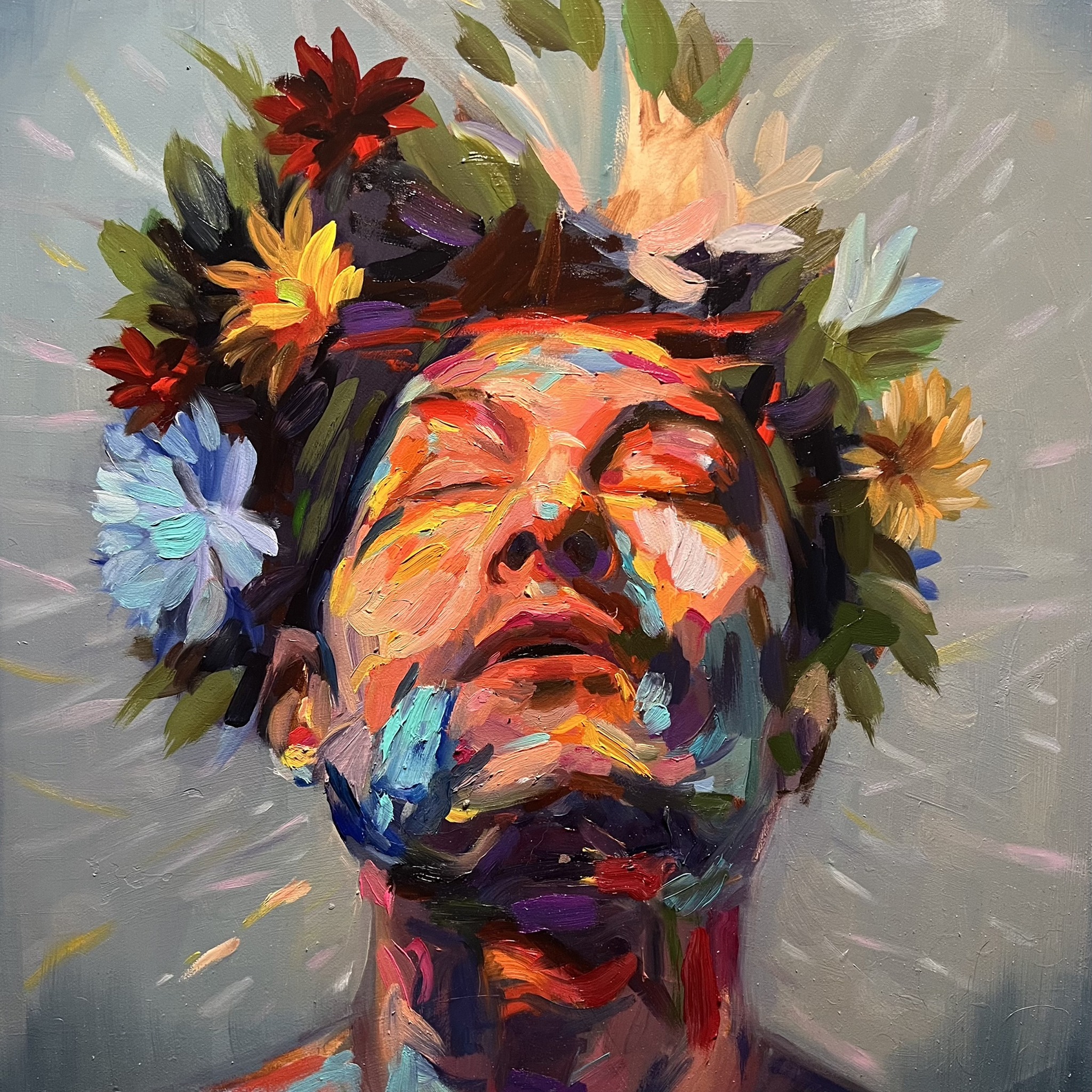
“Flowers Shall Grow” by Mery McNett
TAC Gallery
Through April 26
“Flowers Shall Grow”—a solo exhibition by Mery McNett, on view through tomorrow at the TAC Gallery—feels especially enticing in late April, as the world awakens from the depths of winter.
That continuum of life and loss is McNett’s subject here, in oil paintings that explore grief with stunning colors and pensive, often supernatural subjects. Each work contains its own pattern of fluorescents, which viewers can probe with flashlights provided in the gallery. Also provided are 3D glasses that further animate these works. The overall experience is otherworldly; McNett successfully recreates the surreal nature of losing someone and trying to piece together a life afterward.
Music provides another layer to the paintings; viewers can scan each work’s accompanying QR code to hear the songs McNett listened to when she was creating them. The tunes range from the Midsommar and Antichrist soundtracks to Bjork, Madonna, Les Baxter, and Patricia Wolf, all ethereal and most instrumental. The music adds a restful element, inviting visitors to linger a bit longer with each work and to sit with what they’re seeing and hearing for a richer experience.
Not so restful, for me at least, was the invitation to write a note to someone I’ve lost on tissue paper, crumple it up, and tape it to a small wire stem, making my own flower. Perhaps others had more luck with the project, but I couldn't make my ball of thin tissue paper stay on the wire after multiple attempts. I was excited about a keepsake but ended up frustrated, with a ball of material I will throw away. Still, I’m never upset to ponder what I’d say to my father if I could still speak to him, so the act of writing itself was evocative.
Many of the faces in McNett’s paintings are curious, upward-facing, earnest, and in some instances disturbing, especially when paired with a Midsommar tune that evokes beauty masking horror. One such work is the remarkable “The Light,” whose subject seems entranced from above, decked out in a crown of color and flowers that want to continue outside the painting’s boundaries. The subject’s eyes are ghostly, the mouth agape in either wonder or terror.