


Broken Arrow Community Playhouse: "Almost, Maine"
Broken Arrow Community Playhouse
February 14, 2026
It was—to paraphrase the opening stage direction of Almost, Maine—an unseasonably warm Saturday night in the middle of (allegedly) winter in a small town in northeastern Oklahoma called Broken Arrow. This is where I found myself on Valentine’s night to see a community production of this much-loved 2004 play about love by John Carini, produced by the Broken Arrow Community Playhouse.
The play takes place in the mythical, fictional, not-quite-a-town of Almost (because, as a character explains, they never got organized enough to create a township) in the snowy, northernmost part of the state. Through nine scenes, the script introduces an assortment of fuzzy hat-, parka- and boot-clad-characters who, all around 9 p.m., fall in and out of love under the northern lights. If it sounds like the makings of a Hallmark Christmas movie without an explicit holiday tie-in, that’s because it is.
I’m not going to lie: at this point in the day, I already felt sickly saturated with Valentine’s Day social media posts and consumerism, so it was definitely a cynical ass that I dragged down the BA Expressway. But under the direction of Don Tabberer and Nicky Finch, this cast lured me into the delicate world of Almost.
Nine actors took on upwards of three different roles each to cover all 20 characters in the script. Some performers made me giddy, like Jimmy Reiner, who made Lendall so likable that by the time he got to his big monologue in a scene called “Getting it Back” I had a big goofy grin on my face. Others drew me in for their vulnerability, like Kara Lord with her nervous optimism in “Story of Hope.”
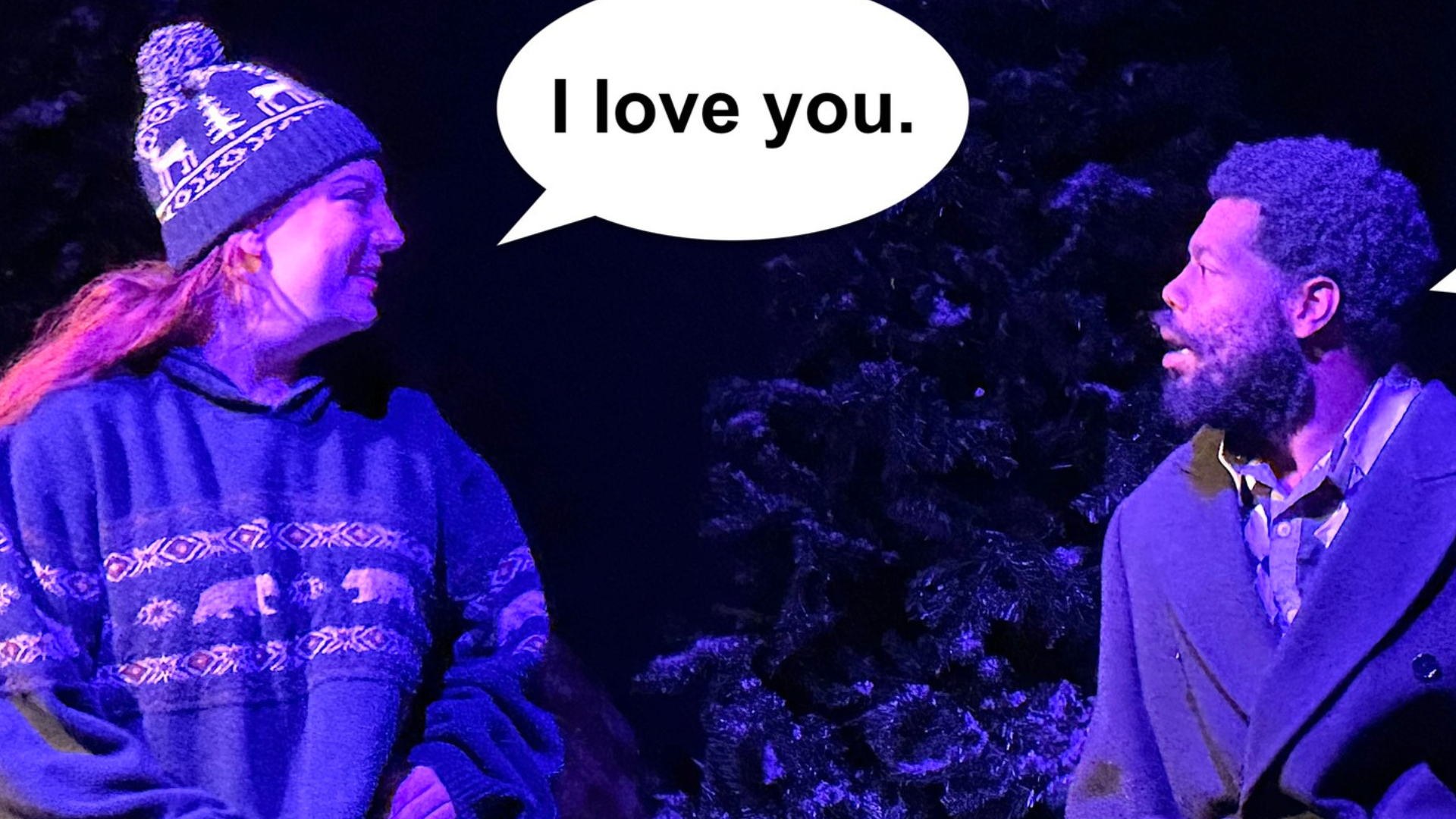
The true endorphin-pumping moments revolved around a few couplets that really brought me into the playwright’s world. In the scene “Sad and Glad,” Caleb Baumgartner (Jimmy) and Nik Reese (Sandrine) perfectly encapsulated that jittery, awkward adrenalin rush you get when you run into your ex in public. Christian Stubblefield (Steve) and Hannah Gray (Marvalyn) had a lively rapport in a scene filled with pinpoint physical comedy and tender intimacy. And I couldn’t help but get caught up in Stubblefield and Mae Huck's wistful performances as Pete and Ginette, the only couple the audience returns to throughout the play, even though I already knew the punchline of one of their scenes: no way was Ginette going to leave Pete alone on the bench.