


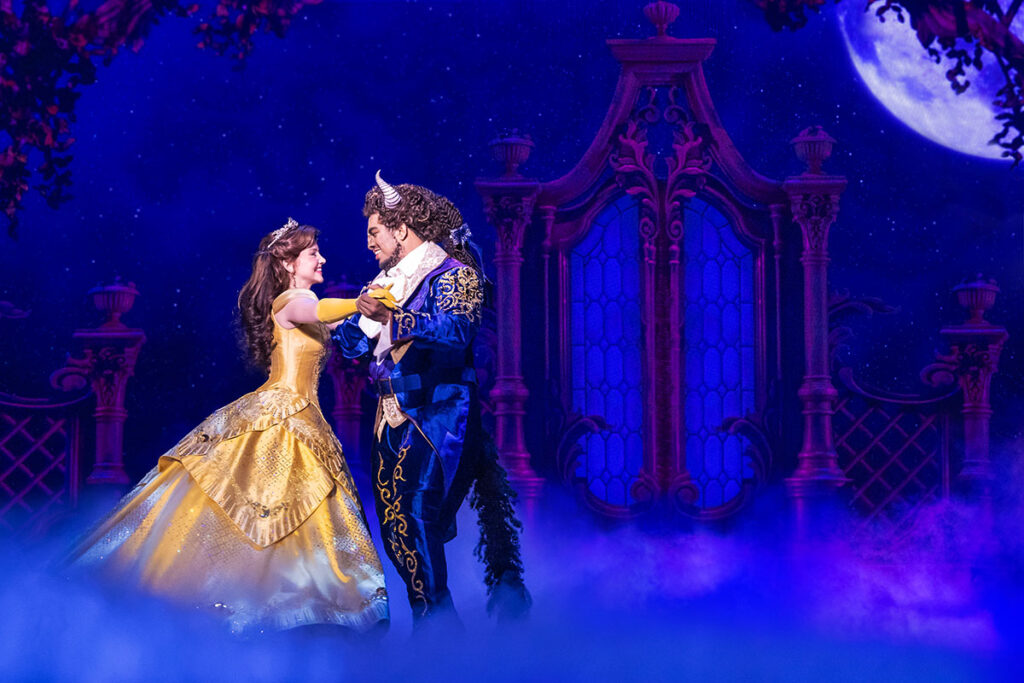
I loved Beauty and the Beast growing up. As a 90s-cusp kid who tended towards bookishness, I understood Belle’s flabbergasted stance towards book shops, stories, and fantasies. When she cracked open a book to escape the mundane or her peers' ostracization, I felt in myself the same longing: there must be something more than this provincial life. Such is the feeling that reawakened inside me when watching the touring production of the Beauty and the Beast musical, which swung through Tulsa’s PAC last week.
I could have sworn I’d outgrown the wildly capitalistic, Sora-AI-aligned, smile-until-it-breaks-you Walt Disney Company—indeed, when I mentioned that I had tickets to the show, a friend might have detected the slightest roll in my eyes—but, in the auditorium, seated with hundreds of other viewers, many being youngsters in full costume as Belle or the Beast and holding a single rose, my eyes turned from rolling to glistening. The magic, I must admit, still holds.
Held together with pitch-perfect performances by nearly every member of the cast, the musical explodes onto the stage with the opening sequence of the Beast’s curse, using some sort of quickly-ascending scaffolding to propel the Old Hag who curses him into the sky of the stage, revealing her within a matter of seconds to be a radiant princess. That moment set the tone for the rest of the show, whose effects and choreography made the scenes of Belle’s provincial village and the Beast's castle into moving, living organisms.
Kyra Belle Johnson as Belle—yes, that is her real middle name—fit her casting from front to back, deploying the bookish charm and unwavering idealism of her character, with a see-it-from-a-mile smile that you could probably steer a ship by. The character of Lumiere, the talking candelabra, literally lit up the stage in the hands of Danny Gardner, who conveyed the hopeless situation of the castle help’s curse with a vivacity and humor that had the audience hanging on his every French-accented word. And the two of them, along with a stellar cast of dancers and singers, made “Be Our Guest” the apex of an already-stellar show, complete with kaleidoscopic backgrounds, Rockette-dancing dinner plates, and choral precision.
As the Beast, Fergie L. Philippe1 walked a balance between the hulking, menacing Beast of the villagers’ nightmares and the emotive, scared boy inside, shifting back and forth on a dime. Philippe’s biting self-doubt felt so human that the audience is able to see through his wooly facade far earlier than Belle herself. And when the Beast is transformed back into his human self, through a spinning harness and a dazzle of strobe lights, the audience went wild.
But the most heartstrings were pulled by Chip, played with an eager earnestness by Kanoa Edgar, who lived much of the show in a hand-pushed cart, only his head popping out of a well-built magician’s trick which managed to hide the performer’s body while allowing the audience to see through to the other side. After many scenes of hearing Chip ask Mrs. Potts if he’ll ever get to be “a real boy again,” seeing the young performer rush from offstage into her arms felt like a collective out-breath.
It’s funny to look back on a piece of media like this and realize how much power it still has over me. When Kathy Voytko as Mrs. Potts sang the title song, the first sung notes of it cut straight through my irony-laced, internet-pilled adulthood and beckoned me to feel the power of it, just for a moment. After all this time, and after so much convincing myself it’s not the case, this script, this music, and this story still have the power to move me.