



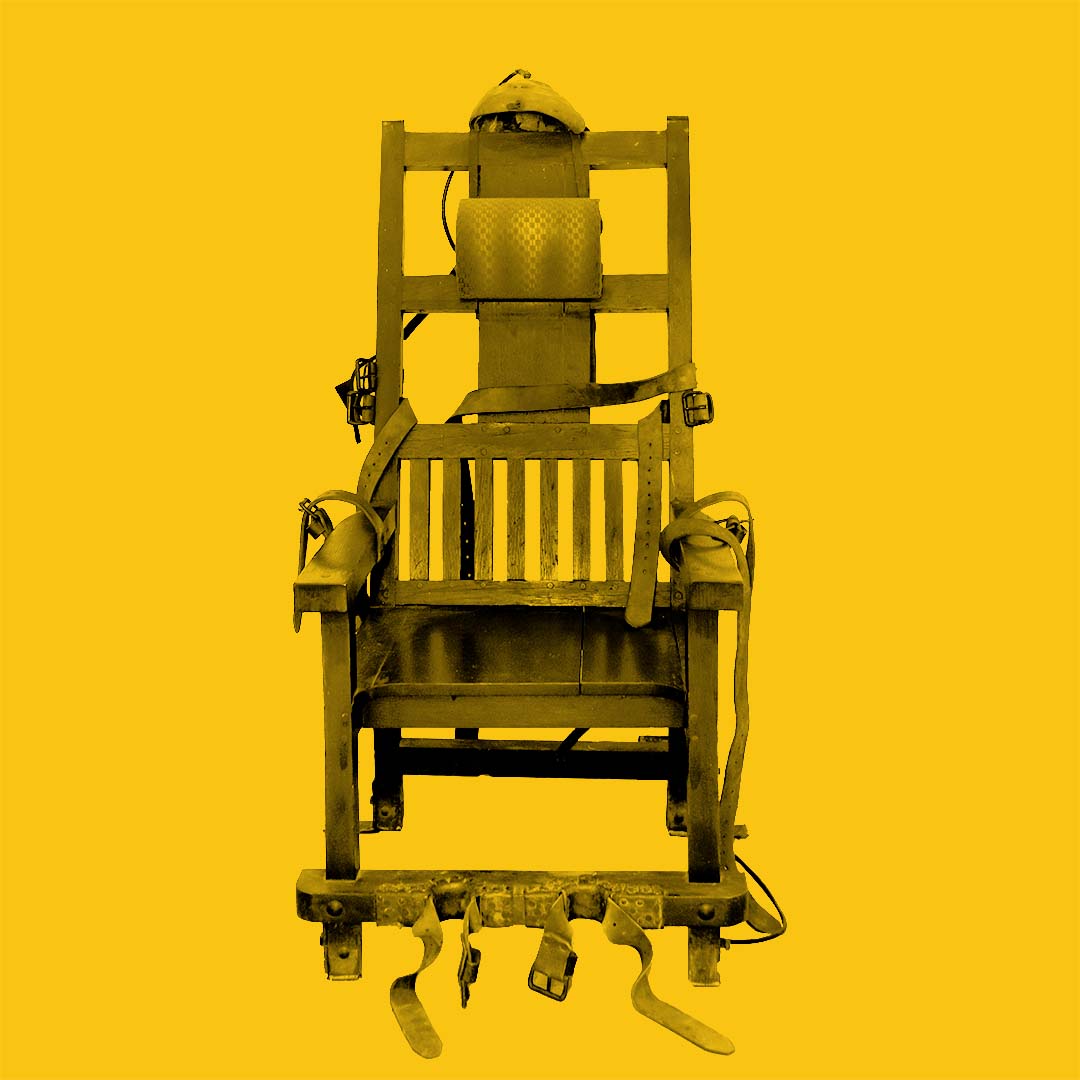
Editor's note: Quietly one of the most powerful stories This Land ever published, the tremendous tension in Death's Yellow Door comes from the fine details that journalist Kelly Kurt amassed over the 16 state executions she witnessed in her career with The Associated Press. The cumulative effect of this detail work is a measured, sober and self-reflective portrait of capital punishment in Oklahoma, an institution that has changed little over the last century. Death's Yellow Door was first published in the Feb. 15, 2012 issue of This Land.
"We may be indifferent to the death penalty and not declare ourselves either way so long as we have not seen a guillotine with our own eyes. But when we do, the shock is violent, and we are compelled to choose sides, for or against.”
Victor Hugo, Les Miserables
Within the maze of oppressive gray halls of the Oklahoma State Penitentiary’s H unit, the door that leads to the death chamber seems as out of place as a birthday balloon. It is yellow. Bright, daisy yellow. The color is unnerving.
It’s almost 6 p.m. when I cross the threshold with six other media witnesses. Gary Roland Welch already lies strapped to a gurney a few feet away behind the window of the adjoining room. He’s hidden from view by a closed shade. We take our seats on a row of metal folding chairs and listen for lingering signs of death row’s sendoff. The sound began 10 minutes earlier, a forceful clanging and rhythmic tapping that echoed through the concrete corridors. CLANG. CLANG. Ping. CLANG. CLANG. Ping. This is how other condemned men pay their respects—by slamming their cell doors with their feet or tapping their commodes. Death row’s goodbye sounds like someone trying to break out.
Six stone-faced men—prosecutors, law officers, and a state official—take seats in front of us. Behind us, behind one-way glass, sit three family members of the man Welch killed. No one is here on Welch’s behalf. My stomach churns as we sit in silence, waiting for the mini blind to rise.
When the shade finally goes up, Welch is looking at us. His thick body is bound to the gurney—legs, arms, chest, shoulders. Tubes run from his arms and disappear into the wall behind him. I glimpse a colorful tattoo on a forearm. A graying ginger beard covers his jaw and chin. He turns his head and his eyes meet mine.
In a matter of minutes, the 49-year-old will choke on his last word and die, marking the nation’s first execution of 2012. For now, he lifts his head, straining to see each witness through the glass. His eyes reach the row’s end, and something unexpected happens.