


Wall Flowers: Patrick Gordon Paintings
Philbrook Museum of Art
through January 3, 2026
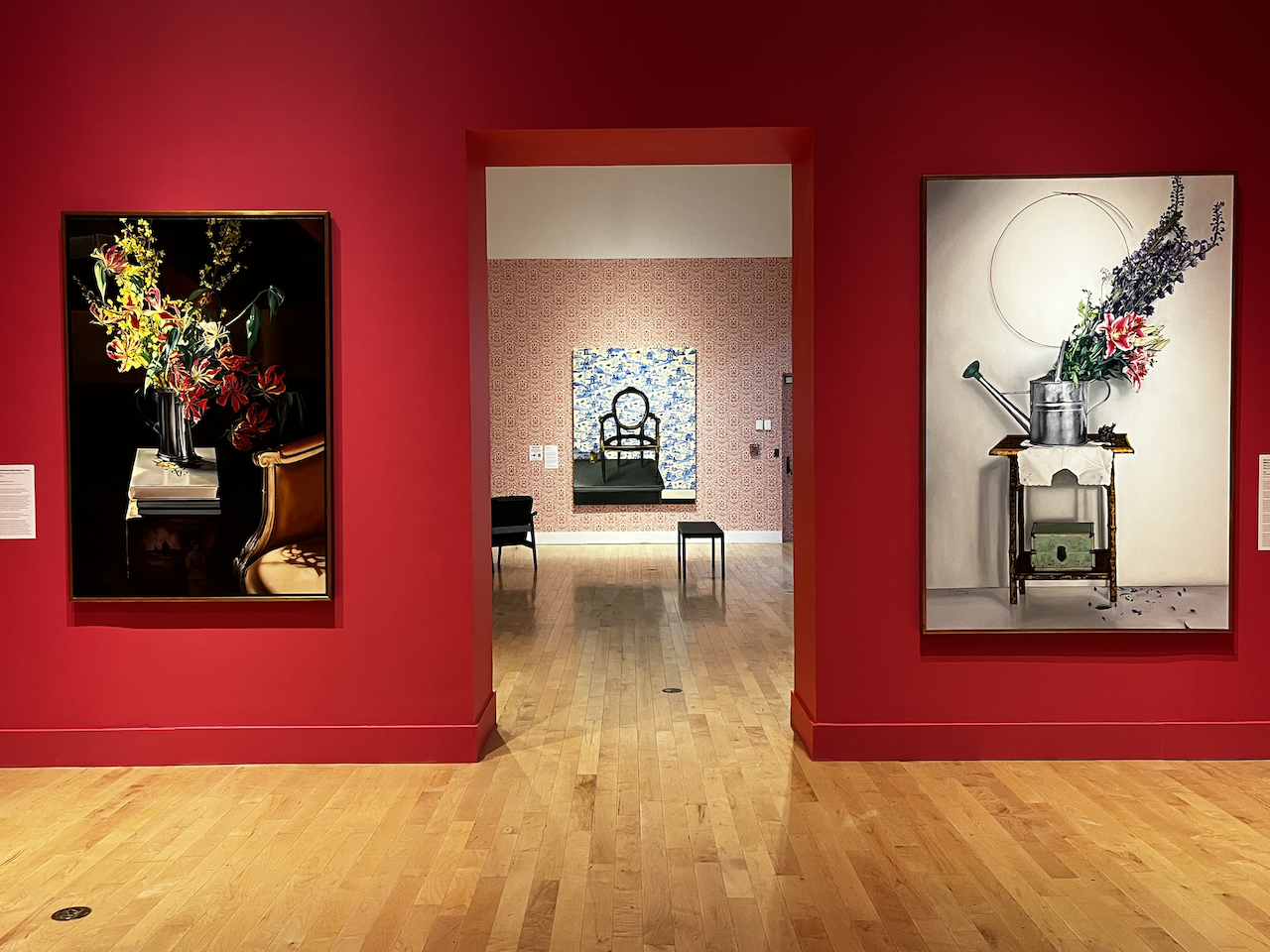
You’ve still got time to drop into Patrick Gordon’s world at Philbrook, and I can’t recommend a more restorative way to end this year. Wall Flowers, a luxurious retrospective spanning the legendary Tulsa artist’s 50-year career, closes January 3, and it’s so worth making space in your holiday calendar to visit. Especially if you’re feeling a little scraped and raw, take one dose of this show and you’ll be all set on beauty and pleasure for a long time.
I keep coming back to Wall Flowers in my mind, long after first seeing it; it’s like drinking a draft of something delicious and bright, a gorgeous sangria or a rich red wine. It’s also, for all its massive scale, incredibly cozy, thanks to the masterful curation of the Philbrook team, which has built what amounts to a house inside a museum that was originally a house. This nesting effect is both charming and astute, since so much of Gordon’s work has to do with close-drawn, intimate spaces where massive stories unfurl through the smallest details—domestic zones where bold creative light shines through.
With its multiple jewel-toned rooms and wallpapered walls with little openings cut into them, Wall Flowers feels like a life-size theatre set that you can walk around inside of. One room features an overstuffed floral couch, next to which Gordon kept regular live-painting studio hours during the run of the exhibit. This sensitive show is as much about the artist as about the artist’s work—which, for a man who paints 10 hours a day, every day, is an appropriate and beautiful tribute. But it's also a space of abundant generosity: peeking through those “windows” in the walls, one can imagine oneself in one’s own home, seeing many-layered scenes and phases of life from a single place.


Gordon grew up in a creative home in Claremore and landed at the University of Tulsa in the 1970s alongside a cadre of outside-the-norm Oklahoma artists who found their own way, during a war-haunted time, in the committed and passionate process of art. This show introduces him with jubilant florals, a trio of black-and-white photographic portraits, and a series of watercolors whose patterns and palettes feel like my deepest, most treasured 1980s media memories. A full-to-bursting cabinet of Gordon’s memorabilia, artfully arranged, stands like a diorama of a life in which beauty, humor, labor, learning, and love dwell comfortably together.


When Gordon switched from the demands of watercolors to the different demands of oils in the ‘90s, he unlocked a whole world of light and shade. His oil paintings make a huge visual impact in Wall Flowers; standing in front of them is somehow like standing inside them. Portraits, florals, still lifes—every one is a concentrated history of a moment, full of gravity and whimsy and (to use Gordon’s word) sass. “Stillness” means quite the opposite of “a lack of movement” here, thanks to Gordon’s masterful, surprising, clever play with framing and pattern, which invites the viewer to stop and feel the pulse of distinctive energy within the subject (a sort of play that the show’s arrangement itself plays with).

We see prominent Tulsans; forthright children; even—set into a room of their own—a series of exquisite men wearing ballgowns that are both armature and adornment, calculation and expression. The textures of those gowns are as sumptuous as the petals of his roses, and the stances of the men are as striking as his floral arrangements.

For Gordon (who has been out as a gay man since his 30s, setting him firmly within not just the Neo-Realist but also the Queer Prairie pantheon), “decoration” is not a frivolous throwaway, but rather a deeply personal matter. It takes work, passion, energy. It means something—something that takes time and attention to get to know. The Philbrook team homes in on that theme with a wall display that breaks down a still life by tucking the stories of some of its elements behind little doors, as well as with an interactive room where visitors can create their own collections of items that together signify “a life.”


Wall Flowers is a portrait not just of the artist but of a particular era in this city. Gordon cites Thomas Gainsborough, Joshua Reynolds, and John Singer Sargent as influences on his work—painters who, like him, were as attuned to social forces as they were to the drape of fabric and the planes of a face. Among his many other contributions to Tulsa (including co-founding Tulsa CARES), Gordon has painted signature pieces for many local arts organizations, forever weaving together the city’s profusion of creativity with his instantly recognizable style.

A few days ago, when I was doing some holiday shopping at a vintage mall, my jaw dropped when I saw a framed, signed, and numbered Gordon print hanging in one of the booths: his still life made for Tulsa Ballet’s 40th anniversary. I remember seeing this piece when it was unveiled; I’d just spent a few years as an apprentice with the company and was emerging into the wider world of art that Tulsa had to offer. I remember looking at it and thinking: how wonderful it would be to live in this beautiful world. But where was that world? In the ballet, or in my city, or in this artist’s hand, or in me? Turns out, the beautiful world was the one that was full of what I valued most, whatever or wherever that might be at any given moment. Of course, I took that signed print home, where it will now adorn my own ever-changing personal space.
Art like this—just like the flowers and people and still lifes it captures—teaches us about beauty and bonds and the large magic in seemingly small choices. It teaches us to look more closely at what we care about, and then expands and deepens that care. Wall Flowers will guide your eye to what that means for you, and like Gordon’s whole career has done, bring it to vivid and moving life.


