

This story originally appeared in the November 15, 2011 edition of This Land.
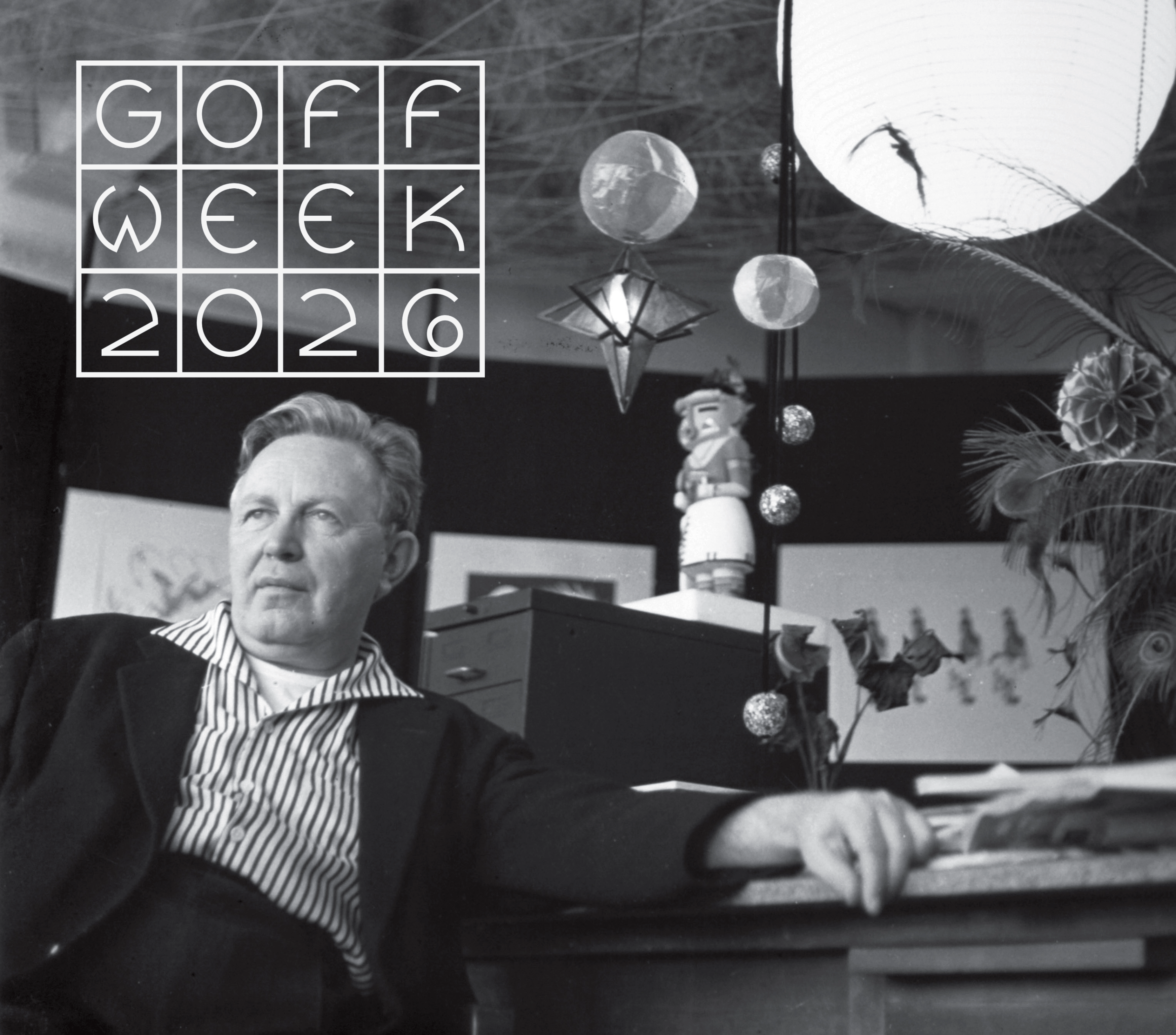
An important, yet often overlooked, dimension of Bruce Goff’s contribution to American architecture was his years teaching at the University of Oklahoma. Although he never attended a university, Goff was invited to join the faculty in January 1947 and was appointed Chairman of the School of Architecture in May 1948. He was a brilliant teacher and leader. He had notable accomplishments with 30 years of experience in architecture. And he had clear ideas about the process of design, with his view that teaching was not just a job but almost a religion.
The developing philosophy of the school reflected Goff’s philosophy of architecture. It was a program based on freedom of self-expression with a pedagogical premise that all individuals had a potential for creativity. The goal of the school was to create a nurturing environment that might help students discover their own potential. Goff wrote to a prospective applicant, “in developing our student’s creative ability, we try to give them the necessary means to express themselves (technically)... and, to help them find their own aesthetic direction.” Goff believed that most schools of architecture—though they had discarded the historicism of Beaux-Arts education—were engaged in a “new eclecticism” that allowed them to indiscriminately appropriate ideas from contemporary masters like Mies van der Rohe, Le Corbusier and Frank Lloyd Wright. It became, in many schools, “...the fashion to clan together into one of these three camps, each feeling the other is insane or unclean,” Goff wrote.
Such education, Goff believed, could only lead to lifeless imitation with little understanding of underlying principles. For Goff, it was critical to distinguish between inspiration, influence, and imitation. Great works of the past, as well as nature, might inspire or influence a design, but the principles must be understood and assimilated to produce an authentic work that was not an imitation of what another had done. Goff said, “...we are not interested in producing disciples of any man but rather in developing individuals with sound principles.”
Goff was particularly disdainful of the popular International Style emerging in America during the post-war years of the late 1940s and 1950s. In his view, those expressions were derivative of a continuum of limiting and rigid design principles. Goff was critical of an architecture that relied solely on the expression of a glass wall with an exposed structural grid to sustain visual interest. A glass box, Goff believed, offered only a cold image of anonymity. They were the same everywhere, with little relationship to specific places. And they were invariably devoid of any emotional content and diversity of expression that might give rise to an association with a particular environment or feelings of aspiration.
* * *
The ambiguity of design was an ever-present issue for the students. They were well aware of Goff’s familiar adage: “You can do anything you want to do as long as it is good. There is no right solution.” They had the freedom to choose, but how did they know what to choose? Goff, and other faculty, urged students to follow their own instincts through trusting their intuition. One’s initial ideas were usually the best because they were uniquely one’s own. As an extension of Wright’s belief in the “democracy” of architecture, Goff insisted that students had “the right to have their own ideas.”
Yet, they were also encouraged to be curious and keep an open mind in conceptualization. They should not be afraid to try other things. There was no form, color, or texture that should be taboo. But as the seed of an idea developed, recognizing and understanding the order within that idea was imperative. The only way one could achieve originality, and the potential for richness and variety of expression, was by a critical understanding: achieving order in a design was dependent upon the discipline of rejection of all that was not true to the idea. It was through a process of discovery that one arrived at an honest expression. This was the meaning of Goff ’s oft-used statement of design as “discipline in freedom.” Ultimately, creativity would only be achieved through intuition, rational thought and the discarding of ideas that did not sustain the order of the initial concept.
In a public lecture at OU, Goff once referred to himself as an “old-fashioned architect.” He didn’t explain what he meant, yet in many respects his aesthetic values were rooted in the early 20th century. The enduring sources of his philosophic commitment to creative architecture were drawn principally from Frank Lloyd Wright and French impressionist composer Claude Debussy. Wright embraced the ideals of Emerson and Whitman, and Debussy was influenced by the symbolist poets of the fin-de-siècle. Goff also drew inspiration from the art nouveau movement. He admired the freedom of Antoni Gaudi’s expression and frequently spoke of the Catalan as the “world’s greatest architect.” He considered the Holy Family Cathedral in Barcelona one of the finest works of the century. It was, Goff said, a design that is “expressive of its purpose, its material, and reason for being and still it transcends all of these into a spiritual quality that is woefully lacking in almost all contemporary work, where the emphasis is on material things rather than other values.”
Goff was also influenced by the writings of Gertrude Stein, the architecture of the Vienna secessionists, buildings of the Amsterdam architects, and the artistic visions of the German expressionists. Yet he despised the architecture, art and music of the Renaissance. He was attracted to the architecture of ancient cultures: the stone buildings of Angkor Wat in Cambodia; the pattern-rich temples of India and golden temples of Thailand; Buddhist temples and Shintó shrines of Japan; Pre-Columbian architecture of Mexico and Central America; and the vernacular architecture of Java and Africa.
* * *
When Wright would invoke “democracy” as a value attributed to organic architecture, Goff would do the same, only with different and more direct language. In Goff’s vocabulary, the concept of “freedom” was emphasized in discussions of one’s right to individual expression. Each, however, attached a metaphorical linkage to architecture with an Emersonian praise of the individual. Similarly, the buildings of both acknowledge the presence of nature as a source of inspiration and value. Wright’s expression of cantilevers in architecture corresponding to “the branches of a tree” is one of the central metaphors of his oeuvre. He often alluded to the Price Tower as “the tree that escaped the crowded forest.” Goff, too, embraced the same ideals of naturalism metaphorically. The cantilevered components that manifest in many of his buildings as planes, beams, and pinnacles are subliminal references of correspondence with the natural world. One of his finest works, the Bavinger House—a spiral of rough stone heaved upward out of a forest—is a profound metaphorical proclamation of a transcendental vision of the natural world. Goff attributed the intensity of feeling in Debussy's music to the inspiration the composer drew from nature. It was a clear affirmation of the interdependency of “human feelings and aesthetic values.” An awareness of one’s feelings, Goff insisted, was essential in honoring the necessary discipline of a composition to attain an expression of freedom and individuality. Goff said, “Your feeling is the safest thing to rely on, and I think it is the one quality that we have that is really our own.”
Goff ’s ideas for design relied on a process of inductive reasoning. The wide range of premises defining his language of conceptualization led to a conclusion that one building would not, and should not, look like another. His creativity was predicated on a freedom of preconceptions in negotiating the nexus of rationality and imagination. The congruence between what Goff wrote and taught, and the manifestations of his values, is apparent in his highly original pattern of thought as a translation of continuity in convictions into a reality of diversity.
One of Goff’s critical values was the necessity of “discipline in freedom,” as proclaimed by Debussy. Recognition of the order inherent in an idea, and how one might sustain and magnify that idea, was central to Goff’s values and his conviction toward not relying on the outworn formulas of the past—or the over-used formulas of the present—in the process of creativity. In his view, it was imperative to acknowledge the developmental order in the moment of the present. A conceptual idea had a life of its own and must be nurtured. The importance of this premise is apparent in his writings, his teaching and his buildings. This defining continuity of values is central to his conviction of necessity for each composition to have its own expression.
Goff believed one can have great variety in a design and the ability to understand the order inherent in the composition would lead to a richness of expression. Goff said that the “architect should be free to operate with any color; any texture and he shouldn’t have to apologize for doing a certain design, or have to justify himself. It is a matter of having a great many ideas ... to use them to make a whole design that is still part of the continuous present ...” he believed that any rules could be broken but “you have to use discipline, there is no such thing as doing a work of art without discipline and order.” Discipline did not mean punishment or self-denial; for Goff it meant simply a sense of order and a sense of belonging together. It was a feeling “of continuity, of grammar, or language, or means, so that you feel that is part of the same composition,” and not part of the order of another composition. Feelings were of primary importance to Goff as a driving force.
* * *
Goff nurtured students’ appetite for “aesthetic food” with his own enthusiasm and knowledge of music, painting, sculpture, film and Japanese art. Music, especially modern classical music, was both a major source of inspiration and an important influence on the development of his architectural expression. The music he liked best seemed to parallel his commitment to design with “the idea of the composition growing from the inside out and ... disciplined into an organic whole that had its own order.” Music possessed “... the elements of invention, rhythm, proportion, balance, scale, orchestration of the media, counterpoint, consonance, dissonance, texture, incident, and ornament, all as felt by the artist and composed into an ordered whole.”
Goff maintained that he learned more about architecture from music than from other architects. Music, he believed, pointed out more clearly than architecture some of the basic concepts of composition. He developed an advanced design studio that involved short, interpretive projects based on specific design principles, many of which used the terminology of music composition. The course, with reading assignments of Debussy’s Monsieur Croche the Dilettante Hater and Gertrude Stein’s Composition as Explanation, was defined by a series of design projects of usually one-week in duration to explore a particular formal aspect of architecture without regard to function. Goff emphasized that the projects provided both an opportunity to re-evaluate the principles of design and to “... explore individually (those principles) as a means to learn to criticize your own work.”
Students were asked to prepare a graphic illustration of their own interpretation of each assignment. There was no formula and no rules, nor was the project an end in itself. It was simply a time to explore, to reflect and “... to relax the creative process ... and learn to use these elements unconsciously.” Students were given great freedom in defining the architectural character of each of the projects. Goff encouraged them to stretch their imaginations and explore mobile or free-forms in addition to geometric forms. The content of the studio included assignments on rhythm; opacity, translucency, and transparency; modulation; balance; theme, variation and development; incident, terminal, climax; site relationships; orchestration of materials; ornament; and scale.
Goff could be quite demanding, in spite of his casual, friendly relationship with students. In his lectures he reminded students of his expectations that they must attend the required design studio all afternoon three times a week and the special sessions on Wednesday evenings. However, he also understood if a student missed class for some other conflicting event, such as a special lecture in another discipline or a concert, for Goff was prone to say, “Don’t let school get in the way of your education.”