


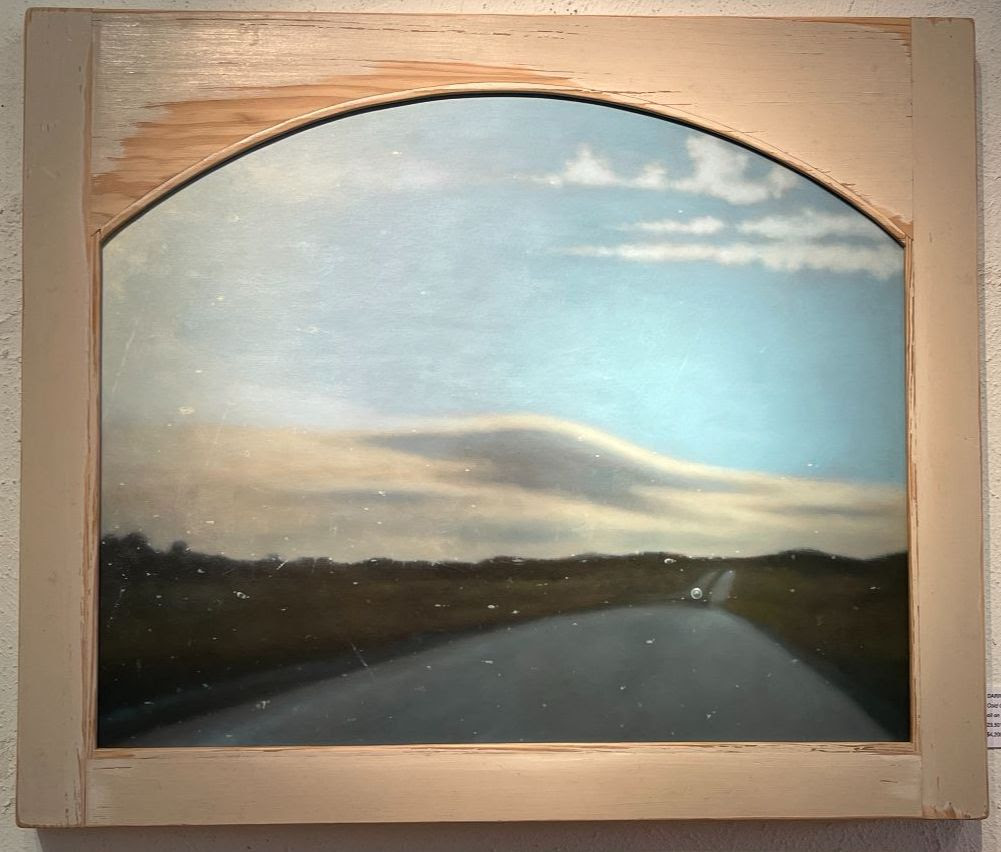
Darren Dirksen: "November Grass"
Through December 9
Joseph Gierek Fine Art
In the introduction to her "Best Music of 2023" list, New Yorker music critic Amanda Petrusich writes that she's been finding herself "thrashing against the seduction of newness, and moreover the presumption that newness is always where the heat is.” Reading that after spending an afternoon with a group of oil paintings by Darren Dirksen, I knew just what Petrusich meant—how good it is to meet this moment (“our era of generalized collapse,” she calls it) alongside artists whose work feels lived-in, trustworthy, who’ve worked out how their own vision meets a moment, decade after decade, through it all.
Dirksen, a longtime Oklahoma artist who has spent the last couple of years fighting aplastic anemia and enduring a bone marrow transplant, makes work about moments: ones that take millennia to unfold, ones that happen so ephemerally that it takes an artist’s eye to capture them, and ones where both kinds of time surreally coexist. If you don’t know his work, find your way to Joseph Gierek Fine Art (east of the Meadow Gold sign on Route 66) and give yourself some time with it before his current show there, called “November Grass,” closes this Saturday.
Standing in front of a Dirksen painting is like standing in nature itself. You glance at a strand of water, a patch of sky, and you think you’ve taken it all in—then suddenly your attention snags on a tiny detail and you’re pulled into a slower, deeper, more humble kind of knowing. In Cold Glass, as in many of his pieces, time and space seem both eternal and immediate. Through a close-up car window pocked by frozen air, we see a road reaching into the distance, slightly blurred, a gentle sun meeting winter’s chill right at the boundary where our fingertips might meet it on the glass. Dirksen hand-builds the frames for his work (some with his own flint-knapping embedded in them); they’re an integral part of each piece, the paintings themselves like windowpanes inside some ancient architecture. Here, wood from the old pews of a church near the Cherokee Heritage Center cradles a visual moment that details a very specific felt-sense: cold and warmth, closeness and distance, that transitional place of early spring or late fall, held safely—even pleasurably—at the edges of things.
Dirksen often works from photographs he takes on walks or drives; some of the pieces in this show were made, incredibly, while he was in the hospital, such as Storm Out My Window, a mesmerizing study that merges pinpoint clarity with sweeping force. The precision of his draftsmanship comes through in works like A Million and One Miles, where the everyday reality of a concrete embankment becomes part of a larger, even more monumental story. Fleeting scenes from nature—a grackle capturing its next meal, ice forming under shadows on a creek—bring a sense of delicious disorientation (are we upside down or right side up? looking out or in?) even as their hyper-realism lets us know we’re really here, standing on a planet whose very strangeness is its beauty and its gift.
Wood, bone, metal, earth: these elements are guideposts in Dirksen’s world, as well as the materials he uses to capture what his artist statement calls “my secret roads to secret places,” where it’s possible to “shelter long enough to survive.” How do we live when, as this artist has, we learn we have more time in this brutal and precious world? The Man of a Thousand Generations—born, Dirksen writes, after the last Ice Age, familiar with cycles of upheaval and collapse—walks through the centuries with both death and life as companions; he “observes truths only the perspective of time can reveal.”