



Green Corn Rebellion + David Hernandez
Thelma’s Peach
March 20, 2026
Normally when I go out to listen to local music, it’s just me, a notebook, a pen, and my thoughts. I listen, I write, I leave, and sometimes I come back. I’ve been soaking up music in Tulsa ever since I moved here, finding my way into the city through its sounds, but until now my writing about it has mostly lived in my notebooks. Last week, as I headed out for my first review assignment, I knew I’d be writing for someone other than me. I was writing for you, and that changed how I listened, changed what I saw.
Listening to live music in Tulsa, for me, is a time to wander between venues. I'm not one to sit and stay. Time becomes relative, where suddenly it's not about the hour—it's about the music. Musicians intermingle onstage and off, blurring the boundaries between "out there" and "in here."
When I got to Thelma's Peach on Friday night to hear David Hernandez and Green Corn Rebellion, the heat of the day still hung in the air. In the parking lot, I met GCR’s Chris Foster (aka Poppa Foster), his partner Joy, and Peter Tomshany, who was peeling an orange. Peter offered me a couple wedges, freshly peeled, and they were delicious.
I walked to the door to pay my cover. It was AJ’s first night working the door, at least I think it was. I see him around lots, but this was his first posting I’ve seen. Johnny Murrell was on his phone, sharing pictures on Instagram to promote the show: “This music is sick. We need more bodies here.” He was right.
Standing in the parking lot and on the patio, I could hear guitars and fiddle wafting into the cooling night air. A song ended just as I walked inside, the small crowd applauding as the strings picked up again: David Hernandez on the guitar, Gary Sizemore on the fiddle, and another guitarist whose name I forgot to write down.
Usually if you see a couple of guitars and a fiddle on stage in Tulsa, you’re listening to folk or bluegrass. Not tonight. Hernandez plays the Spanish guitar, and I loved watching his fingers strum, pluck, and slide while he sang in smoky smooth Spanish. With each new song, a new patron arrived. When it came time for their call-back song, the whole bar was singing along: “Up above my head, there’s singing everywhere.”

I ordered some wine and wandered back outside, where I found Chris, Peter, and percussionist Nicholas Foster reviewing the GCR set list. Green Corn Rebellion—named for the 1917 armed uprising of socialist-aligned tenant farmers in rural Oklahoma—started over a decade ago, but it had been some time since the band played a gig.
They began speaking a language I didn’t understand. Key changes, bridges, transposing: all ways their songs have matured and changed over the years. Peter needed a pen, so he borrowed mine. It’s always good to have something you love to write with.
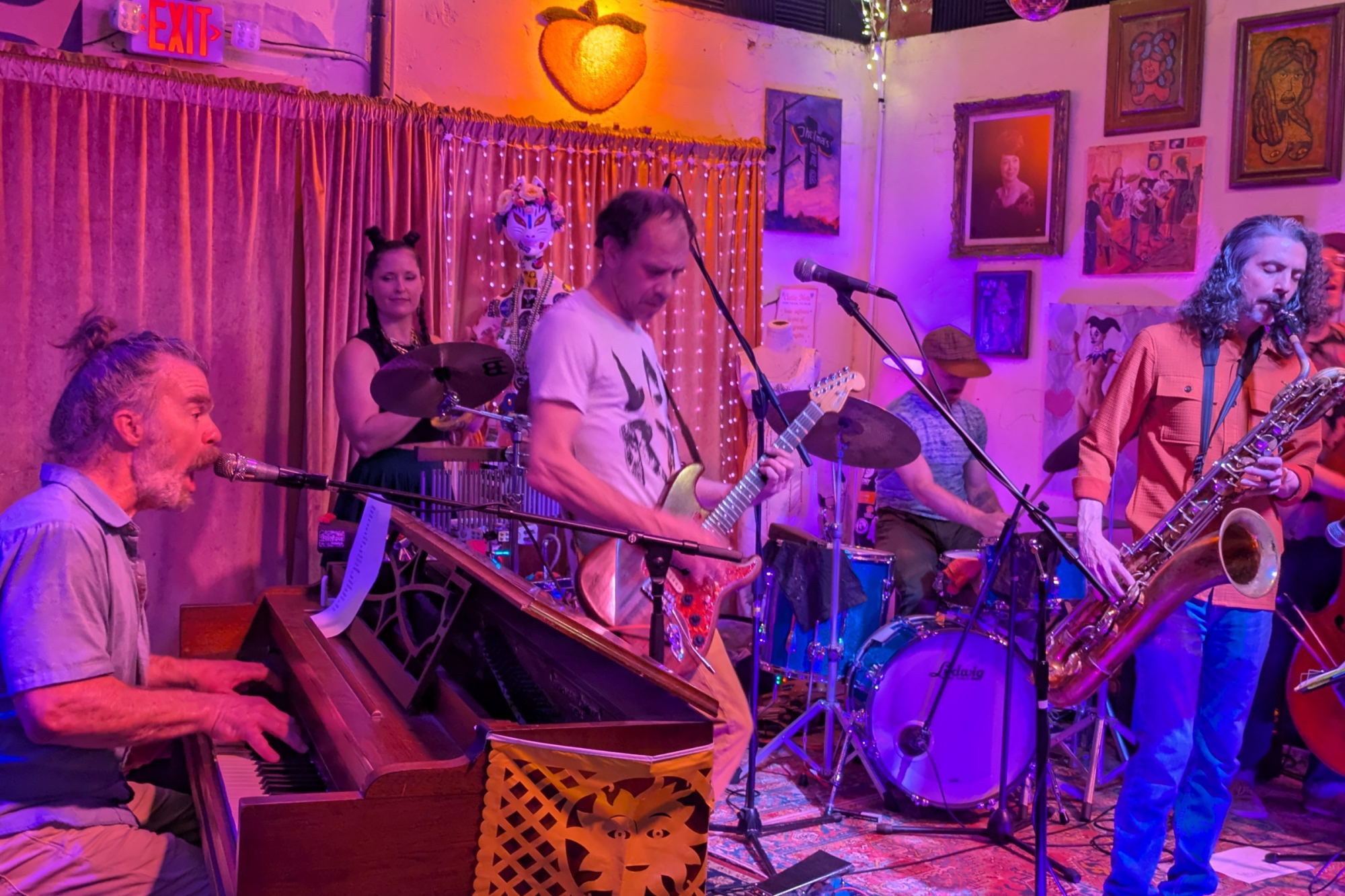
When GCR first started up, they also had three female backup singers, but as life moved on, so did their lives. This was one of Tulsa’s first “supergroup” bands, and tonight’s show would be a reunion of sorts: a piano, a guitar, two percussion kits, a stand-up bass, and a baritone saxophone.
They made their notes, and Peter returned my pen. It felt like a good time to go back inside for the last song of the first set. The guitarist whose name I don’t know leaned casually up against the piano. Hernandez perched on a stool, hunched over his guitar while his fingers flew. Sizemore sat on a stool too, with his bow gliding across the fiddle strings. They finished up and got us ready for GCR: “Y’all know Poppa Foster because he’s in eight or ten bands around town.” The crowd cheered again.
As this beautiful set came to a close, I started getting restless. When I go to listen to music, that’s what I want to do, and when the music stops, I feel compelled to find more. It’s not hard to do around here.
It usually takes 20-30 minutes to turn over the stage for the next band, so I figured I had some time to check out what was happening at Mercury Lounge. I’m glad I did. There were more people outside than inside, but you could hear the music everywhere. Fast, hard, punk. This was the stuff I grew up on as a kid, and it made my heart happy. The band? Some Hearts. It was moshpit-worthy music, but the dance floor was nearly empty. Mercury Lounge can be like that sometimes.
I headed back to Thelma’s just in time for GCR to get warmed up. Before I walked around to the patio to come inside, I went to the front door (the band entrance) and leaned the back of my head against the wall to feel the vibration. That’s all music is: vibration. It’s a different way to listen now and then, taking some time to let your whole body feel it, not just your ears.
Inside, Thelma’s was the opposite of Mercury Lounge. People weren’t talking. They were dancing. I’d say there were about half as many people at Thelma’s, but nearly everyone was crowding the stage, swaying their hips and bopping their heads.

GCR played straight through their entire setlist (about 20 songs) without taking a break. It’s hard to describe this genre of music: Rock? Folk? Funk? Those words sort of get there, but not really. When Chris Foster brought out a banjo, it was another one of those Tulsa music moments where I thought, “How’s that gonna work?” The rest of the music didn’t match what you expect when you see a banjo. But it did. The word I wrote down was “slunky.” I’m not sure it’s a real word, but it definitely fits.
I love seeing bands play together who’ve played together lots. Small head nods from the piano to the guitar for a solo. Each instrument building to the climax and then stopping for just a brief, collective moment of silence before the funky drop. The music in tune, and the musicians attuned.
As they kept playing, as the night grew later, the crowd slowly thinned. Soon it was time for me to leave too, but plenty of folks were still dancing. I walked to my truck, looking at the sky. The air was cool and the stars were bright. It was a night of music worthy of welcoming spring: fresh, familiar, full of life and sound.


