


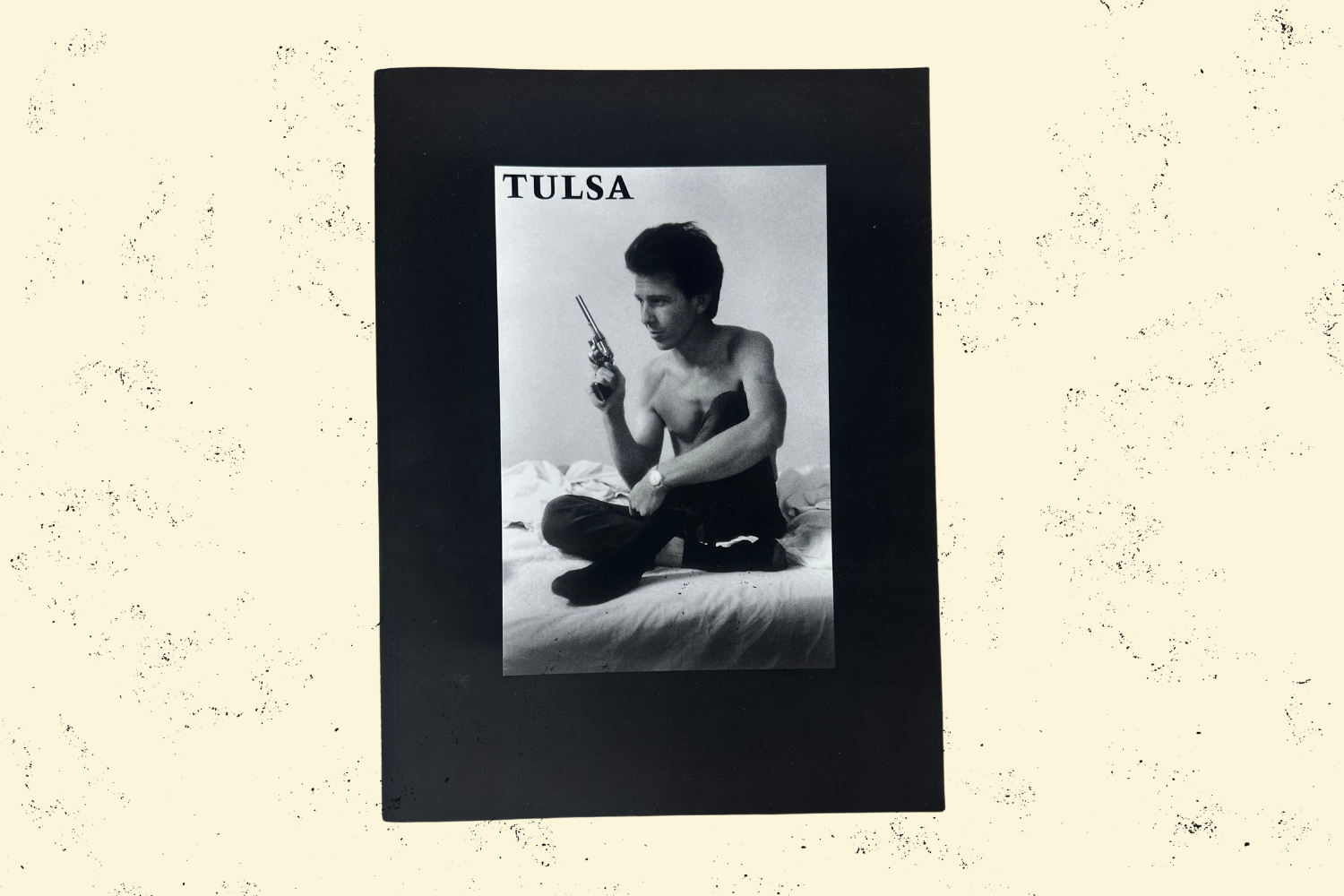
Editor's note: Artist and filmmaker Larry Clark's seminal pictorial Tulsa was a controversial document at the time of its release. It captured a hedonistic, desperate scene of teenage drug use in Tulsa in the 1960s. In this essay from the May 1, 2012 issue of This Land, the daughter of one of these teenagers tries to piece together her own picture of a man she never knew.
He’s on the cover. A shirtless skinny young man sits crossed legged with his left knee drawn up toward his body and cradled in his left arm.
He is perched on an unmade bed with plain white sheets tousled in the background. With a subtle smirk on his face, he grips a 32/20 revolver in his right hand and loosely points it upward. There is a cool steadiness to his demeanor with an undertone of wild rebellion. The photo is reminiscent of James Dean’s bad boy in Rebel Without a Cause, but the man in the photo is no actor. I scour the picture with a magnifying glass, desperate for any detail that might reveal something about the man. He is wearing a wedding ring. The picture must have been taken before 1964, unless he continued to wear his wedding ring after the death of his wife, which is unlikely. If the photo were taken around 1964, it would make the man’s age close to 20. His name was Billy Joe Mann, born in 1943, the same year as his friend, Larry Clark. Billy Mann, iconic cover boy of Tulsa, was my father.
Larry Clark is a Tulsa native, and a controversial photographer, writer, film director, and producer. Drugs, teenage sex, and violence are reoccurring themes in his work. Some of his film titles include Kids (1995), Bully (2001), and Ken Park (2002). Clark’s first success, Tulsa (1971) is a black and white pictorial of the drug scene in Tulsa, Oklahoma. Larry photographed his friends shooting drugs over a period between 1962 and 1971, but Larry wasn’t just an innocent bystander, he indulged in shooting drugs too. The book was raw and disturbing, especially for the time. The pictorial exploits the recklessness of youth, the turning point of naivety, and the utter abandonment of self-respect. It inspired such films as Martin Scorsese’s Taxi Driver (1976), Francis Ford Coppola’s Rumble Fish (1983), and Gus Van Sant’s Drugstore Cowboy (1989). I haven’t seen these movies in years, but I remember a raw grittiness and undercurrent of desperation in some of the characters in those films, similar to the characters in Tulsa. However, the characters in Tulsa were real people— desperate, indulgent, and addicted. Some of those people, to this day, are friends of my family. And some of those people were my family.
In the spring of 2009, a gnawing feeling began to fester in my gut. It occurred to me that Larry Clark and the people who might be able to tell me something about my father were, like me, getting older. If they die, I thought, I’ll never know anything about my father and my roots. I searched the internet for information about Larry Clark, then posted a comment on his MySpace page and other blog sites with links to Larry and Tulsa. No one responded. One night in March of 2009, I ran across one particular website that had several postings about Larry and his work, but mostly his debut piece, Tulsa. There was a phone number, so I called. I knew it was a long shot but I didn’t have anything to lose. I told the site owner my story and he said that he would get my phone number to Clark. Soon after, Larry called me. He knew who I was and seemed sympathetic to my plight. He promised to look through old boxes located in his basement in New York as soon as he could; Clark was in LA at the time. Larry is a very busy man and we have been in sporadic communication, with long silences in between, ever since. I expressed my concern about his old gang of friends and their age.
“Larry, if you guys die, I don’t know how I’ll ever learn about my father,” I told him. “The things that I want to know, only you can tell me.”
Clark recalled that he had old 16mm footage of Billy and he had a reel-to-reel tape recording of an interview with him, as well. I think the year of the interview was around 1969 or 1970. My father died in October of 1970. The fact that the tape recording exists torments me. His words are so close, yet achingly out of reach. Does my father reveal any redeeming qualities in that interview? What did he say, feel, and believe about life? What was the purpose of the interview anyway? The thought of viewing images of my father alive and animated, and hearing his voice for the first time since I was an infant, caught me off guard. Tears rolled down my cheeks as I hushed a gasp under my breath and tried to keep my composure. I didn’t know that I had so many emotions about my father. I want to see his face, his eyes. I want to read his body language. I want to experience him living and breathing. I want to know him too. When I talked to Clark on the phone and asked him about my father, he didn’t share many personal details about Billy Mann, but I believe that his creative property can tell me volumes about my father. In early 2011, after his Paris showing of “Kiss the Past Hello,” Clark said that he had put together a book of pictures for me of my family: my father, mother, sister, and me, that he had taken back in the day. He said that we would get together, just he and I, to watch the film and listen to the reel-to-reel. That was over a year ago; I am still waiting. I believe that he is in France working on a new film. He is a very busy man. The photos are important to me because I don’t have any family pictures of me with my mother and father. Not one. After my mother’s death, Billy refused to give any of the photos that they had to my grandparents. After my father’s death, they were lost forever. It won’t change the past, but at least I’ll know.
I remember the first time that I laid eyes on Tulsa. Larry’s artistic portrayals of his friend, Billy Mann, are the only pictures that I have ever seen of my father. If it were not for Tulsa, I would not even know what my father looked like. It was 1972. I was living with relatives in California, and while they were at work, my sister had been rifling through their closet and found Tulsa hidden away in a box on the top shelf. From the second floor of our brand new two-story home, I heard urgent yelling beckoning me to come.